Can you see the northern lights in Ruka tonight?
Clouded out — 100% cloud at best between 18:04 and 05:34.
Checked against NOAA SWPC and the FMI HARMONIE forecast.
Tonight Ruka is 26 of 26 on the ranked table of places.
Get an alert when Ruka lights up
A heads-up in the hours before dark when tonight's forecast Kp reaches your choice and the cloud forecast leaves a gap, and an alert when the field is active over a clear enough sky at Ruka. Two a night at most, nothing on the other nights.
Alerts come to this browser on this device. No email, no account; turn them off here or from any alert.
Aurora forecast for Ruka: the next three nights
| Night | Dark, local time | Forecast Kp | Kp needed | Clearest hour |
|---|---|---|---|---|
| TonightFri 13 Nov | 18:04–05:34 | Kp 1.67 | Kp 2 | 100% at best |
| Clouded out — 100% cloud at best. | ||||
| Saturday nightSat 14 Nov | 18:02–05:38 | Kp 1.67 | Kp 2 | 10% at best |
| Unlikely — Kp up to 1.67 is forecast while it is dark, and Ruka needs about Kp 2. 10% cloud at best. | ||||
| Sunday nightSun 15 Nov | 18:00–05:40 | Kp 1.67 until 02:00 | Kp 2 | not forecast yet |
| Unlikely — Kp up to 1.67 is forecast until 02:00, and Ruka needs about Kp 2. The cloud forecast does not reach this night yet. | ||||
Checked . Kp from the NOAA SWPC three-day forecast, issued ; cloud from FMI HARMONIE forecast, issued . Tonight's row is the verdict above, which also reads the Kp now, OVATION and the magnetometers; the nights after rest on the forecasts alone.
Key facts
- Astronomically dark in Ruka tonight from 18:04 to 05:34 local time, 11 hours and 30 minutes, as of .
- Aurora outlook for the next three nights: Fri 13 Nov, Clouded out; Sat 14 Nov, Unlikely; Sun 15 Nov, Unlikely, as of .
- In the 2026–27 season, astronomical darkness returns between 1 September and 15 September and ends between 1 April and 15 April.
- Ruka is at 66.17°N, 29.14°E.
Updated
Located at 66.2°N in Finland without a polar night, Ruka sits south of the Arctic Circle where seeing the northern lights requires about Kp 2 geomagnetic activity.
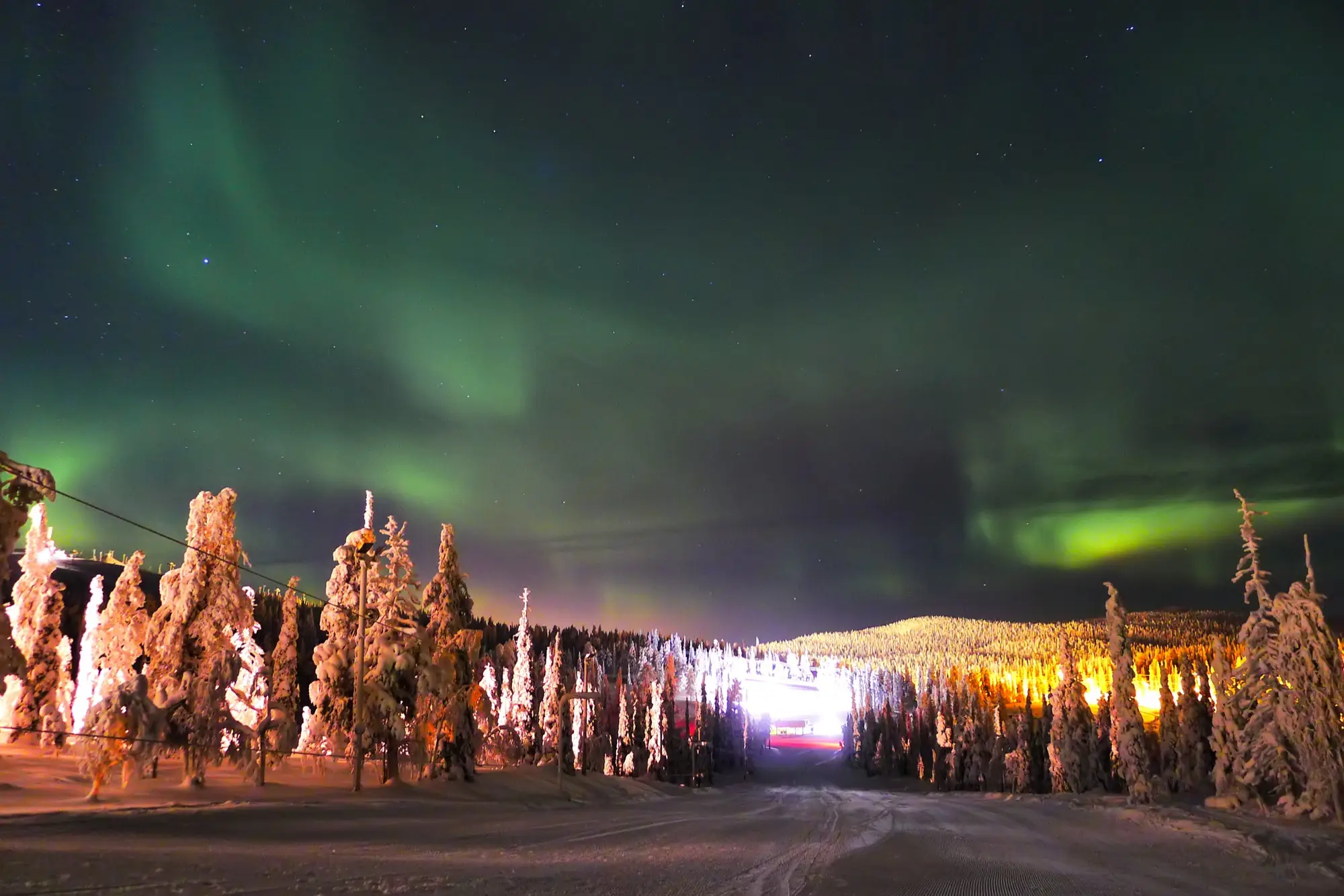
Photo: Timo Newton-Syms, CC BY-SA 2.0

The evidence
- Geomagnetic activity
- Kp 0.67 (quiet) NOAA SWPC, estimated Kp,Forecast peak Kp 1.67 during the dark hours NOAA SWPC 3-day forecast, issued 02:30 EET0% chance of aurora overhead NOAA SWPC OVATION,
- Cloud over the dark hours
- 100% cloud at best around 18:00, 100% at worst FMI HARMONIE forecast, covering 18:04–05:34
- Darkness
- Astronomical dark 18:04–05:34 (11h 30m) computed here from the date and the coordinatesSunset 14:50, sunrise 08:48 computed here
- Moon
- Waxing crescent, 17% lit, below the horizon at the start of the dark hours computed here
Finland's all-sky aurora cameras are at Kevo, Kilpisjärvi and Muonio, run by the Finnish Meteorological Institute, and at Nyrölä, Hankasalmi and Metsähovi in the south. Their images are not published under a licence that lets us embed them, so we link instead: FMI's all-sky camera images. See where the data comes from for what we checked.
How dark does it get in Ruka tonight?
It is astronomically dark — dark enough to see the aurora — from 18:04 to 05:34 local time, 11 hours and 30 minutes.
Dark hours by date, 2026–27 season
| Date | Dark from | Dark until | Hours of darkness |
|---|---|---|---|
| 1 September | Not dark enough for the aurora | ||
| 15 September | 23:04 | 02:56 | 3h 52m |
| 1 October | 21:30 | 04:18 | 6h 48m |
| 15 October | 20:32 | 05:10 | 8h 38m |
| 1 November | 18:34 | 05:02 | 10h 28m |
| 15 November | 18:00 | 05:40 | 11h 40m |
| 1 December | 17:34 | 06:14 | 12h 40m |
| 15 December | 17:28 | 06:32 | 13h 04m |
| 1 January | 17:38 | 06:38 | 13h 00m |
| 15 January | 18:02 | 06:26 | 12h 24m |
| 1 February | 18:42 | 05:52 | 11h 10m |
| 15 February | 19:24 | 05:12 | 9h 48m |
| 1 March | 20:10 | 04:22 | 8h 12m |
| 15 March | 21:06 | 03:18 | 6h 12m |
| 1 April | 23:58 | 02:18 | 2h 20m |
| 15 April | Not dark enough for the aurora | ||
Astronomical darkness (the sun more than 18° below the horizon), Ruka local time, computed here from the date and the coordinates.
The northern lights appear in Ruka, but the resort sits south of central Lapland and sees less frequent auroral activity. Ruka-Kuusamo states that a clear sky or minimal cloud is a precondition for seeing them, and advises heading to open or high places outside villages, away from street lights.
When to see the northern lights in Ruka
The Finnish Meteorological Institute (FMI) calculates that at the latitudes of Oulu and Kuusamo, auroras occur on approximately one night in four, assuming every night were dark and cloudless. By comparison, FMI figures show central Lapland (including Sodankylä, Levi, and Ylläs) experiences auroral activity three to four nights a week, while Kilpisjärvi in the far north reaches three nights in four. Auroral occurrences increase the further north you travel.
According to FMI, auroras happen fairly evenly throughout the year, with a slight peak in autumn and spring compared to winter and summer. Summer nights, particularly in northern latitudes, are too bright to reveal the faint glow. Ruka-Kuusamo tourist information notes that while northern lights may appear year-round, cloud cover or light summer nights can make them impossible to see, and displays cannot be reliably predicted. Ruka-Kuusamo says the double aurora, the northern lights reflected on calm water, is possible on the shores of lakes and ponds in Kuusamo from August to November.
FMI identifies a couple of hours either side of midnight as the most typical window for viewing, though auroras can appear at random intervals throughout the night. During major geomagnetic storms, displays can extend from sunset to sunrise. The weather does not affect whether auroras occur, but because the aurora forms above all clouds, it cannot be seen when the sky is covered by thick cloud. In Finland, cloud cover is particularly high during autumn and winter, when roughly 65% to 85% of the sky is covered, and clear days are least frequent in November and December. When clear, dark conditions do occur, FMI notes the night is usually cold, requiring warm clothing for long waits outdoors. Human eyes take tens of minutes to adapt fully to the dark, any torch used should have only a dim red light, and the naked eye perceives the aurora as paler than it appears in camera exposures. You can read more about planning around Finnish weather in the best time to visit Finland or compare broader sighting trends in best places to see the northern lights.
How to get to Ruka
Finnair operates flights between Helsinki and Kuusamo throughout the year. The flight takes approximately one hour, with multiple daily services running during the winter. For the 2026–2027 winter season, which runs from 25 October 2026 to 27 March 2027, Finavia lists direct scheduled services to Kuusamo from Berlin, Düsseldorf, Frankfurt, Helsinki, London Gatwick, Riga, and Zurich. In the 2026–2027 winter, Ruka-Kuusamo counts nine direct flights operated by airBaltic, Edelweiss, Eurowings, and Lufthansa from eight European cities, alongside charter flights brought in by tour operators.
Finavia states that Kuusamo airport sits a 30-minute drive from Ruka, while Oulanka, Salla, Riisitunturi, Iso-Syöte, and Hossa national parks are about an hour's drive away from the airport. Ruka-Kuusamo bus information explains that an airport bus meets all scheduled flights and waits for arriving passengers. Tickets are sold through the Matkahuolto website and must be booked at least 24 hours prior to travel. This airport bus does not serve charter flights; if the bus does not serve your location, Ruka-Kuusamo recommends pre-booking a taxi.
Rail travellers can take the train to Oulu, Rovaniemi, or Kemijärvi and continue onwards to Kuusamo by bus or car. A daily night train runs from Helsinki to Kemijärvi, connecting with a scheduled bus to Ruka. The car-carrier train operates to Kemijärvi from Wednesday to Sunday. The connecting Kemijärvi–Kuusamo bus runs every day, is especially suited to night-train arrivals at Kemijärvi according to Ruka-Kuusamo, and waits at most 60 minutes if the rail service is delayed. You can buy the bus tickets with your train tickets at vr.fi. In winter, direct bus services also run from the Helsinki area to Ruka. On weekdays, a bus connects Kuusamo and Rovaniemi, running via Kuusamo town centre, Rovaniemi bus station, and Rovaniemi railway station, as well as linking Kuusamo and Rovaniemi airports. This service does not operate on weekends or weekday public holidays; for travel onwards from that hub, see the Rovaniemi northern lights planning guide. By road from Helsinki the most direct route is national road 5, a little over 800 km. Drivers should note that the reindeer herding area begins near Kiiminki on the route via Oulu, and in Suomussalmi on the route via Kajaani. Once in the resort area, Ruka-Kuusamo states a personal car is not required because local public transport functions well.
Where to stand to see the aurora
Ruka-Kuusamo advises viewing from open or high positions situated outside settlements, clear of the glow from street lamps. Ruka-Kuusamo says the Ruka webcam shows the northern lights in real time and as saved images.
Key vantage points recommended by Ruka-Kuusamo include:
- Juhannuskallio: Located near the peak of Rukatunturi fell, Juhannuskallio (Midsummer Rock) is accessible by car. It has a special restriction area, so stay on the marked paths.
- Valtavaara: One of the highest fells in Kuusamo, situated near Ruka. An old fire guard's hut stands on the summit, offering open sightlines towards Riisitunturi, Konttainen, and Lake Kitkajärvi.
- Konttainen: Part of a fell ridge that includes Pyhävaara, Rukatunturi, Valtavaara, and Kumpuvaara. The summit looks out towards Riisitunturi across Lake Kitkajärvi. In winter, the snowshoe tracks leading to Konttainen and around Ruka are generally passable on foot, except in heavy snowfall or during the spring thaw. These tracks are not groomed, and walking on cross-country ski trails is strictly prohibited, with limited exceptions.
- Riisitunturi: Located on the Posio side, where an open wilderness hut on the fell summit offers overnight shelter for backcountry visitors.
Ruka-Kuusamo lists guided northern lights safaris on a reindeer sleigh, on a Finnhorse or on snowshoes, and trips by snowmobile or in a sleigh pulled by one. Ruka-Kuusamo also notes that some accommodation lets you watch the northern lights lying down under a glass roof, with options ranging from villas for a few people to large log cabins.
Where to watch near Ruka
- Juhannuskallio 1.3 km south-east. You can reach this rock by car close to Rukatunturi fell's peak for views around Ruka, which Ruka-Kuusamo names as an aurora viewing spot. It has a special restriction area; stay on the marked paths.
- Valtavaara 3.2 km north-east. Ruka-Kuusamo lists this area for northern lights viewing, set on one of the highest fells in Kuusamo. You can reach the area along winter snowshoe trails or take a ski trail towards the peak.
- Konttainen 6.0 km north-east. Ruka-Kuusamo names this area for aurora viewing, with open views from the top across surrounding fells and lakes. You reach it via an ungroomed snowshoe trail, usually walkable in winter except in heavy snowfall or spring thaw.
- Riisitunturi 27 km west. You can reach the peak via the circular, 4.3 km Riisin rääpäsy trail, though climbs make the trails demanding. According to Ruka-Kuusamo, an adventurous aurora watcher can spend the night in the peak's open wilderness hut.
What the numbers mean
Four things have to line up before you see anything, and three of them are on this page above. The fourth is your own eyes adjusting, which takes about twenty minutes in real darkness and does not survive a glance at a phone.
Darkness comes first because it cannot be argued with. The aurora is always there when the field is active; you can only see it once the sun is more than 18° below the horizon, which is what the dark band above marks. In Ruka that is 11 hours and 30 minutes tonight.
Kp is a global index of how disturbed the Earth's magnetic field is, from 0 to 9, published every three hours. It is a blunt instrument: it says the whole planet was disturbed, not that the aurora is over Ruka now. At 66°N the auroral oval usually sits overhead already, so a quiet Kp is no reason to stay in.
The local disturbance is the better number, and it is the one most aurora pages do not have. FMI runs magnetometers across Lapland; we take the rate of change of the horizontal field at the nearest one, in nanotesla per minute. Ruka has none within 120 km, so its verdict rests on Kp and OVATION. A field moving fast overhead means current flowing overhead, which is the aurora itself. Above roughly 40 nT/min it is usually visible; above 100 a substorm is running and it will be moving.
Cloud ends most attempts. The figure above is the total cloud cover FMI's HARMONIE model forecasts for the dark hours, at these exact coordinates. Anything over about 70% and you will not see through it; under 30% and it stops mattering.
The moon does not stop the aurora. A full moon high in the sky washes out the faint green arcs that make up most displays, so a strong night still shows and a marginal one does not.
Plan the trip
- Best places to see the northern lights
- Northern lights in Finland: when and where to go
- The best time to visit Finland, month by month
- Christmas in Finland: what Finns actually do
- Dog sledding and reindeer in Lapland: how to choose
- Ruka webcams: every live camera
Nearby
Also on this site: how the daylight changes through the year, and the other 25 places.