Can you see the northern lights in Ylläs tonight?
Clouded out — 100% cloud at best between 18:22 and 05:56.
Checked against NOAA SWPC, FMI's Muonio magnetometer and the FMI HARMONIE forecast.
Tonight Ylläs is 23 of 26 on the ranked table of places.
Get an alert when Ylläs lights up
A heads-up in the hours before dark when tonight's forecast Kp reaches your choice and the cloud forecast leaves a gap, and an alert when the field is active over a clear enough sky at Ylläs. Two a night at most, nothing on the other nights.
Alerts come to this browser on this device. No email, no account; turn them off here or from any alert.
Aurora forecast for Ylläs: the next three nights
| Night | Dark, local time | Forecast Kp | Kp needed | Clearest hour |
|---|---|---|---|---|
| TonightFri 13 Nov | 18:22–05:56 | Kp 1.67 | Kp 1 | 100% at best |
| Clouded out — 100% cloud at best. | ||||
| Saturday nightSat 14 Nov | 18:20–05:58 | Kp 1.67 | Kp 1 | 0% at best |
| Possible — Kp up to 1.67 is forecast while it is dark, and Ylläs needs about Kp 1. 0% cloud at best. | ||||
| Sunday nightSun 15 Nov | 18:18–06:00 | Kp 1.67 until 02:00 | Kp 1 | not forecast yet |
| Possible — Kp up to 1.67 is forecast until 02:00, and Ylläs needs about Kp 1. The cloud forecast does not reach this night yet. | ||||
Checked . Kp from the NOAA SWPC three-day forecast, issued ; cloud from FMI HARMONIE forecast, issued . Tonight's row is the verdict above, which also reads the Kp now, OVATION and the magnetometers; the nights after rest on the forecasts alone.
Key facts
- Astronomically dark in Ylläs tonight from 18:22 to 05:56 local time, 11 hours and 34 minutes, as of .
- Aurora outlook for the next three nights: Fri 13 Nov, Clouded out; Sat 14 Nov, Possible; Sun 15 Nov, Possible, as of .
- In the 2026–27 season, astronomical darkness returns between 1 September and 15 September and ends between 15 March and 1 April.
- Ylläs is at 67.55°N, 24.26°E.
Updated
The sun rises every day of the year in Ylläs at 67.6°N in Finland, where a quiet geomagnetic night is often enough to see the aurora.
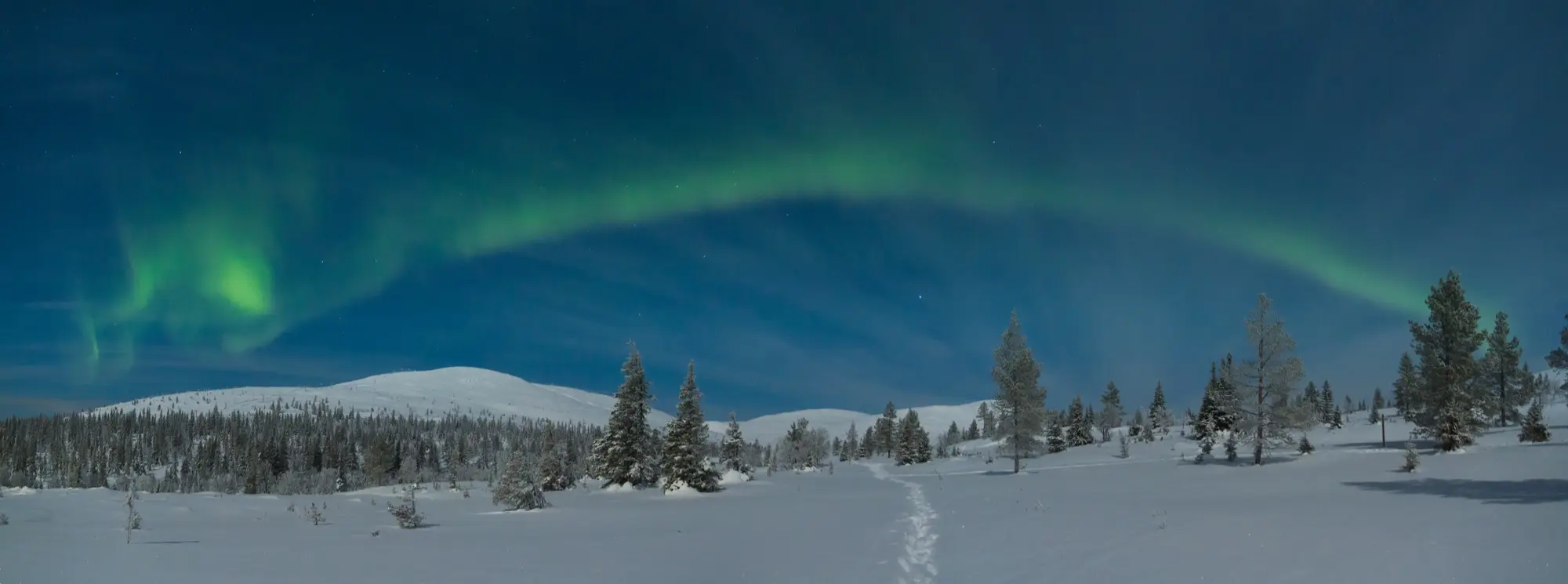
Photo: Ximonic (Simo Räsänen), CC BY-SA 3.0

The evidence
- Geomagnetic activity
- Kp 0.67 (quiet) NOAA SWPC, estimated Kp,Forecast peak Kp 1.67 during the dark hours NOAA SWPC 3-day forecast, issued 02:30 EET0% chance of aurora overhead NOAA SWPC OVATION,Local disturbance 4 nT/min at Muonio, 61 km away FMI magnetometer network,
- Cloud over the dark hours
- 100% cloud at best around 18:00, 100% at worst FMI HARMONIE forecast, covering 18:22–05:56
- Darkness
- Astronomical dark 18:22–05:56 (11h 34m) computed here from the date and the coordinatesSunset 14:53, sunrise 09:24 computed here
- Moon
- Waxing crescent, 17% lit, below the horizon at the start of the dark hours computed here
Finland's all-sky aurora cameras are at Kevo, Kilpisjärvi and Muonio, run by the Finnish Meteorological Institute, and at Nyrölä, Hankasalmi and Metsähovi in the south. Their images are not published under a licence that lets us embed them, so we link instead: FMI's all-sky camera images. See where the data comes from for what we checked.
How dark does it get in Ylläs tonight?
It is astronomically dark — dark enough to see the aurora — from 18:22 to 05:56 local time, 11 hours and 34 minutes.
Dark hours by date, 2026–27 season
| Date | Dark from | Dark until | Hours of darkness |
|---|---|---|---|
| 1 September | Not dark enough for the aurora | ||
| 15 September | 23:52 | 02:48 | 2h 56m |
| 1 October | 22:00 | 04:28 | 6h 28m |
| 15 October | 20:56 | 05:24 | 8h 28m |
| 1 November | 18:56 | 05:22 | 10h 26m |
| 15 November | 18:18 | 06:00 | 11h 42m |
| 1 December | 17:50 | 06:36 | 12h 46m |
| 15 December | 17:42 | 06:56 | 13h 14m |
| 1 January | 17:54 | 07:02 | 13h 08m |
| 15 January | 18:18 | 06:48 | 12h 30m |
| 1 February | 19:02 | 06:12 | 11h 10m |
| 15 February | 19:46 | 05:30 | 9h 44m |
| 1 March | 20:36 | 04:36 | 8h 00m |
| 15 March | 21:38 | 03:26 | 5h 48m |
| 1 April | Not dark enough for the aurora | ||
Astronomical darkness (the sun more than 18° below the horizon), Ylläs local time, computed here from the date and the coordinates.
In central Lapland, the northern lights show on three to four nights a week when skies are dark and clear. Visit Ylläs notes that autumn weather is generally cloudier than spring, and thick cloud hides the aurora. You can reach the fell by direct airport bus from Kittilä or by connecting shuttle from the night train at Kolari.
When to see the northern lights in Ylläs
Statistics from the Finnish Meteorological Institute place central Lapland, which includes Ylläs, Levi and Sodankylä, at auroral displays on three to four nights a week. That rate reflects how often you could see the lights if every night were dark and clear. The institute notes that auroral activity occurs fairly evenly across the year, with slightly more displays in autumn and spring than in winter and summer. However, northern summer nights are too bright to reveal the faint glow.
The most typical window for viewing is a couple of hours either side of midnight, though displays can appear at any hour of the night. During major geomagnetic storms, they can last from sunset to sunrise.
Local tourism body Visit Ylläs states that the aurora season starts in late August, and that autumn offers good viewing without needing to wait for snow, provided skies stay clear. The organisation considers spring the best time after winter, noting that autumn weather is generally cloudier than spring's. By late April, lengthening daylight reduces the chance of seeing a display.
Because the aurora forms above all clouds, it cannot be seen when the sky is covered by thick cloud. FMI figures show that cloud cover is especially abundant in autumn and winter, when about 65% to 85% of the sky is covered, with clear days least frequent in November and December. Weather does not affect whether auroras occur. Visit Ylläs says a completely cloudy evening may not be worth trying, but if you can see even one star the aurora is possible. Look to the northern sky, where Visit Ylläs says the aurora usually appears. The organisation says the biggest mistake is to step out for a quick look, because the aurora can come and go quickly, so take your time.
How to get to Ylläs
Visit Ylläs says Ylläs is in the municipality of Kolari and has two villages on different sides of the fell: Äkäslompolo and Ylläsjärvi. It is a half-hour drive from Kolari station and from Kittilä airport.
Finavia puts Ylläs around 35 km from Kittilä airport, and says the airport has multiple daily connections from Helsinki. For the winter season running from 25 October 2026 to 27 March 2027, Finavia lists scheduled routes to Kittilä from Amsterdam, Berlin, Brussels, Düsseldorf, Frankfurt, Helsinki, Liverpool, London Gatwick, London Luton, Manchester, Milan, Munich, Paris, Riga, Vienna and Zurich, excluding charters. Liikenne Rundgren operates the connecting bus between Kittilä airport and Ylläs; outside the main season and in summer, transfers run on demand and must be booked ahead. Timetables are published and tickets go on sale via Matkahuolto on the 20th day of the month before.
By rail, the night train from Helsinki reaches Kolari the following morning, connecting with a 35 km shuttle bus to Ylläs. The train runs nightly in winter and mainly four times a week in summer. VR gives Kolari station as 35 km from Ylläs with a connecting bus of around 30 to 60 minutes, and its trip search lets you buy the train and bus tickets in one go. Car-carrying wagons operate on routes to Kolari, Rovaniemi and Kemijärvi, with two night trains departing Helsinki for Kolari on the busiest ski-season nights. You can also travel on the night train north toward Rovaniemi.
From Rovaniemi, Visit Ylläs says it is best to come by car or taxi, about a 2-hour drive. The indirect bus via Levi runs only on days a train arrives in Kolari, and the waits between buses can be very long. By road from the south, Visit Ylläs says to follow road 21 (E8) to Kolari and turn onto road 939 for Ylläsjärvi. From Rovaniemi, take road 79 to Kittilä and then road 80 to Ylläsjärvi. The two villages are 15 km apart; drive carefully and watch for reindeer.
Where to stand to see the aurora
Visit Ylläs says you can watch the aurora from your own yard, but for the best views and photographs it advises an open place with a good view to the north. Broader area details appear in our guide to Ylläs.
Visit Ylläs highlights several viewing locations:
- Lake Äkäslompolo and the Ylläs swing: Signposted paths behind the K-Market Jounin Kauppa lead to the shore of Lake Äkäslompolo, which provides a wide-open view of the sky. On calm nights the lake reflects the aurora.
- Lake Ylläsjärvi: Named alongside Lake Äkäslompolo by Visit Ylläs as a good spot.
- Äkäslompolo ski resort car park: A viewpoint for aurora watching by car with a direct view to the north.
- Kellokas visitor centre: The backyard has a wide view towards Pallas-Yllästunturi national park, the northern sky and the fells, is easy to reach, and suits families.
- Tuomikuru day-trip hut: The trail starts from the Ylläsjärvi side, leading to a hut where the sky opens wide in all directions.
- Kukastunturi: The summit provides views in every direction. In autumn the easiest way up is by bike, though the wind on the fell can make it feel colder.
- Kuertunturi: In winter, a relatively easy climb where you can photograph the aurora with snow-covered trees.
Visit Ylläs says fewer trees higher up the fells give a better view of the sky. Visit Ylläs asks aurora watchers to respect private property and never to park in someone's yard or on the road. It also advises bringing a headlamp while avoiding dazzling the group. FMI says to give your eyes time to adjust to the dark, which takes tens of minutes, and to use only a dim red light if you need a lamp.
Where to watch near Ylläs
- Ylläs swing (Lake Äkäslompolo) 7.4 km north-west. You can walk there by following signs from behind K-Market Jounin Kauppa to the lakeshore. It offers an open sky with Kesänki fell in the distance, and the lake reflects the aurora on calm nights.
- Kellokas visitor centre 4.7 km north-west. The backyard of the visitor centre is easy to reach and can be combined with an evening walk on the nature trail. Visit Ylläs says it has a wide view towards the northern sky, the fells and the national park.
- Tuomikuru day-trip hut 2.0 km north. The sky opens wide in all directions from the hut, which you reach on a short hike into the national park. Visit Ylläs notes that the trail starts from the Ylläsjärvi side.
- Kuertunturi 9.2 km north-west. You can photograph the aurora against snow-covered trees, with fewer trees higher up offering clearer views of the sky. In winter, Visit Ylläs considers the fell a relatively easy climb for watching the northern lights.
What the numbers mean
Four things have to line up before you see anything, and three of them are on this page above. The fourth is your own eyes adjusting, which takes about twenty minutes in real darkness and does not survive a glance at a phone.
Darkness comes first because it cannot be argued with. The aurora is always there when the field is active; you can only see it once the sun is more than 18° below the horizon, which is what the dark band above marks. In Ylläs that is 11 hours and 34 minutes tonight.
Kp is a global index of how disturbed the Earth's magnetic field is, from 0 to 9, published every three hours. It is a blunt instrument: it says the whole planet was disturbed, not that the aurora is over Ylläs now. At 68°N the auroral oval usually sits overhead already, so a quiet Kp is no reason to stay in.
The local disturbance is the better number, and it is the one most aurora pages do not have. FMI runs magnetometers across Lapland; we take the rate of change of the horizontal field at the nearest one, in nanotesla per minute, which for Ylläs is Muonio, 61 km away. A field moving fast overhead means current flowing overhead, which is the aurora itself. Above roughly 40 nT/min it is usually visible; above 100 a substorm is running and it will be moving.
Cloud ends most attempts. The figure above is the total cloud cover FMI's HARMONIE model forecasts for the dark hours, at these exact coordinates. Anything over about 70% and you will not see through it; under 30% and it stops mattering.
The moon does not stop the aurora. A full moon high in the sky washes out the faint green arcs that make up most displays, so a strong night still shows and a marginal one does not.
Getting there tonight
Tornio to Kilpisjärvi: Extremely poor driving conditions on Tornio to Kilpisjärvi — the surface runs -15.9 to -2.7 °C. The surface is at or below freezing at 12 of 12 stations, from Tornio Kukkola K northwards. · Rovaniemi to Levi and Kittilä: Poor driving conditions forecast on Rovaniemi to Levi and Kittilä — the surface runs -8.8 to -6.3 °C. The surface is at or below freezing at 4 of 4 stations, from Rovaniemi Patokoski northwards.


Plan the trip
- Best places to see the northern lights
- Northern lights in Finland: when and where to go
- Ylläs: Finland’s biggest ski hill and its fells
- Levi: skiing, polar night and the aurora
- Dog sledding and reindeer in Lapland: how to choose
- Ylläs webcams: every live camera
Nearby
Also on this site: how the daylight changes through the year, and the other 25 places.