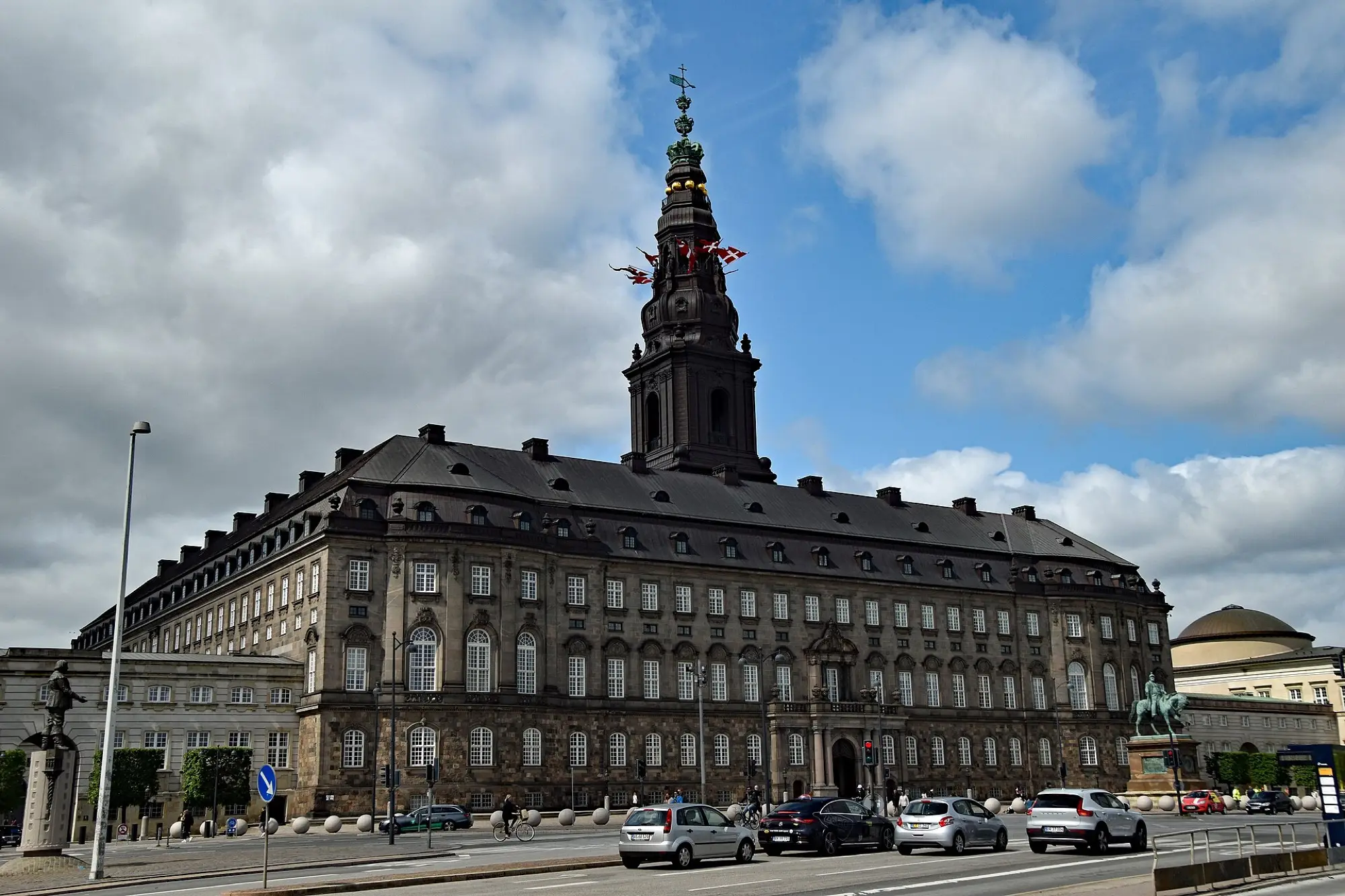

Christiansborg Palace on Slotsholmen (castle islet) houses the Danish parliament and the King's Royal Reception Rooms. Four separate parts are open to visitors on individual tickets or on a combined Palace Ticket (DKK 225 at the door), under-18s go free, and the 106-metre tower is free.
Christiansborg in short
Christiansborg, once home to kings and queens, houses the Danish parliament, the Supreme Court and the Ministry of State. The King holds audiences and receives heads of state at Christiansborg, which is also home to parliament and the Prime Minister's Office.
Three palaces and two fires
According to The Royal Danish Collection, the history of the site spans several buildings:
- In 1167 Bishop Absalon built a fortress on the small island of Slotsholmen to defend the city.
- In 1369 the Hanseatic League seized Absalon's fortress and tore it down stone by stone.
- Around 1380 Copenhagen Castle was built on the ruins and in time became the main royal residence.
- In 1731 Copenhagen Castle was demolished and Christian VI began building the first Christiansborg.
- The first Christiansborg was inaugurated in 1740; it cost about half the annual national budget.
- The first Christiansborg burned in 1794, leaving only ruins; the stables survived the fire.
- Frederik VI inaugurated the second Christiansborg in 1828, a neoclassical palace designed by C. F. Hansen.
- The second Christiansborg burned to the ground in 1884; the palace chapel survived.
- The third and present Christiansborg was completed in 1928, with one wing for the King's reception rooms and the other for the two chambers of parliament.
The tower was built as part of the present palace, built in 1907-1928 and designed by the architect Thorvald Jørgensen.
Inside the royal reception rooms
New monarchs are proclaimed from the balcony of the Throne Room; the last time was on 14 January 2024, when the Prime Minister proclaimed King Frederik X. The thrones in the Throne Room are no longer used and stay as a relic of absolutism (1660 to 1848); the King's throne has two gilded lions, the Queen's two gilded griffins, and both were saved from the fire of 1884.
The Great Hall, the largest in the palace, is 40 metres long, 14 metres wide and 10 metres tall and seats 400 dinner guests. Bjørn Nørgaard's tapestries in the Great Hall show a thousand years of Danish history; they were a gift to Queen Margrethe II on her 50th birthday and have hung there since 2000.
Daily public tours of the Royal Reception Rooms in English start at 12.30 and 15.00.
The ruins under the palace
Under the palace you can see the ruins of Absalon's castle and of Copenhagen Castle, evidence that Slotsholmen has been a centre of power for 800 years. Absalon's ring wall, of limestone from Stevns Klint, enclosed a site about 53 metres across and was about five metres tall and 1.5 metres thick.
Copenhagen was conquered at least three times while Absalon's castle stood, in 1245, 1249 and 1259. To destroy the castle, the Hanseatic cities hired 34 stonemasons. The ruins include those of Absalon's medieval fortress and of Christian IV's Copenhagen Castle with the Blue Tower prison.
The royal kitchen and the stables
The Royal Kitchen recreates 15 May 1937, the day of the gala dinner for Christian X's silver jubilee. The Royal Danish Collection says the kitchen has one of Europe's biggest collections of copper cookware; it was built for the third palace, completed in 1928, and no fewer than 275 guests were invited to the jubilee dinner.
The Royal Stables, which survived two great fires, are the only remaining part of the original Christiansborg of 1740; the horses stand among marble columns and eat from marble cribs. The stables keep 14 to 16 coach horses; there were once up to 250. The white horses come from the historical stud farm at Kladruby in the Czech Republic, a UNESCO World Heritage site, and are used on royal occasions such as the New Year's levee, state visits and weddings.
Tickets, passes and the Copenhagen Card
A Palace Ticket covers all the sites. Buying online saves DKK 10 per entrance ticket.
| Ticket type | Door price (Adult) | Online price (Adult) | Door price (Student) | Online price (Student) |
|---|---|---|---|---|
| Palace Ticket | DKK 225 | DKK 215 | DKK 150 | DKK 140 |
| Royal Reception Rooms | DKK 150 | DKK 140 | DKK 100 | DKK 90 |
| Royal Stables | DKK 85 | DKK 75 | DKK 60 | DKK 50 |
| Royal Kitchen | DKK 85 | DKK 75 | DKK 60 | DKK 50 |
| Ruins | DKK 85 | DKK 75 | DKK 60 | DKK 50 |
Visitors aged 0 to 17 go free, though visitors under 18 still need a ticket.
The Royal Palace Pass costs DKK 255 at the door or DKK 245 online and covers every visitor site at Christiansborg, Rosenborg Castle and the Amalienborg Museum for 72 hours from the first visit; Christiansborg may close for official events. At the door the Royal Palace Pass (DKK 255) costs DKK 30 more than the Christiansborg Palace Ticket (DKK 225), and online (DKK 245 against DKK 215) also DKK 30 more. A Palace Ticket (DKK 225) and Rosenborg (DKK 150) bought at the door come to DKK 375, DKK 120 more than the pass.
The Copenhagen Card's attraction list includes four Christiansborg sites, the Royal Reception Rooms, the ruins, the Royal Stables and the Royal Kitchen.
Opening hours and closures
From 2 November to 21 March the sites operate on winter opening hours:
| Site | Days open (2 Nov to 21 Mar) | Hours |
|---|---|---|
| Royal Reception Rooms | Tuesday to Sunday | 10.00-17.00 |
| Ruins | Tuesday to Sunday | 10.00-17.00 |
| Royal Kitchen | Tuesday to Sunday | 10.00-17.00 |
| Royal Stables | Tuesday to Sunday | 13.30-16.00 |
| Palace Chapel | Sundays only | 10.00-17.00 |
From 2 November to 21 March the Royal Reception Rooms, the Ruins and the Royal Kitchen are closed on Mondays, and in the same period the Royal Stables are closed on Mondays.
- Over Christmas 2026 the Reception Rooms, the Ruins and the Kitchen are closed on 24 and 25 December, open 10.00-17.00 from 26 to 30 December and 10.00-14.00 on 31 December.
- The Royal Stables open 13.30-16.00 from 26 to 30 December and are closed on 31 December.
- All the sites at Christiansborg are closed from 1 to 7 January.
The sites at Christiansborg may close without notice for official state or royal events, so the palace asks you to check the week's hours before you go.
The free tower
VisitCopenhagen says the 106-metre tower of Christiansborg is the highest in Copenhagen, 40 centimetres higher than the City Hall tower. The tower opened to the public in June 2014 and is free for everyone, making it one of the free things to do in Copenhagen.
The tower's entrance is at the King's Gate, the large gate in the centre of the palace beneath the tower, reached from the palace square or from the inner courtyard. A lift goes from the entrance to the top; the stairs cannot be used, and there may be a queue because space at the top is limited. The tower has a restaurant where you can dine.
VisitCopenhagen's day-by-day listing for late November and early December, read on the date this page was checked, gives the tower's hours as 11:00 am-09:00 pm from Tuesday to Saturday and 11:00 am-05:30 pm on Sunday.
Getting there and what you can bring
The palace's visitor address is Prins Jørgens Gård 5, 1218 Copenhagen K. For those exploring Copenhagen, the nearest metro station is Gammel Strand. The Metro's page for Gammel Strand puts Christiansborg about 150 metres from the station.
Parking around the palace is very limited; the underground car park at BLOX is a 10-minute walk away.
The cloakroom takes only small bags and umbrellas; large bags, suitcases, prams and pushchairs are not allowed inside, though pushchairs can be left in the Queen's Gate at your own risk. You cannot eat or drink inside the visitor sites; there are outdoor tables in the Royal Library Garden and benches at the riding ground for a packed lunch.
All the visitor sites can be reached with a walking frame or a wheelchair; ask the ticket desk staff for the lift.