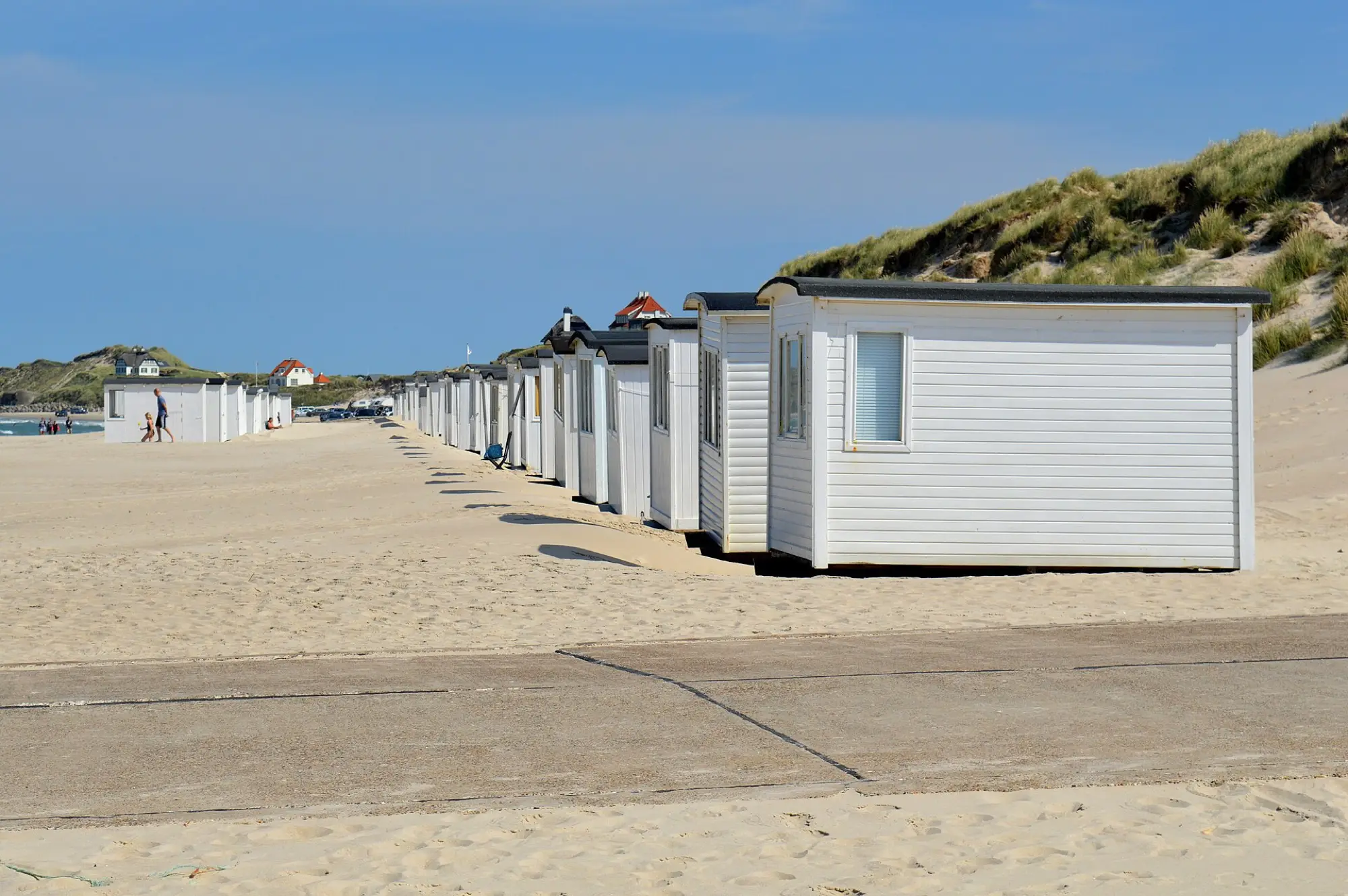

June, July and August are Denmark's warmest months, DMI's preliminary 1991-2020 national mean is 16.9 °C in July and August, the sea around Denmark is 17 °C to 22 °C by VisitDenmark's figures, Friluftsrådet lists 144 Blue Flag beaches, and in Copenhagen the longest day has 17h 32m of daylight. This guide covers the country beyond Copenhagen; if you are visiting the capital, see our guide to Copenhagen in summer.
The summer weather
VisitDenmark says Denmark has four distinct seasons and the summer months of June, July and August are the hottest. For monthly figures across the year, see our guide to Denmark weather by month.
For Denmark as a whole, preliminary 1991-2020 values from the Danish Meteorological Institute give the following national values:
- June: mean temperature 14.5 °C, average daily high 18.5 °C, precipitation 64.3 mm
- July: mean temperature 16.9 °C, average daily high 21.2 °C, precipitation 65.8 mm
- August: mean temperature 16.9 °C, average daily high 21.2 °C, precipitation 82.1 mm
VisitDenmark says the prevailing wind is westerly, so the west coast of Denmark gets more rain than the rest of the country.
The long days
Computed on this site, on the summer solstice, 21 June, the sun rises in Copenhagen at 04:25 and sets at 21:57, 17h 32m of daylight. You can find sunrise and sunset times on our daylight in Copenhagen page.
This site's daylight page says that only between 5 May and 6 August does summer twilight prevent full astronomical darkness across midnight in Copenhagen. Copenhagen has neither polar night nor midnight sun.
Beaches and Blue Flags
VisitDenmark says Denmark has over 7,400 km of coastline. Friluftsrådet (the Outdoor Council) is the national operator of the Blue Flag awards in Denmark; the programme is owned by the Foundation for Environmental Education.
Friluftsrådet lists 144 beaches with the Blue Flag, and 72 bathing places with its Badepunkt (bathing point) label, on the date this page was checked. Badepunkt is a Nordic award for clean bathing water and basic facilities; a Badepunkt is often smaller than a Blue Flag beach and can be a beach, a lake, a bathing pier or a harbour bath.
Key rules define these sites:
- The Blue Flag season for beaches runs from 1 June to 15 September, though a municipality can choose a shorter season starting on 1 June.
- In the Blue Flag season a Blue Flag beach guarantees clean bathing water, good outdoor, waste and toilet facilities, lifesaving and first aid equipment, and handicap facilities on at least one beach per municipality.
- Friluftsrådet warns that it is generally forbidden to swim in Danish marinas.
Is the water clean?
Miljøstyrelsen (the Danish Environmental Protection Agency) says Denmark has the sixth longest coastline in the EU and that measurements are taken every year at more than 1000 bathing beaches and bathing lakes. Miljøstyrelsen says 88 of Denmark's 98 municipalities have official bathing-water sites where the water is tested for bacteria through the bathing season.
Miljøstyrelsen says the bathing season runs from 1 June to 1 September, and a municipality can extend it to 15 September. Bathing water is classed as poor, sufficient, good or excellent from the E. coli and enterococci in at least 16 samples over four consecutive years.
Miljøstyrelsen says almost all Danish beaches have bathing water of high quality, but algae and sewage can spoil a beach, permanently or for short periods. Miljøstyrelsen says polluted bathing water is most often caused by sewers overflowing after a heavy downpour, and advises never to go in straight after long heavy rain, to check whether the municipality has put up warnings or the Blue Flag has been taken down, and to wait a couple of days to be sure. Miljøstyrelsen says the current state of the bathing water is published by each municipality on its own website.
How warm the sea gets
VisitDenmark gives the sea temperature around Denmark from June to August as between 17 °C and 22 °C. VisitDenmark says the sea around Denmark can rise to around 25 °C in August.
The west coast
VisitDenmark highlights several areas along the west coast:
- Søndervig: VisitDenmark describes Søndervig in West Jutland as a seaside resort for the last century, with a beach backed by sand dunes on the North Sea.
- Rømø: VisitDenmark says the island of Rømø on the west coast has some of the largest beaches in Europe, where you can drive down to the water.
- Blåvand: VisitDenmark describes Blåvand beach, near Hvide Sande in West Jutland, as 40 km long.
- Blokhus: VisitDenmark says that at Blokhus you can drive along the beach by car from Rødhus in the south to Løkken in the north.
VisitDenmark calls a swim in the North Sea a wonderful experience on a summer day but asks swimmers to respect its great forces of nature.
Skagen and Grenen
Enjoy Nordjylland says that in summer Skagen's 7,000 residents are joined by guests from all over the world, and that nothing in the town is far, so you can get around by bike or on foot. For details on visiting the area, see our guide to Skagen.
Enjoy Nordjylland describes Grenen as the place where the Skagerrak and the Kattegat meet; it is open all year. Swimming at Grenen is strictly prohibited because of dangerous currents.
Sankt Hans on 23 June
VisitDenmark says midsummer is marked throughout Denmark every year on 23 June with bonfires and festivities, and that in Djursland bonfires burn along the beaches. Sankt Hans Aften is celebrated with bonfires, speeches and the midsummer song "Vi elsker vort land" (We love our country), written by the poet Holger Drachmann in 1885.
A straw witch is sometimes put on top of the bonfire; the story goes that when she burns, she flies to Bloksbjerg in Germany.
Three summer festivals: Roskilde, Smukfest and Tønder
| Festival | Town | 2027 dates |
|---|---|---|
| Roskilde Festival | Roskilde | 26 June to 3 July 2027 |
| Smukfest | Skanderborg | 1 to 8 August 2027 (subject to change) |
| Tønder Festival | Tønder | 25 to 28 August 2027 |
Roskilde Festival 2027 takes place from 26 June to 3 July 2027. Roskilde Festival is looking for volunteers to help create the 2027 festival for 130,000 participants. Practical information is covered in our guide to Roskilde Festival.
Smukfest in Skanderborg gives its 2027 dates as 1 to 8 August, in the beech wood (Bøgeskoven), subject to change. Smukfest counts sixty thousand visitors a day, eighteen thousand of them helpers, and a festival town the size of Fredericia. Smukfest describes itself as nonprofit since 1980. Smukfest says its festival site is built with care in a protected beech wood, and that trains run to Skanderborg station, from where buses go to the site.
Tønder Festival 2027 runs from 25 to 28 August 2027. Tønder Festival puts hand-made music at its centre, with roots in folk, roots rock, country, blues, cajun and world music.
Renting a summer house
VisitDenmark calls renting a holiday cottage a Danish obsession and a way to "do it like the Danes". VisitDenmark says there are over 40,000 holiday homes (sommerhuse) to rent in Denmark. VisitDenmark names North Jutland, Bornholm, the west coast, Fyn and the Danish Riviera as popular holiday-home areas.
VisitDenmark describes how renting a holiday cottage works:
- Holiday cottages are normally rented for a week, with Saturday the usual change-over day; outside the high season, shorter stays are possible.
- Holiday homes come with kitchen utensils, crockery, pillows and duvets, but you normally bring your own bed linen, and you can usually pay for cleaning at the end of the stay.
- VisitDenmark says a basic holiday cottage with two to three bedrooms can start at around DKK 3,500 for a week in the high season, and luxury summer houses with pools and jacuzzis from around DKK 11,500.