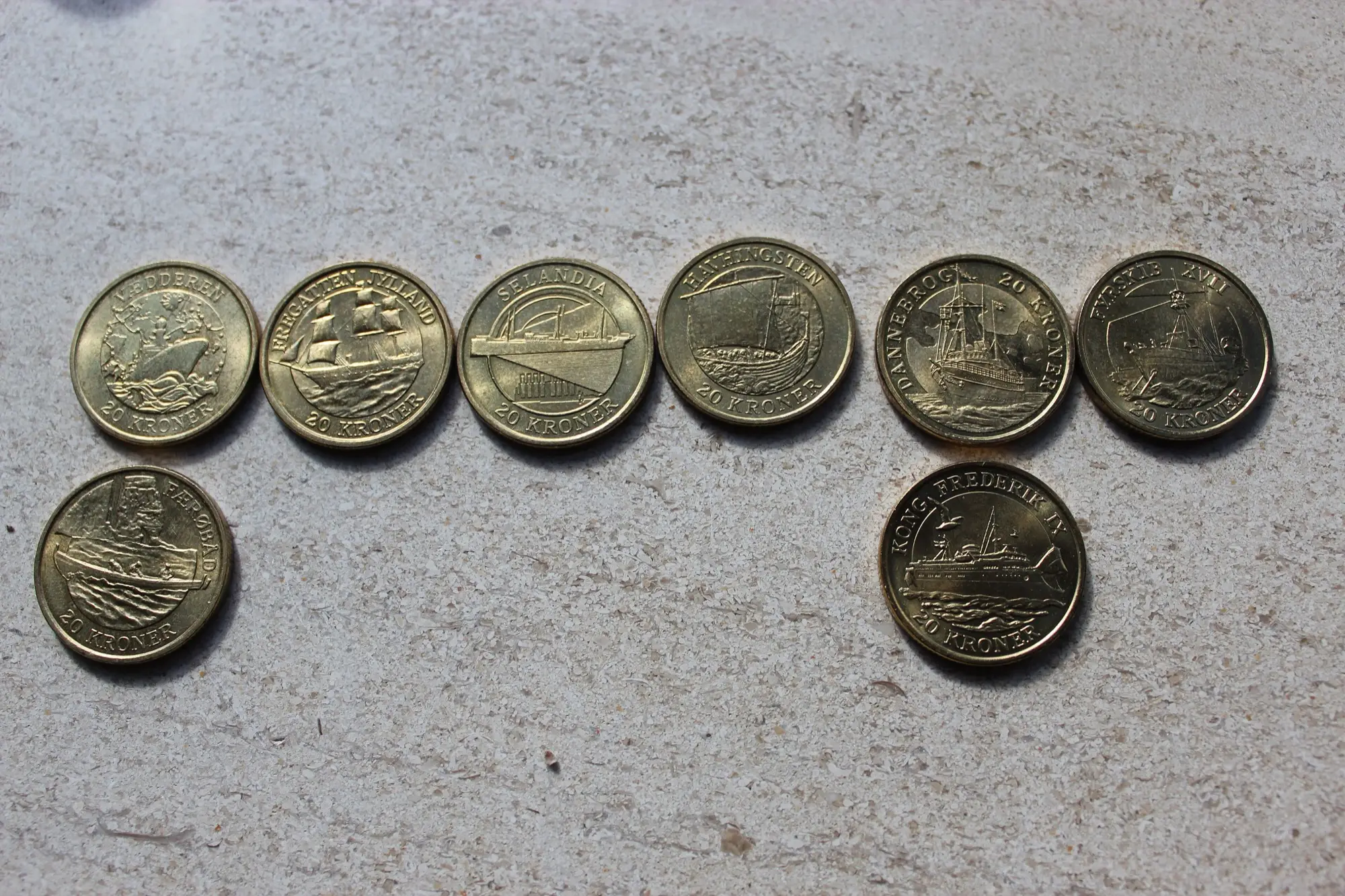

The currency in Denmark is the Danish krone (DKK, written kr.). Cards and mobile payments such as MobilePay and Apple Pay are taken almost everywhere and many places are cashless. Service is included in hotel, restaurant and taxi bills, so a tip is up to you. The old 1,000-krone notes are no longer legal tender.
The Danish krone
VisitDenmark says the Danish krone is the official currency of Denmark, Greenland and the Faroe Islands. The currency sign is "kr." and the ISO code is DKK. VisitDenmark points to an online rates page for the exchange rate.
There are 100 øre in a krone, but øre coins are rarely used. The 50 øre coin is the only one still in circulation. Banknotes come in 50, 100, 200 and 500 kroner. Coins come in 1, 2, 5, 10 and 20 kroner, plus the 50 øre coin.
VisitDenmark says there are no restrictions on the amount of currency you may bring in or take out. However, anything over €10,000 (about 75,000 kr) must be declared, as the Danish tax authority explains. If you plan your budget using our guide to Denmark or check the cost of living in Denmark, keep these denominations in mind.
Cards and mobile payments
International credit cards can be used in restaurants, hotels, petrol stations and shops. A business has the right to charge an extra fee for an international card. Not all do, and you are told before you pay if a fee applies.
VisitDenmark says many smaller shops and supermarkets do not accept international credit cards. VisitDenmark also calls Denmark a highly digital society where cash is accepted in most places, but many shops, cafés and restaurants are cashless and take only cards or mobile payments such as MobilePay or Apple Pay. If you explore Copenhagen, you will find that digital payments are the standard method for most day-to-day transactions. You can also check whether a Copenhagen Card fits your plans.
Cash, ATMs and banks
VisitDenmark notes that some kiosks and supermarkets stop accepting cash after 8 pm. If you plan to pay cash late in the evening, carry a card as well.
You can withdraw cash from bank ATMs with Visa, Cirrus, Maestro or Mastercard. You are told of any charges before the withdrawal, and most ATMs can be used 24/7. Danish banks normally open on weekdays from 9.30 or 10am to 4pm. Many stay open until 5.30pm on Thursdays, and banks are closed on Saturday and Sunday.
The 1,000-krone note and older banknotes
Danmarks Nationalbank announced on 30 November 2023 that the older banknote series (1944, 1952, 1972 and 1997) and the 1000-krone note of the 2009 series would cease to be legal tender after 31 May 2025.
Until 31 May 2026 those notes could be exchanged only at Danmarks Nationalbank's three exchange points in Odense, Aarhus and Copenhagen. After 31 May 2026 any unreturned notes of those series lose their face value.
Tipping in Denmark
VisitDenmark says service charges are included in hotel, restaurant and taxi bills, and you are free to tip for great service. How much you tip is up to you. VisitDenmark says there is no set etiquette for it in Denmark.
Taxis can be paid in cash or by credit card, and every driver gives you a receipt.
VAT refunds for visitors from outside the EU
If you live outside the EU you can reclaim the VAT on goods bought in Denmark. VisitDenmark says the refund is between 10% and 19%, which is the VAT minus an administration fee.
You can claim only on purchases over 300 kr. Refunds are available only from shops that are part of the scheme. Planet and Global Blue run it.