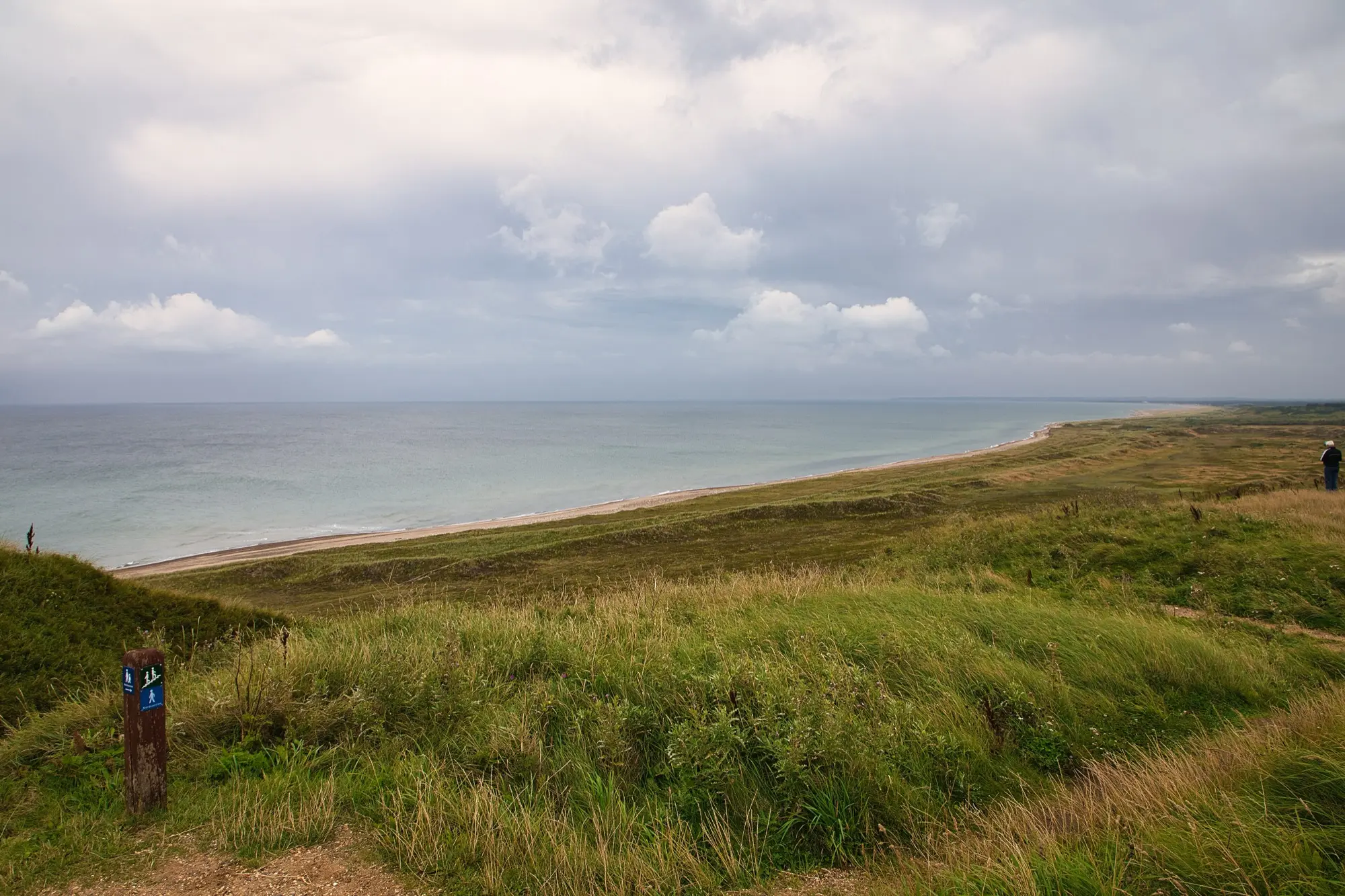

North Jutland's wild west coast runs from Rubjerg Knude, the lighthouse in the dunes that was moved 70 metres inland in 2019, through the surf village of Klitmøller (Cold Hawaii) to Thy National Park, Denmark's first national park, opened in 2008; Skagen and Aalborg are covered on their own pages.
Rubjerg Knude, the lighthouse in the dunes
VisitDenmark calls Rubjerg Knude, the lighthouse on cliff-high dunes on the north coast, one of Denmark's most iconic landmarks. When the lighthouse was built over 100 years ago, it stood 200m inland.
Work to move the lighthouse began on 14 August 2019, and on 22 October 2019 it was moved 70 m inland on specially built rails. According to Wikipedia's record of the lighthouse, the structure is 23 metres high and weighs 720 tonnes.
Thy National Park
The dune and heath landscape of Thy was selected on 29 June 2007 as the first national park in Denmark proper. Thy National Park opened to the public on 22 August 2008, situated in northwest Jutland along the coast from Hanstholm to Agger Tange.
The park covers 244 km² in all, running 55 km north to south and 5 to 12 km east to west. VisitDenmark calls Thy Denmark's wildest national park, featuring dunes, twisted forests and seaside villages. Life around the park is shaped by the North Sea at fishing villages such as Stenbjerg, where you can join fishing trips with local fishermen.
Cold Hawaii at Klitmøller
VisitDenmark calls Klitmøller, known as Cold Hawaii, a surfers' paradise with some of the best surfing conditions in Europe and a welcoming surf community, whatever your level.
The local surf club, NASA (North Atlantic Surf Association) in Klitmøller, was founded in 1997.
The bird cliffs at Bulbjerg
VisitDenmark says the limestone cliffs at Bulbjerg are the only rocky cliffs in North Jutland, formations 60 million years old.
The Bulbjerg cliffs serve as an important breeding ground for black-legged kittiwakes.
Løkken and the west coast beaches
VisitDenmark says the north is known for dunes and wide sandy beaches, with calmer beaches on the sheltered east coast.
At Løkken, VisitDenmark points to the white beach huts, holiday cottages and blue fishing boats pulled up on the sand.
Oysters on the Limfjord
The Limfjord is the stretch of water that separates North Jutland from the rest of mainland Denmark.
VisitDenmark says you can join the Danish Shellfish Center on the Limfjord for a two-hour hunt for some of Europe's last wild oysters. In addition to foraging trips on the water, VisitDenmark suggests stopping at the Limfjord islands of Fur and Mors for their geology.
Læsø and its seaweed roofs
On the island of Læsø you can see 19 cottages with traditional eelgrass roofs, many of them listed buildings.
Læsø is also known for its sea salt, and you can visit the saltworks to see how it is made.
Skagen and Aalborg
VisitDenmark lists 13 wonders in the north of Denmark, from landmarks losing their fight against the ocean to sights covered by sand, and you can see where they sit on the map of Denmark.
To the north, VisitDenmark calls Skagen a 700-year-old fishing village turned holiday town. Grenen is Denmark's northernmost point, where two seas meet. VisitDenmark says the current is too strong to swim.
Aalborg. Near Aalborg, Lindholm Høje is an Iron Age and Viking burial site over 1,500 years old.