
For unusual things to do in Denmark, you can see ten distinct oddities across the Denmark mainland and its shores: hunting Thomas Dambo's giant wooden trolls, the good luck troll's home town of Gjøl, the troll forest near Tisvildeleje, the lighthouse that was moved at Rubjerg Knude, the wandering dune of Råbjerg Mile, standing where two seas meet at Grenen, climbing Denmark's highest point, the extinction layer in Stevns Klint, driving across the sea floor to Mandø, and the fortress islands of Christiansø. You can locate these areas on a map of Denmark.
Hunt for Thomas Dambo's giant trolls
VisitDenmark says Thomas Dambo is the artist behind the Six Forgotten Giants, giant wooden trolls hidden in the forests and hills around Greater Copenhagen. Built from recycled wood with local volunteers, they turn a walk into a treasure hunt. VisitDenmark states the project has become a global hit, seen by hundreds of millions, and has inspired new troll trails across Denmark and beyond. The six sculptures stand in forests, meadows and by water in suburban Copenhagen.
Visit the good luck troll's home town
VisitDenmark says Thomas Dam, a Danish woodcarver, created the good luck troll in the 1950s, the wild-haired figure that became a global toy craze and inspired the Trolls films. You can learn about Dam's original creation in Gjøl, the town where he lived. VisitDenmark says the spiky-haired trolls originate in Denmark, not Norway.
Walk the troll forest near Tisvildeleje
VisitDenmark describes the troll forest near Tisvildeleje in North Zealand, where twisted trees bend around the paths and date back to the last years of the 18th century. VisitDenmark says the shapes come from the wind and pine worm larvae, and the forest has been protected for over a hundred years.
See the lighthouse that was moved at Rubjerg Knude
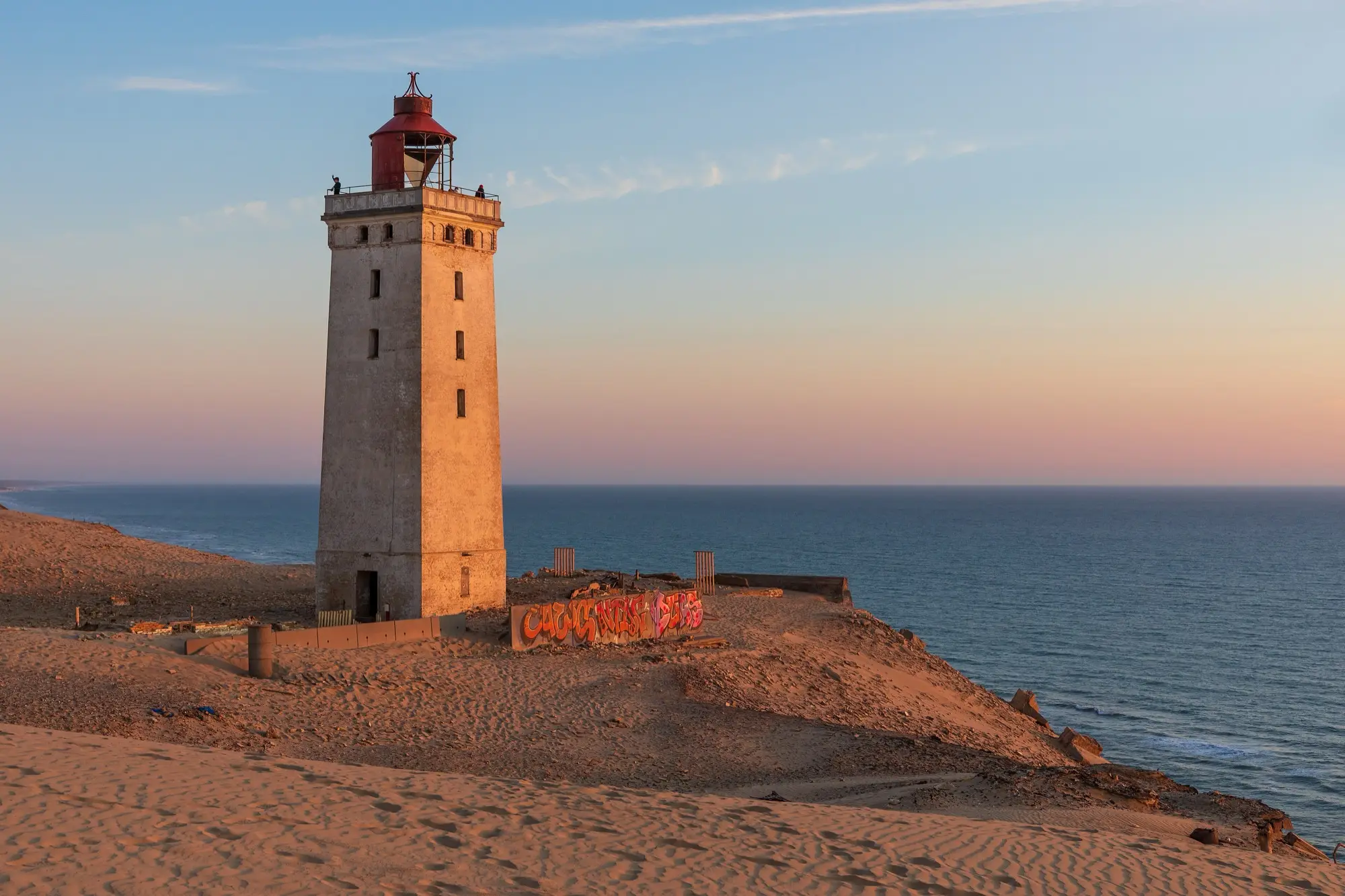
Lex says Rubjerg Knude lighthouse, 23 m tall, 12 km west of Hjørring, was first lit on the third day of Christmas in 1900. The lighthouse first stood free above the beach, but the west wind built a dune around it that in the end hid it from ships. Lex notes the light was given up on 1 August 1968. On 22 October 2019 the 700-tonne lighthouse was moved 70 metres in 4.5 hours, because it would otherwise have fallen into the sea.
Climb Råbjerg Mile, the wandering dune
Lex says Råbjerg Mile is a large, bare wandering dune 15 km south-west of Skagen. In more than 100 years of moving freely east it has travelled about 1 km. Lex describes the dune as a bare 1 km² heap of drifting sand that rises 20 m above the surrounding flats on its east side.
Stand where two seas meet at Grenen
Lex says Grenen is a gravelly, active sand spit 4 km north-east of Skagen, the outermost tip of Skagen Odde, which shifts with the weather. The waves of the Skagerrak and the Kattegat meet there in a crossing pattern. Lex records that Grenen is growing and has moved about 1 km north in the last 200 years.
Climb Denmark's highest point
Lex says Møllehøj, at 170.86 metres above sea level, is Denmark's highest natural point, ahead of Yding Skovhøj (170.77 m) and Ejer Bavnehøj (170.35 m). Møllehøj, 200 m north-west of Ejer Bavnehøj south of Skanderborg, was measured in 2005 as Denmark's highest natural point, 9 cm higher than Yding Skovhøj without its burial mound. Yding Skovhøj measures 172.54 m with its middle burial mound.
Touch the extinction layer at Stevns Klint
Lex says Stevns Klint is a sea cliff about 14 kilometres long on the east side of the Stevns peninsula, with frequent landslides. The cliff shows a black layer of fiskeler (fish clay), a few centimetres thick, that marks the Cretaceous-Tertiary boundary. Stevns Klint, with its famous fish clay layer, was added to UNESCO's World Heritage List in 2014. A landslide in 1928 tore the chancel off Højerup Church.
Drive across the sea floor to Mandø
Lex says you reach Mandø from the mainland along the Låningsvejen over the tidal flats at low tide, as the gravel road is flooded at high tide. You can read about exploring such Danish islands across the country. Lex reports that the link to the mainland is kept up by a special vehicle.
Sail to the fortress islands of Christiansø
Lex says Christiansø is an inhabited rocky island in the Baltic, 20 km north of Svaneke on Bornholm. Christian V had the rocky islands turned into a naval fortress in 1684. Christiansøfarten runs the boat to Christiansø from Gudhjem. Christiansøfarten says dogs and other animals may not be brought to Christiansø.