The rule people expect is a date range. Finland's is a date range and a condition, and the condition is the part that catches visitors out.
The rule
Winter tyres must be used in Finland from 1 November to 31 March, if the weather or the road conditions require it. Traficom's wording is "jos sää tai keli sitä vaatii" — if the weather or the driving surface demands it.
So there is no day on which your summer tyres become illegal and no day on which they become legal again. During those five months, the question is what the road is doing, and on 20 November in Rovaniemi, the road is doing quite a lot. Outside these months, summer tyres are allowed whatever the weather.
This matters in both directions:
- A warm early November in Helsinki does not oblige you to change. Traficom's own advice is to change a week early rather than a day late, but the law is about conditions.
- Snow on 15 April in Lapland is entirely normal, and you are outside the period. You are still responsible for driving a car that can stop.
Tread depth
| Minimum by law | Recommended | |
|---|---|---|
| Winter tyres | 3.0 mm | 5 mm in snow or slush |
| Summer tyres | 1.6 mm | 4 mm in the wet, to resist aquaplaning |
The 3.0 mm winter minimum is higher than in most of Europe, where 1.6 mm is the usual figure for all tyres. A set that is legal in Germany can be illegal here.
Studs
Studded tyres are allowed over the same 1 November to 31 March period, and at other times of the year when conditions are demanding — which is the provision that makes a May snowfall in Lapland legal to drive on studs.
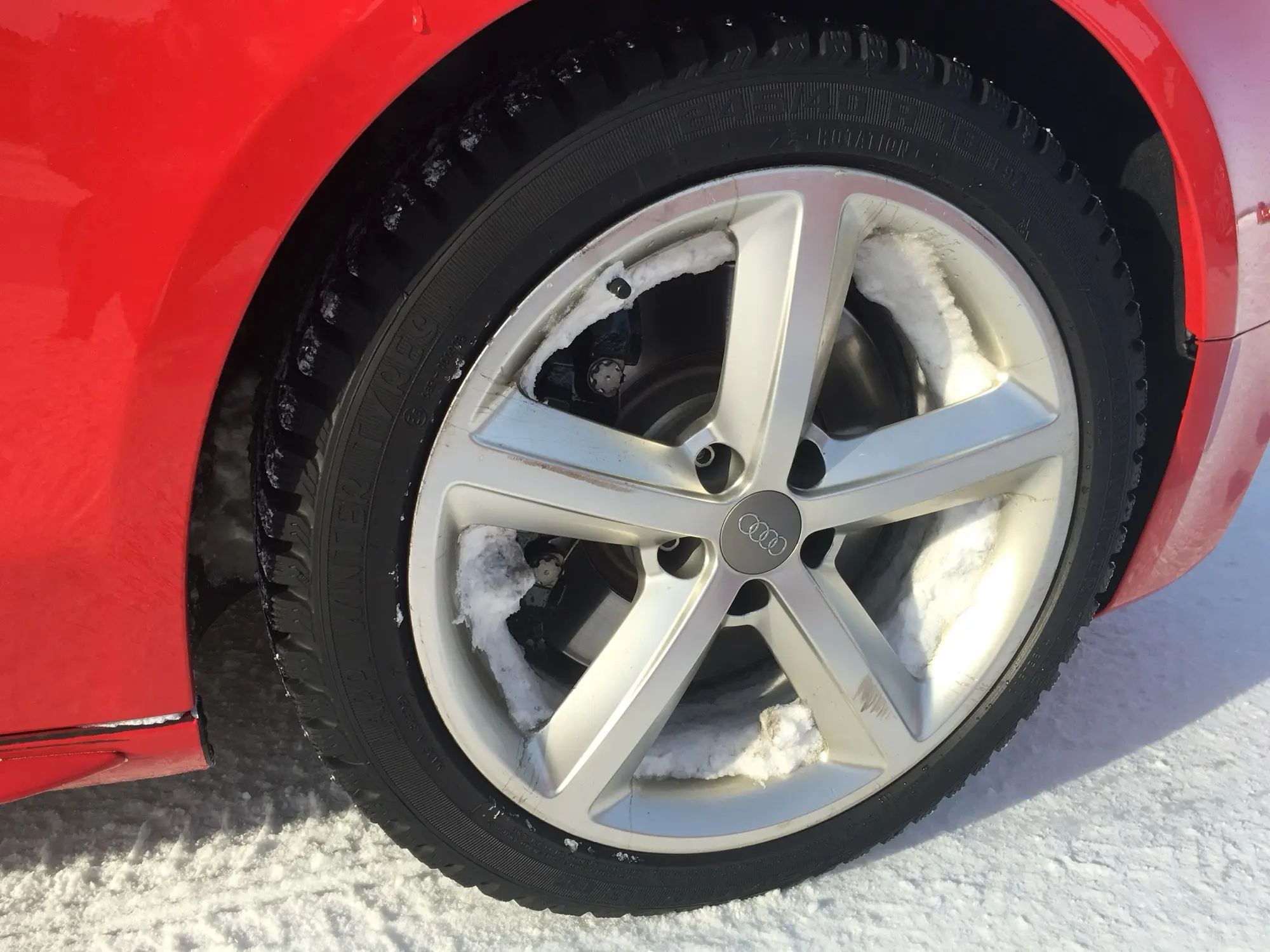
Studs grip better on ice; the non-studded winter tyre, called a kitkarengas in Finnish and a friction tyre in English, works better on packed snow and does less damage to the road surface. If you fit studs, all four tyres must be studded. Mixing tyre types on one car is not allowed.
The snowflake symbol, which is new
Since 1 December 2024, non-studded winter tyres on cars and vans must carry the three-peak mountain snowflake symbol — the little mountain with a snowflake inside it, moulded into the sidewall. The older "M+S" marking on its own is no longer enough.
This is the change that most English-language pages about Finland have not caught up with. If you are bringing your own car, look at the sidewall before you look at the calendar.
There is a separate ice-grip symbol. That one is not mandatory; it tells you the tyre has been tested for demanding winter conditions.
Which vehicles
Winter tyres with at least 3.0 mm of tread are required on:
- passenger cars up to 3.5 tonnes
- vans
- special-purpose vehicles up to 3.5 tonnes
- motorcycles, mopeds, tricycles and quadricycles
- trailers over 0.75 tonnes and up to 3.5 tonnes
If your car is registered abroad
Foreign-registered vehicles follow the same Finnish rules while they are in Finland. Driving in on Polish or German plates does not exempt you, and neither does a rental agreement signed in Sweden.
If you are hiring a car
A car hired in Finland in winter comes fitted with winter tyres; it is the hire company's obligation, not an extra you have to request. What is worth asking about is the block heater — the plug on the front bumper that warms the engine before you start it. In Lapland in January, that is the difference between a car that starts and one that does not, and hotel car parks have the sockets for it.
What the road is actually doing right now
The rule is about conditions, and conditions are measurable. Every route on this site shows the road surface temperature from Fintraffic's own roadside stations next to each camera, with the time it was measured:
- Oulu to Rovaniemi — the drive into Lapland
- Rovaniemi to Saariselkä and Inari — the Arctic highway
- Tornio to Kilpisjärvi — the most exposed driving in the country
A surface reading at or below 0 °C is the answer to 'do I need winter tyres today?', and it is a more useful answer than the date.
The same question, the other side of the world
Nevada has the opposite arrangement: no tyre period at all, and instead a chain control that closes a mountain pass to anything without chains within minutes of a storm arriving.