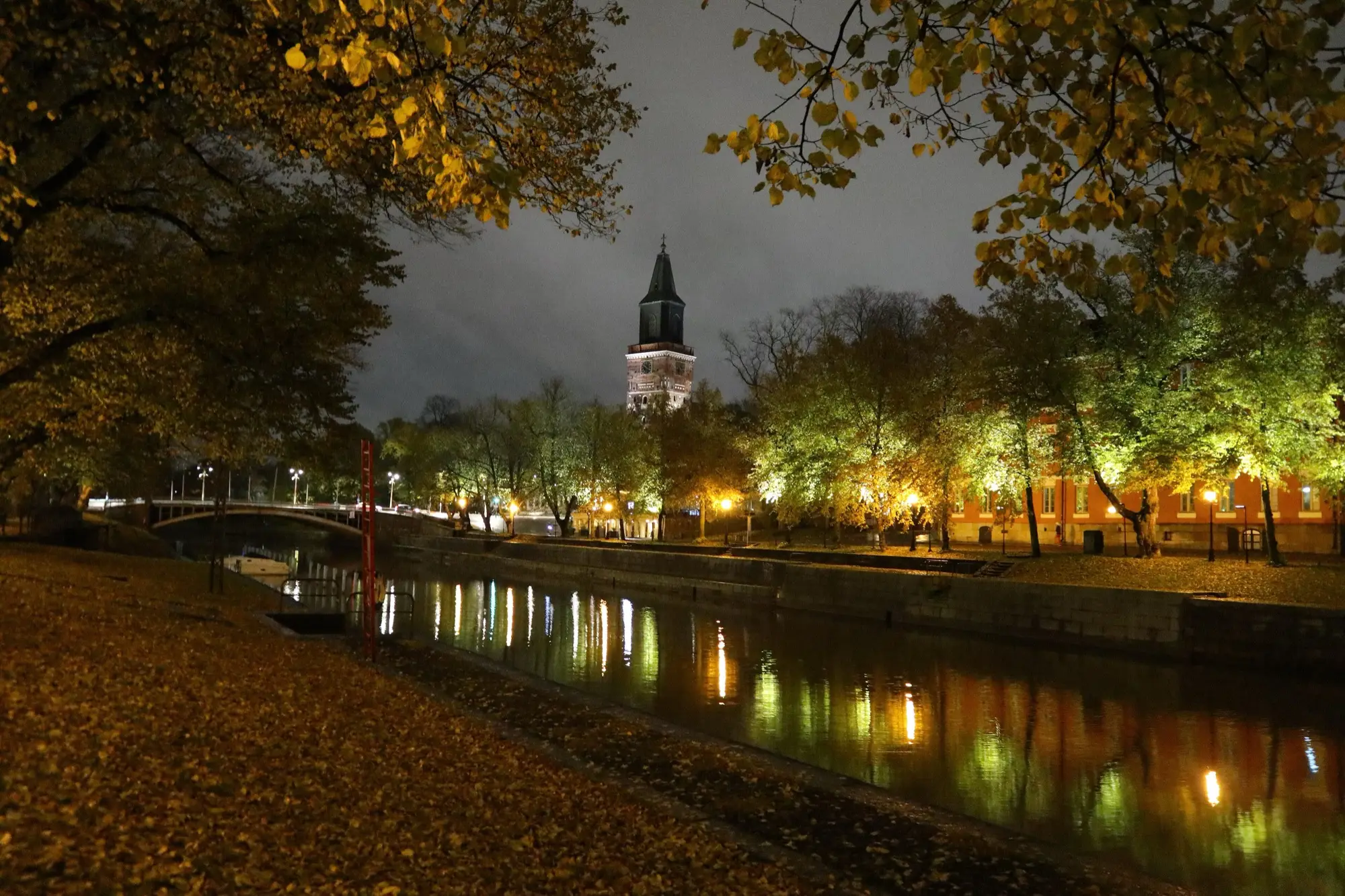

Turku is Finland's oldest city and former capital, set along the banks of the Aura River. When planning a visit, note that Turku Cathedral is closed for extensive renovation from 9 February 2026 to 2 December 2028. Key attractions, including medieval Turku Castle, the wooden quarter of Luostarinmäki, and regional transport out to Naantali, remain open to explore.
Getting to Turku and around on Föli
According to Visit Turku, there are hourly train services to Turku from Helsinki. Turku has three railway stations: Kupittaa, Turku central (Logomo), and Turku port. If driving from Helsinki, check the live road conditions and weather cameras along the E18 motorway before departure.
Local transport across the urban area is operated by Föli. The network covers seven municipalities: Turku, Kaarina, Raisio, Naantali, Lieto, Paimio, and Rusko. An adult single ticket paid by contactless card costs €3.15. If paying in cash directly on the bus, an adult single ticket costs €4.50. Every single ticket is valid for two hours on buses and water buses. On all Föli buses and water buses, you can pay using a contactless debit card, credit card, or mobile device. Tickets are also sold in the Föli app, and a physical Föli travel card can be loaded at local service points or via the Föli web shop. Anyone transporting a child in a pushchair or pram travels free of charge on Föli buses, and children under 7 travel free when accompanied by a paying passenger.
The layout of the city centres on the Aura River (Aurajoki). In the local Turku dialect, the two riverbanks are named täl puol jokke ("this side") and tois puol jokke ("the other side"). Locals use "this side" to describe the older eastern bank, where Turku Cathedral stands. "The other side" refers to the newer western bank, which contains Turku Castle and the central commercial marketplaces.
Turku Cathedral, Luostarinmäki and the 1827 fire
Turku Cathedral is the mother church of the Lutheran Church of Finland and serves as the country's national shrine. It was consecrated as a cathedral on 17 June 1300. The cathedral building is closed for renovation from 9 February 2026 to 2 December 2028. Outside, the cathedral bells remain an enduring national symbol: since 19 June 1944, during the Continuation War, the public broadcaster Yle has transmitted the noon chimes of Turku Cathedral across the country. Today, the chimes are heard on weekdays on Yle Radio 1 and Radio Vega.
On 4 September 1827, a catastrophic fire broke out at the house of burgher Hellmann. By the end of that day, three quarters of Turku had burned to the ground. The historic quarter of Luostarinmäki is the only continuous district of wooden residential houses that escaped the Great Fire of 1827. Its buildings, which are more than 200 years old, still stand on their original plots and show urban life in the 18th and 19th centuries.
Admission tickets for the Luostarinmäki museum area cost €12 for adults, €5 for children aged 7 to 15, and €6 for concessions. Entry is free for holders of the Finnish Museum Card (Museokortti).
Down the Aura river to Turku Castle and Forum Marinum
Moving downstream along the Aura River provides access to several historic sites. Crossing the river can be done aboard the Föri, a city ferry that carries passengers across free of charge between piers at Tervahovinkatu on the east bank and Wechterinkuja on the west bank. The ferry is electric and chain-driven. It does not run on 26 December, and during particularly hard winters, an ice bridge replaces it.
Near the riverbanks, the free Turku funicular runs from Linnankatu 55b (between Linnankatu and Graniittilinnankatu), carrying passengers up to the summit of Kakolanmäki hill. The hill is dominated by Kakola, a granite structure that Visit Turku calls Finland's most notorious prison. The prison closed in 2007, and the building now houses Hotel Kakola.
Further down towards the harbour sits Forum Marinum. Its largest museum ships float along the Aura River: the full-rigger Suomen Joutsen, the barque Sigyn, the gunboat Karjala, the minelayer Keihässalmi, and the passenger ship Bore. These ships are open to visitors in the summer months only. Among them, the full-rigger Suomen Joutsen was built in Saint-Nazaire in 1902 and remains the last surviving full-rigger in Finland.
At the mouth of the Aura River stands Turku Castle. Construction began in the 1280s on what was originally a rocky island. Court life in the castle reached its peak under Duke John during the 1550s and 1560s. Standard entry tickets cost €18 for adults, €8 for children aged 7 to 15, and €9 for concessions, with free entry for Museum Card holders. The castle runs the Little Knight Tour (Pikkuritarikierros), a guided tour for children aged five and over that concludes with a ceremony with royalty where participants become Little Knights of Turku Castle. This tour is run exclusively for pre-booked groups, in Finnish and Swedish, and cannot be joined as an ad-hoc public walk-up.
From the port area beyond the castle, vessels depart for the Baltic Sea; consult the Turku to Stockholm ferry guide for connections across to Sweden.
Turku Market Hall and eating in town
Turku Market Hall (Turun kauppahalli) on Eerikinkatu opened in 1896 and is the second oldest market hall in Finland. The hall operates from Monday to Friday between 8 am and 6 pm, and on Saturday from 8 am to 4 pm. It provides a central venue to sample regional specialities, outlined in the overview of Finnish food and lunch buffets.
Turku is also the home base of the Hesburger fast-food chain. Its operational roots date to 1966, when founders Heikki and Kirsti Salmela established Kievari Grilli in neighbouring Naantali. The business later relocated to Turku, where the first restaurant branded as Hesburger opened in 1980 inside the Hansa shopping centre.
Ruissalo, Kupittaa Park and Naantali
Outside the historic centre, Turku offers expansive parklands and water links. Kupittaanpuisto (Kupittaa Park) spans 24 hectares, making it the oldest and largest urban park in Finland. The grounds house an adventure park, a children's traffic park, a dedicated bird park, an outdoor swimming pool, a pavilion restaurant, and a sports hall.
To reach the island of Ruissalo, visitors can use public transit. In 2026, Föli's seasonal water buses ran daily from 9 May to 30 August, followed by services across three weekends in September. The water bus departs from Martinsilta in central Turku and sails to Ruissalo, making intermediary stops at Forum Marinum, as well as either Pikisaari on Hirvensalo or the Ruissalo shipyard. The water bus fare is the standard single transit price of €3.15 for an adult. Throughout the year, Föli bus 28 operates overland from central Turku straight to Ruissalo, running along the full length of the island.
For day excursions further afield, local Föli bus lines 6 and 6A depart from stops near Turku Market Square, running about every fifteen minutes to Naantali, the home of Moominworld. Beyond Naantali, the southwestern coast connects into regional island routes detailed in the Turku archipelago guide.