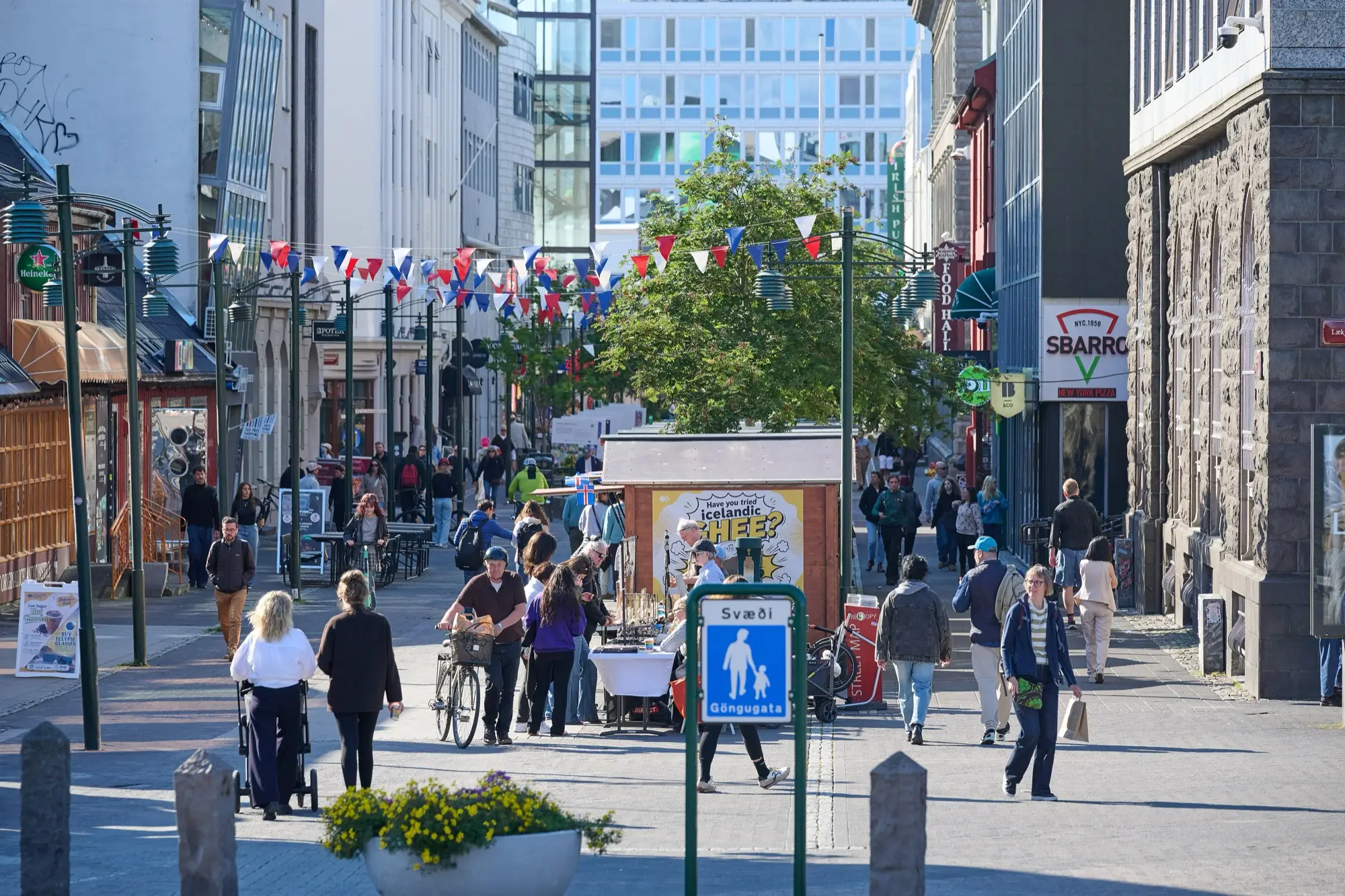
Eurostat puts Iceland's price level at 173.5 against an EU average of 100 for 2025. Full-time regular earnings averaged ISK 913 thousand a month in 2025, according to Statistics Iceland. Income tax is withheld at 31.49% to 46.29% less a personal tax credit of ISK 72,492 a month, while consumer prices rose 5.9% in the year to October 2026.
How expensive Iceland is
Eurostat's 2025 price level index for household final consumption expenditure puts Iceland at 173.5. By comparison, Switzerland scored 171.3, Denmark 139.7, the United States 133.3, Norway 128.6, the United Kingdom 123.3, Sweden 121.0 and Finland 120.8.
This index means Iceland's consumer prices sit 73.5% above the European Union average. Compared directly to Finland, Iceland is about 1.44 times as expensive, which makes it about 44% dearer. The figures were published by Eurostat in June 2026, with the next release scheduled for December 2026. For a tourist perspective on these metrics, read our guide on is Iceland expensive.
Price levels vary significantly depending on the category of goods or services:
| Category | 2025 price level index (EU = 100) |
|---|---|
| Alcoholic drinks and tobacco | 230.6 |
| Restaurants and accommodation | 173.2 |
| Food and non-alcoholic drinks | 155.8 |
| Transport | 147.5 |
Eurostat notes that all EFTA countries, Iceland included, had higher price levels for food than any EU country. This pattern also holds specifically for meat and dairy products, as well as for vegetables.
Inflation
Statistics Iceland reported on 29 October 2026 that the consumer price index was 5.9% higher in October 2026 than in October 2025.
Between September and October 2026, overall prices rose 0.44%. During that single month, fuel costs saw notable increases: diesel rose by 11.2% and petrol rose by 8.0%.
What people earn
Statistics Iceland published its 2025 earnings figures on 13 May 2026. Across all workers, average regular monthly earnings were 816 thousand ISK in 2025. For full-time staff, regular monthly earnings reached an average of 913 thousand ISK, while the median stood at 826 thousand ISK. When factoring in overtime and extra payments, mean total monthly earnings for full-time employees reached 1,058 thousand ISK. You can check more details in our overview of the average salary in Iceland.
About 64% of full-time employees earned less than the average figure, because the highest salaries pull the statistical mean upward.
Pay is governed closely by collective agreements. As stated by Ísland.is, collective wage agreements establish minimum wage rates for each role, factoring in age and accumulated length of service. You are permitted to negotiate better terms individually with your employer. However, employers and employees may not agree lower wages or worse terms than the collective agreement provides; any contract clauses that attempt to do so are legally invalid.
Income tax
Icelandic income tax is collected each month through a pay-as-you-earn withholding system managed by Skatturinn (Iceland Revenue and Customs). The applicable rates depend on total earnings across three primary thresholds:
| Monthly income bracket | 2026 withholding rate |
|---|---|
| 0 to 498,122 ISK | 31.49% |
| 498,123 to 1,398,450 ISK | 37.99% |
| Above 1,398,450 ISK | 46.29% |
Before tax is calculated, taxable income is determined by taking your gross salary and subtracting the pension fund premium. The mandatory pension deduction is 4% of employment income. In addition, voluntary pension contributions of up to another 4% are tax-deductible.
Once the gross tax figure is established, a personal tax credit of ISK 72,492 a month is deducted directly from the calculated tax amount. Full details on filing and deductions can be found in our guide to Iceland income tax.
Everyday prices
Daily transport and recreation costs follow standardized rates in the capital. An adult single fare on Strætó buses (the public bus network) in the capital area costs 690 kr. Paying contactless with a card or a phone incurs the exact same 690 kr. price.
For public recreation, admission fees apply at local swimming pools. Since 5 May 2026, a single swim at a Reykjavík city pool costs 1,500 kr. for adults and 400 kr. for children aged 10 to 17. Children aged 0 to 9 enter free of charge when accompanied by a guardian.
Goods and services carry value added tax (virðisaukaskattur). Iceland applies a standard VAT rate of 24% and a reduced rate of 11%. According to Skatturinn, the reduced 11% rate applies to hotel and guest rooms, campsites, food and catering, alcoholic beverages, and passenger transport, including sightseeing tours and whale watching.
Retail alcohol sales are strictly controlled. When buying alcohol outside bars and restaurants, customers purchase from Vínbúðin, the state-run monopoly stores. The operating authority ÁTVR notes that across all Nordic nations with the exception of Denmark, state monopolies hold the exclusive right to sell alcoholic beverages retail. Staff at Vínbúðin check credentials to confirm that every customer has reached the legal minimum age of 20.
For everyday food shopping, Visit Iceland points out that supermarket chains Bónus and Krónan often provide the lowest grocery prices. When it comes to drinking water, tap water is safe to drink everywhere in the country, so you do not need to spend money on bottled water. If you are planning a visit, see our guide on the cost of travelling in Iceland.
The local currency is the Icelandic króna (ISK). Payment cards are accepted almost everywhere, including inside taxis and on local buses, meaning you will hardly ever need cash.
Rent
Official rental market figures are collected and published by HMS (the Housing and Construction Authority) via its dedicated rent price viewer, leiguverðsjá. This page provides no rent figure because none could be checked against the verified sources.
When planning your relocation budget and organizing local paperwork, refer to our step-by-step walkthrough for moving to Iceland.