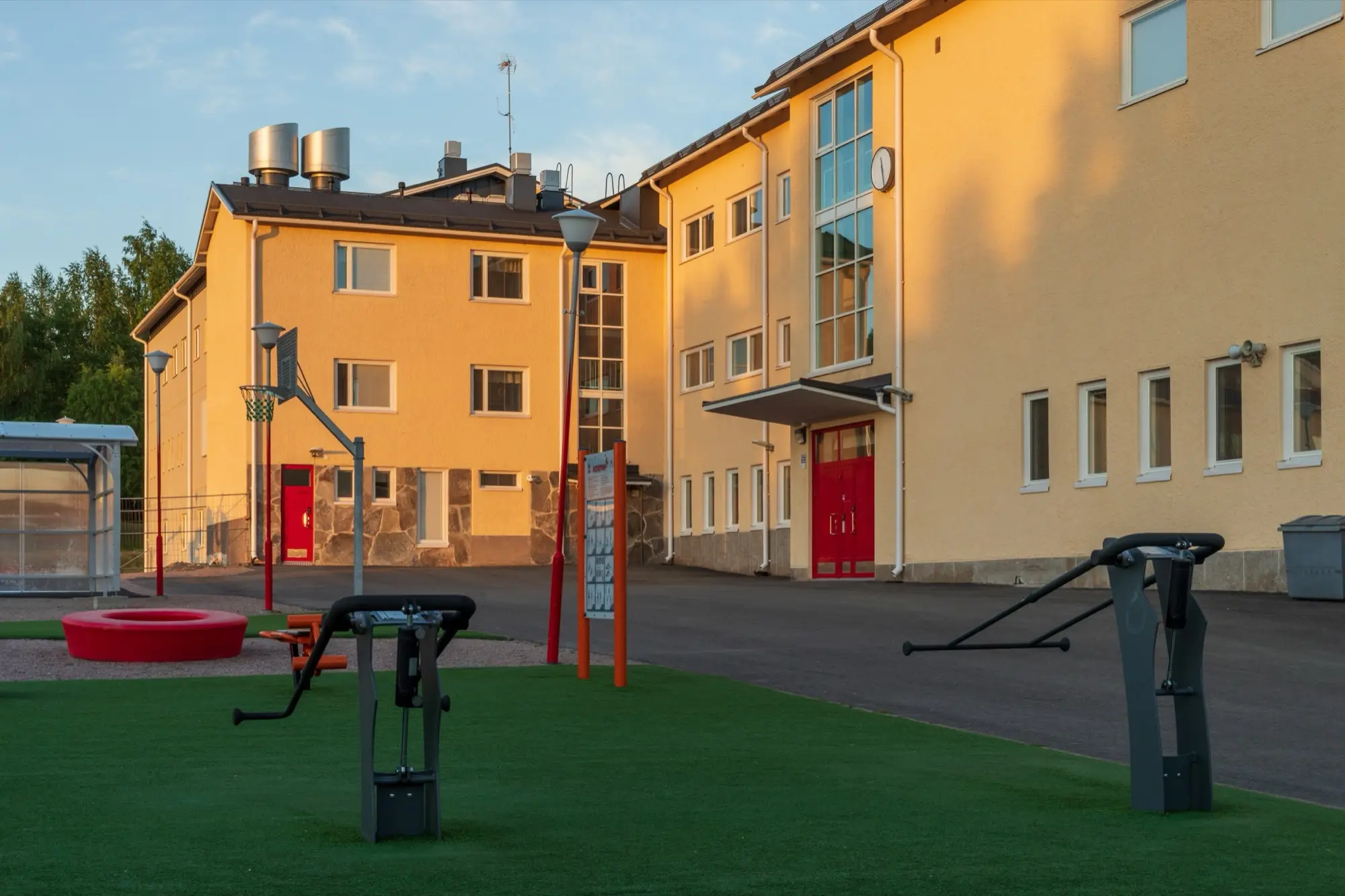
Comprehensive education in Finland is free for everyone, and the largest cities have international schools and schools where the language of instruction is English. Getting a place depends on an English test and often on where you live. Private schools teaching in another language under a special educational mission given by the ministry may charge reasonable fees.
Free or fee-paying — how English-language schooling works in Finland
In Finland, all children must receive comprehensive education (perusopetus). This schooling usually starts in the year a child turns 7, lasts nine years, and is free for everyone. You can read more about the overall structure in our guide to the Finnish education system.
Under the Basic Education Act, a school's language of instruction is Finnish or Swedish. However, in a separate teaching group or school, the teaching may be given mainly or entirely in another language. The Basic Education Act makes teaching, textbooks and other learning materials, as well as a daily meal, free of charge for pupils.
The same section of the act lets a private organisation or foundation charge pupils reasonable fees, provided it teaches in a language other than Finnish or Swedish under a special educational mission granted by the ministry. The largest cities have international schools and schools where the language of instruction is English, and details are usually published on each city's official website. There are also private schools in Finland that teach in German, French, or Russian.
Helsinki — the city's English-language schools and how to get a place
In Helsinki, the city's English-language education is offered at Ressu Comprehensive School, Maunula Primary School, Maunula Comprehensive School, and Kulosaari Comprehensive School. Swedish-language city schools do not offer English-language education. The syllabus for mother tongue and literature is taught in Finnish, and the learning objectives and content remain identical to standard Finnish-language education. English-language instruction at Ressu Comprehensive School follows the International Baccalaureate (IB) frame of reference.
Applicants need native or near-native English proficiency but do not require prior Finnish skills, though applicants for grades 8 and 9 also need spoken Finnish at level A1. Through continuous admission, pupils moving to Helsinki during comprehensive school who have studied in English-language education elsewhere in Finland or abroad within the last 18 months can apply for grades 1–9. A family's home address must be officially registered in Helsinki before taking the language test; registering your address is part of the first steps after moving to Finland. Studying English merely as a single subject is not enough to qualify.
Helsinki holds language tests once a month at the schools, but not in June or July. The test must be taken on-site and cannot be completed remotely. Grade 1 applicants are not expected to read or write. According to the City of Helsinki, the remaining test dates for the 2026–2027 school year include:
- 5 November 2026
- 3 December 2026
- 7 January 2027
- 4 February 2027
- 4 March 2027
- 1 April 2027
- 5 May 2027
Ressu Comprehensive School also runs a temporary admission class for children staying in Finland for no more than two years. There is no English test for this class, applications are accepted all year and processed every two weeks, and the placement ends automatically after two years. This temporary class is strictly for children who live in Helsinki temporarily, are not Finnish citizens, were not born in Finland, and do not meet the requirements for studying in Finnish.
Helsinki also provides bilingual comprehensive education combining Finnish with English, Swedish, Spanish, Chinese, Northern Sámi, Russian, or Estonian. Helsinki's education guidance answers questions regarding English-language basic education at [email protected] or by phone at +358 9 310 15087.
Espoo and Vantaa
In Espoo, municipal English-language education is based at Espoo International School and Kivimies International School for pupils living in Espoo and Kauniainen. Applicants can seek either a permanent or a temporary study place. Unlike a standard placement at a local neighbourhood school, pupils have no subjective right to a place in English-language schooling. Furthermore, pupils admitted to Espoo's English-language education are not eligible for the municipal school transport benefit. Espoo International School is authorised as an IB school and offers the Middle Years Programme in grades 7–9.
In Vantaa, basic education delivered mainly in English takes place at Kaivoksela School (grades 1–6), Rekolanmäki School (grades 1–6), and the International School of Vantaa (grades 1–9). Pupils completing primary education at Kaivoksela or Rekolanmäki can transition into grades 7–9 at the International School of Vantaa without submitting a separate application.
For grade 1 entry at Kaivoksela and Rekolanmäki, children need no English and take a language readiness test in English or Finnish. Applicants for grades 2–6 take an English test, whereas all pupils applying to the International School of Vantaa must sit an English entrance exam. Children living in Vantaa receive priority, and applicants from other municipalities may only be admitted if spare places remain. For the 2027–2028 school year, Vantaa's application periods for grade 1 and grade 7 close on Friday 15 January 2027. In that same school year, a new IB programme begins for grade 1 at the International School of Vantaa.
Tampere, Turku, Oulu and Jyväskylä
The Finnish International School of Tampere (FISTA) selects first-grade pupils via an English test lasting approximately one hour, consisting of an interview and listening tasks without reading or writing. A child must achieve at least 60% overall and score points in every single section; the first-grade test can only be taken once. Applications for grade 1 at FISTA for the next school year run from 4 to 20 January 2027, with tests held on 3–4 February 2027 and results issued by 18 February 2027. FISTA offers a minimum of 20 and a maximum of 88 first-grade places annually. If applications exceed capacity, residents of Tampere receive priority. Having siblings at the school or living in close proximity does not grant any admission priority.
In Turku, basic education in English is provided by Turku International School, which teaches mainly in English and adheres to the national core curriculum. You apply using the online form on the school's website. The school caters to children with adequate English proficiency to complete their studies, including international families relocating to the Turku region and Finnish families returning from abroad.
Oulu International School admits pupils based on grade-level minimum scores in an English test as well as available vacancies. Entrance tests are held only twice per year, in February and August (specifically 19–20 February and 7 August in 2026). Since spring 2021, Finnish children living in Finland must also pass a Finnish language test to gain admission.
In Jyväskylä, comprehensive schooling can be completed in English at Kortepohja School for grades 1–6 and Viitaniemi School for grades 7–9. Language proficiency is tested before admission. Jyväskylä's English classes are intended mainly for pupils who have lived abroad and begun their schooling in English. The supplementary application period for grades 7–9 at Viitaniemi runs from 21 October to 4 November 2026, and for grades 2–6 at Kortepohja from 11 to 24 January 2027. Pupils from other municipalities can apply to Jyväskylä's English teaching if their home municipality commits to pay, and the parents then cover school travel.
Private and state-funded schools that teach in English or another language
The City of Helsinki lists 15 private and government-funded schools. These include:
- The English School of Helsinki
- The European School of Helsinki
- The International School of Helsinki
- The French-Finnish School
- The German School
- The Finnish-Russian School
The City of Helsinki specifies that private comprehensive education providers not included on its official list are not authorised, and any education they provide is comparable to home-schooling.
The English School of Helsinki charges a tuition fee of EUR 673 a year, the same for all grades, which includes a daily warm lunch. The International School of Helsinki is a private institution operating on tuition fees; it receives grants from both the Finnish and United States governments, though these cover only part of its total operating costs. It offers the IB Primary Years, Middle Years, and Diploma programmes. The European School of Helsinki teaches pupils up to the European Baccalaureate.
Finnish lessons, and if your child does not get a place
In Vantaa's English-language schools, all subjects are taught in English except for Finnish language lessons, which are delivered in Finnish. If you want to prepare your family beforehand, you can look into ways of learning Finnish.
If a child is not accepted into an English-language school in Helsinki, they should enrol in preparatory education (valmistava opetus) or their local school (lähikoulu), with assistance provided by the city. Preparatory education for basic education lets a child study Finnish (or Swedish) and some other subjects. Children are enrolled in the local school, usually the one closest to home. You can apply to another school, but a place there is not always possible.
After grade 9 — English-language upper secondary school
In 2027, Turku will open its first municipal English-language general upper secondary school (lukio).