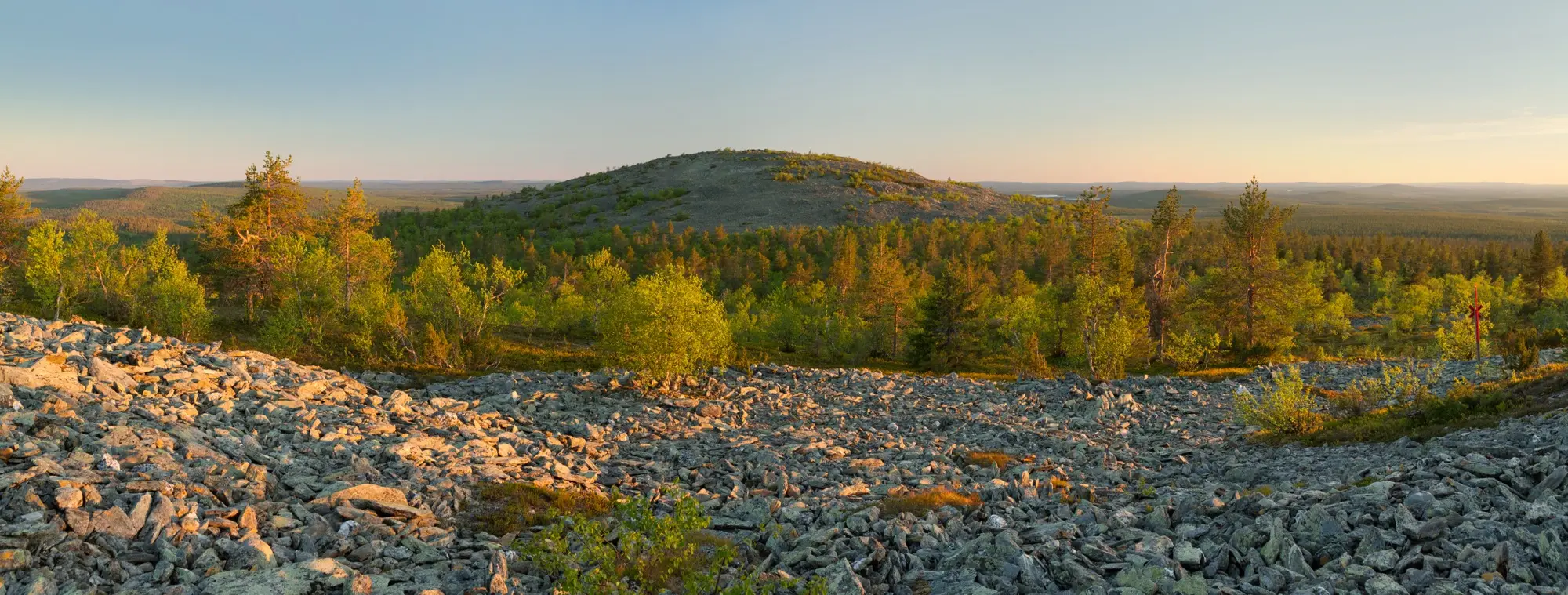

The midnight sun shows north of the Arctic Circle. Among the places this site tracks, it lasts longest in Utsjoki (16 May to 26 July) and shortest in Rovaniemi (6 June to 5 July). These dates require an unobstructed view towards the north.
What the midnight sun is and how far south you see it
According to SMHI, Sweden's meteorological institute, the midnight sun occurs when the sun is above the horizon all day and does not set. Simplified, this happens north of the northern polar circle at about 66.5°N. On the circle itself, it occurs on one day a year at the solstice, and the further north you travel, the longer the phenomenon lasts.
The atmosphere bends sunlight upward by roughly half a degree at the horizon, and the disc of the sun spans another half degree. Because of this refraction, extra days of midnight sun occur at the Arctic Circle. Rovaniemi's town centre sits just south of the Arctic Circle and still has 30 days of midnight sun because of refraction. Arctic Norway notes that the midnight sun is visible up to 100 km south of the Arctic Circle in Helgeland from its islands and mountains. When asked why Norway is called the land of the midnight sun, the tourist board explains that while the phenomenon appears in all countries above the Arctic Circle, northern Norway is much more accessible than most other Arctic areas. For those visiting other Nordic regions, only Grímsey gets the midnight sun in Iceland.
1. Utsjoki: 16 May to 26 July
On our daylight page for Utsjoki, the midnight sun stays continuously above the horizon for 72 days, from 16 May to 26 July. Utsjoki sits at 69.91°N in the Teno (Tana) river valley along the Norwegian border just south of Nuorgam, making it the northernmost municipality in Finland and the European Union.
A daily bus runs from Ivalo to Utsjoki, Karigasniemi, and Nuorgam, with timetables available on Matkahuolto's website. The drive from Ivalo Airport takes 2 hours. During this season, salmon anglers on the Teno fish around the clock in the cool night hours, and blackout curtains are essential in every cabin.
2. Tromsø: 18 May to 24 July
On our daylight page for Tromsø, the midnight sun stays above the horizon for 68 consecutive days, from 18 May to 24 July. The city sits 350 km north of the Arctic Circle.
Tromsø Airport Langnes is about 5 km from the city centre, served by several daily flights from Oslo that take about 1 hour 50 minutes. You do not see the midnight sun in downtown Tromsø, but a quick walk onto the bridge gives a good view. Tromsø's cable car provides a full view of the city, the surrounding mountains, the waterways, and the midnight sun.
3. Kilpisjärvi: 20 May to 21 July
On our daylight page for Kilpisjärvi, the midnight sun holds the sky for 63 consecutive days, from 20 May to 21 July.
Eskelisen's Rovaniemi-Tromsø bus route runs via Kittilä, Muonio, Kilpisjärvi, Skibotn and Nordkjosbotn; the season it lists runs daily from 20 November 2026 to 31 March 2027. The midnight sun lights Lake Kilpisjärvi and the Three-Country Cairn trail to Treriksröset (three-country stone, the boundary cairn where Finland, Sweden, and Norway meet).
4. Abisko: 24 May to 18 July
On our daylight page for Abisko, the midnight sun stays above the horizon for 56 consecutive days, from 24 May to 18 July.
Abisko is 93 km north-west of Kiruna along the E10, a drive of just over an hour. Both SAS and Norwegian fly between Stockholm Arlanda and Kiruna all year round, taking around 90 minutes. You can also take SJ's night train from Stockholm to Narvik and sleep part of the way. Trains stop directly opposite the tourist station at Abisko Turiststation, roughly a 5-minute walk from reception. On our daylight page for Kiruna, the midnight sun stays continuously above the horizon for 50 days, from 27 May to 15 July, over the Kebnekaise massif and the Torne river valley. In Abisko, the sun illuminates the Kungsleden trailhead and Lapporten, the U-shaped mountain notch. The Swedish Tourist Association opens the Aurora Sky Station above Abisko for two separate periods, one in the dark winter and one during the midnight sun, with a closed period between them, requiring visitors to check operating hours before booking.
5. Rovaniemi: 6 June to 5 July
On our daylight page for Rovaniemi, the city experiences 30 days of continuous midnight sun, from 6 June to 5 July. The town centre lies at 66.50°N, just south of the Arctic Circle marker at Napapiiri.
Rovaniemi Airport sits 10 km from the centre. VR's night trains run directly to Rovaniemi, Kolari, and Kemijärvi, carrying passenger cars along. Santa Claus Village sits 8 km north of the city centre along highway 4 towards Ivalo.
Saariselkä, Levi and Oulu
On our daylight page for Saariselkä, the midnight sun begins on 24 May and ends on 18 July, providing a 56-day span for hikers on Sokosti and Kiilopää. The settlement is reached via Ivalo Airport, Finland's northernmost airport, which receives daily flights from Helsinki.
On our daylight page for Levi, Levi sits roughly 140 km north of the Arctic Circle and records 50 days of midnight sun from 27 May to 15 July. Kittilä Airport is located 15 km from Levi.
Oulu stands 165 km south of the Arctic Circle, which denies it a true midnight sun. On 21 June in Oulu, the sun rises at 02:18 and sets just after midnight at 00:21, producing 22h 02m of daylight.
Midsummer under the midnight sun
The midnight sun plays a major role in midsummer festivities across northern Finland. Lighting bonfires, known in Finnish as kokko, and bathing in saunas are standard traditions for celebrating midsummer. In Finnish, midsummer is called juhannus and falls at the end of June. The University of Helsinki Almanac Office designates Midsummer Day, which is also the Day of the Finnish Flag, as the Saturday falling between 20 and 26 June. For celebrations across the border, read about midsummer in Sweden.