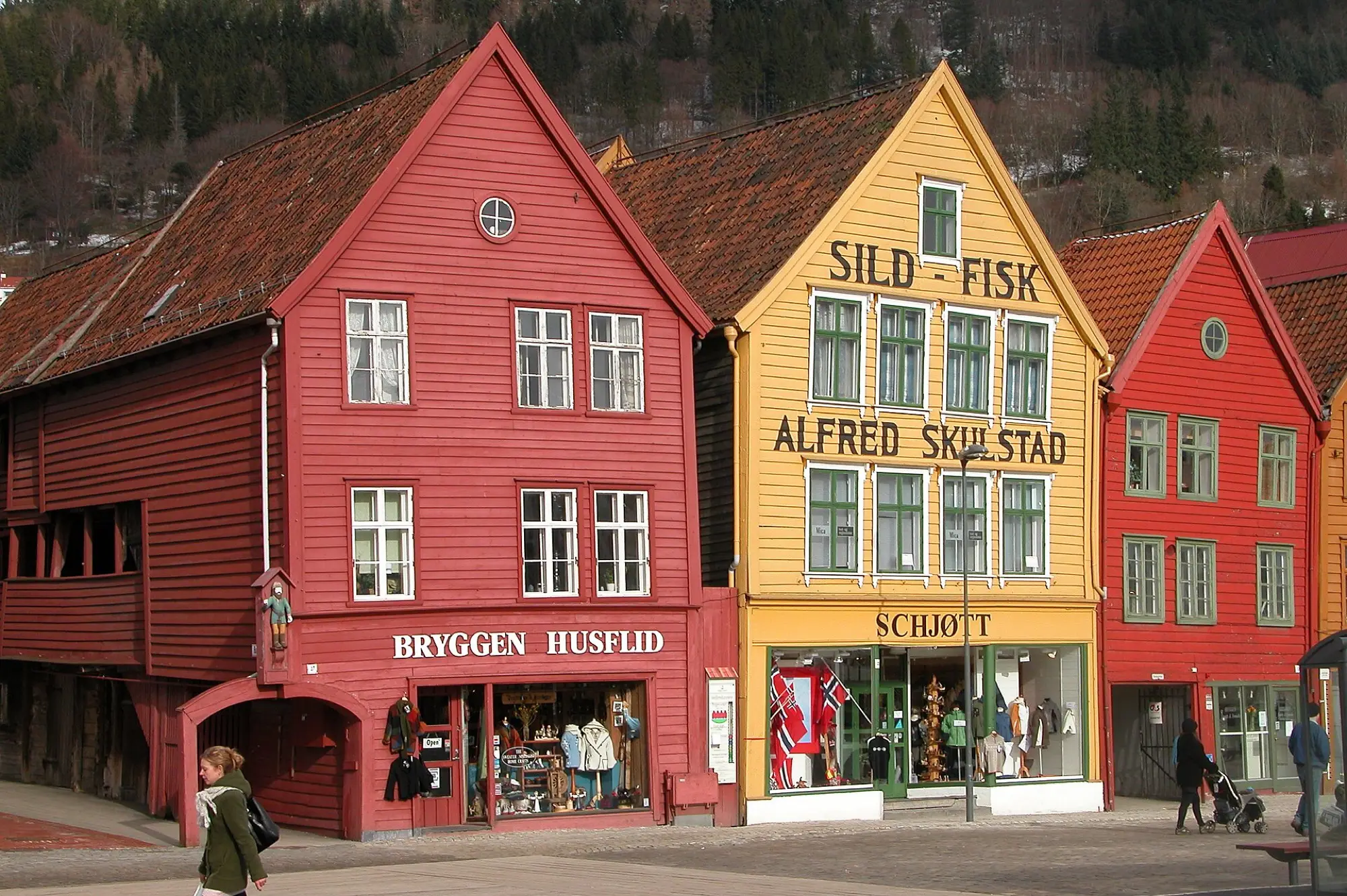

Bryggen is the old Hanseatic wharf on the east side of Vågen, Bergen's central harbour, on the UNESCO World Heritage List since 1979, and free to walk around. Its wooden buildings date from after the fire of 1702. Bryggens Museum and the Hanseatic Museum's Schøtstuene charge entry, and the Hanseatic Museum's own building, Finnegården, is closed for restoration until 2027.
What Bryggen is, and why it is on the UNESCO list
UNESCO describes Bryggen as the old wharf of Bergen, a reminder of the town's importance in the Hanseatic League's trading empire from the 14th to the mid-16th century. Bryggen was inscribed on the World Heritage List in 1979 under criterion (iii), because it bears the traces of social organisation and the use of space in a quarter of Hanseatic merchants dating back to the 14th century.
The Hanseatic League had four overseas offices, and Bryggen is the only one preserved today. Some 62 buildings remain, enough to show how a colony of bachelor German merchants lived and worked. These buildings stand in long, narrow rows facing the harbour, separated by narrow wooden passages. Their layout places offices and dwellings at the front, warehouses in the middle, and assembly rooms, kitchens and fireproof stone cellars at the back.
Stiftelsen Bryggen (the Bryggen Foundation) says Bryggen is not a museum but a heritage site in use, a living district with shops, artists' studios, craft businesses, restaurants and offices. Bryggen is privately owned, and most of the buildings belong to the Bryggen Foundation, which was set up in 1962 to preserve Bryggen.
From the Hanseatic office to the fires of 1702 and 1955
Bergen was founded by King Olav Kyrre around 1070, and through the Middle Ages the oldest part of the town and its economic centre lay on the Bryggen side of the harbour. By the middle of the 1200s the area was densely built, with about 30 gårds (rows of long buildings). Bryggen became one of the Hanseatic League's offices abroad, alongside Novgorod, Bruges and London, and the Germans came to dominate Bryggen for almost 400 years. The trade rested on exporting stockfish (dried cod from northern Norway) and importing grain. The German office was a community of men with its own jurisdiction and school system, and its members were not to mix with the townspeople, least of all the town's women.
A Norwegian office replaced the German one on 17 October 1754, kept the Hanseatic rules and German as the everyday language, and was dissolved on 31 December 1899. Bryggen has burned many times and been rebuilt after every fire on the old plan; its appearance today dates from after the fire of 1702.
Up to 1910 the southern half of Bryggen was torn down and replaced with five-storey brick buildings. The northern half was protected in 1927, but its decay went on. An explosion in the harbour in 1944 wrecked large parts of the roofs. The fire of 1955 burned down half of what was left. Before anything new could be built, the burned site had to be excavated, and the excavations took 13 years; what they found slowly changed opinion in favour of keeping Bryggen.
Stiftelsen Bryggen and Bryggens Venner (the Friends of Bryggen) were founded in 1962, and in 1963 the city council adopted a plan that the buildings were to be kept and restored. Some buildings at the back were moved in 1965 to make an open area for fire emergencies; the layout has not been changed since. The Bryggen Project, a long-term programme to monitor, safeguard and restore both the buildings and the archaeological deposits, was set up formally in 2000.
Walking the passages behind the front
Walking around Bryggen and looking at its World Heritage buildings costs nothing. Behind the Bryggen front are narrow passages with small shops, galleries and artists' studios. The passages and houses are called Holmedalsgården, Bellgården, Jacobsfjorden, Bredsgården and Bugården; you can start at Holmedalsgården at one end or Bugården at the other. In old storerooms that once held salted cod, local designers and artists now sell textile design, jewellery, illustration, knitwear, photography and books.
The typical Bryggen building is an uninsulated storehouse of 2 to 3 storeys, with open galleries towards the passage and a core of log-built storerooms. The stone cellars at the back have thick walls and metal doors and were traditionally used as fireproof buildings. UNESCO notes that restaurants and tourist businesses have changed the feel of the front facades, while the Hanseatic atmosphere can still be sensed further back.
There are no toilets on Bryggen. Bryggen is only partly accessible for wheelchair users; the cobbles at the front are hard for lighter wheelchairs, the wooden walkways are easier, and most galleries and shops are not accessible.
Bryggens Museum: what was dug up after 1955
Bryggens Museum shows the finds from the 13-year excavation after the 1955 fire, which uncovered hundreds of thousands of objects from everyday life in medieval Bergen, including runic inscriptions. The museum was established in 1976. It is built over the remains of Bergen's oldest buildings, from the first half of the 1100s, which are part of the permanent exhibition.
The museum is at Dreggsallmenningen 3, at the northern end of Bryggen. Bryggens Museum is open daily 10:00 - 17:00 from 12 January to 30 December. It is closed on 17 May, 23 to 26 December and 31 December.
Entry costs NOK 170 for an adult and NOK 85 for a student; children aged 0 to 17 go free. The Bergen Card gives 50% off entry to Bryggens Museum. The museum is wheelchair accessible and has a shop and café. A 45-minute guided tour of the exhibition starts at the museum reception daily at 15:00 and costs NOK 200 for an adult and NOK 100 for a child.
The Hanseatic Museum: Finnegården is closed, Schøtstuene is open
The Hanseatic Museum's main building, Finnegården, was built in 1704 and has been a museum since 1872. Its restoration began on 1 October 2018 and runs until the beginning of 2027, and Finnegården cannot be visited while it lasts. The wooden foundation had to be replaced and the building raised to prevent future damage; the facade will be a true copy of today's. The restoration has a budget of NOK 337.9 million. The museum says the scaffolding has come down and the restoration is to be finished in 2026, but Finnegården will not reopen until 2027, with a new exhibition.
Meanwhile the museum has moved to Schøtstuene at Øvregaten 50, the Hanseatic merchants' assembly halls, part of the museum since 1938. Schøtstuene consists of four assembly rooms and two cook houses, with exhibitions on Hanseatic life and on the Finnegården restoration. Under one of the cook houses, a stone house ruin from about 1280 can be seen through a glass floor. There is also a temporary ticket office, an introductory exhibition and the museum shop on Bryggen itself.
Schøtstuene is open Monday to Sunday 10:00 - 16:00 from November to 23 December 2026 and closed 24 to 26 December 2026. From 1 to 14 January 2027 it opens only on Saturday and Sunday, 10:00 - 16:00, and from 15 January to the end of March 2027 daily 10:00 - 16:00. An adult ticket costs NOK 160 including a guided tour, a student NOK 80, and children under 18 go free; with the Bergen Card it costs NOK 130. The guided tour should be booked in advance. From November to March, guided tours start at Schøtstuene on Saturdays and Sundays at 11:00 in Norwegian and at 12:00 and 14:00 in English, and walk on to Bryggen.
Bryggen Guiding: the 90-minute walk from the museum
Bryggen Guiding is a guided walk in English of about 90 minutes, run by Bryggens Museum with the Hanseatic Museum, that includes entry to Bryggens Museum and Schøtstuene on the same day. It starts at Bryggens Museum, passes St Mary's Church, Bergen's oldest surviving building, goes into Schøtstuene, then through the wooden buildings and to the remains of the medieval wine cellar.
From 28 March to 30 September the walk runs daily at 11:00 and 13:00. From 1 October to 30 December, and from 1 February to 27 March, it runs daily at 11:00. There is no walk on 1 May, 17 May or 23 to 26 December.
The walk costs NOK 390 for an adult, NOK 340 with the Bergen Card, NOK 200 for students and children aged 3 to 17, and is free for children under 3. It is best suited to adults, partly outdoors, and because of cobbles and limited access it may not suit people with mobility problems or strollers.
The visitor centre and the Theta museum
Stiftelsen Bryggen runs a staffed visitor centre in the Jacobsfjorden passage. It shows the traditional tools used to build Bryggen, the same kind still used to restore it, and sells books on Bryggen, including the foundation's guidebook. The visitor centre is open Monday to Sunday 10-17 in June, July and August, and Monday to Friday 10-16 in May and September.
The Theta museum is the reconstructed headquarters of the Theta group, young resistance members who ran a secret radio link to England from a small room in Enhjørningsgården on Bryggen between 1940 and 1942. In June, July and August it is open on Tuesdays, Saturdays and Sundays 14-16, with tours every 30 minutes at 14.00, 14.30, 15.00 and 15.30; the rest of the year tours are by arrangement with Bryggens Venner. Entry costs NOK 100 for an adult and NOK 50 for a student; children under 12 go free. It holds 12 to 15 people at a time.
What the Bergen Card saves at Bryggen
The Bergen Card costs NOK 400 for an adult for 24 hours (2026 price). Details on overall value appear in our Bergen Card price guide. At Bryggen, the card offers discounts across the museums and the joint tour:
| What | Adult | Bergen Card | Children |
|---|---|---|---|
| Bryggens Museum entry | NOK 170 | NOK 85 | Free (aged 0 to 17) |
| Bryggens Museum 45-min tour | NOK 200 | not stated | NOK 100 |
| Schøtstuene entry with tour | NOK 160 | NOK 130 | Free (under 18) |
| Bryggen Guiding (90-min walk) | NOK 390 | NOK 340 | NOK 200 (aged 3 to 17) / Free (under 3) |
| Theta museum | NOK 100 | not stated | Free (under 12) |
With the Bergen Card's 50% off, Bryggens Museum costs an adult NOK 85 instead of NOK 170. At Schøtstuene the Bergen Card saves an adult NOK 30 (NOK 130 instead of NOK 160). On the Bryggen Guiding walk the Bergen Card saves an adult NOK 50 (NOK 340 instead of NOK 390).
Paying separately, an adult visiting both Bryggens Museum and Schøtstuene pays NOK 330. The Bryggen Guiding ticket, which includes entry to both museums, costs NOK 60 more than the two entry tickets bought separately. The card's saving at the two museums together is NOK 115 for an adult, well short of the NOK 400 a 24-hour card costs, so Bryggen alone does not pay for the card.
Visiting with care
Bryggen is a smoke-free area; the owners' association and Stiftelsen Bryggen point to the fires that have struck it through history, the last large one in 1955, and Visit Bergen notes that smoking is not permitted at or around Bryggen. The foundation's fire rules ban candles, torches and any other open flame, ban smoking in all the buildings and passages, and allow no premises to be used for overnight stays.
Visit Bergen reminds visitors that Bryggen is private property listed as a World Heritage site, and asks them to be extra mindful to preserve it. Stiftelsen Bryggen has counted passings at the main entrances since 2004; the counts include people who work there, and even with them taken out the yearly figure in recent years approaches 2 million.
In summer Bryggen can become very crowded during the day. Visit Bergen asks summer visitors to come to Bryggen outside the busiest hours, to help conserve it, and suggests coming in the evening. The view of Bryggen from the other side of the harbour, for example from Strandkaien, is Visit Bergen's other suggestion.
How to get to Bryggen
In Bergen city centre walking is the easiest way, and parking in the city centre can be hard. The wharf is close to other things to do in Bergen: Visit Bergen lists Bryggens Museum 114 m, the Hanseatic Museum and Schøtstuene 139 m, St Mary's Church 189 m and the Fish Market 300 m from Bryggen.
The Flybussen airport bus takes about 30 minutes from Bergen Airport Flesland, costs NOK 189 bought in advance online or NOK 220 on the bus, and stops at Bryggen. Light rail line 1 (Bybanen) runs from the airport terminal to the centre of Bergen in about 45 minutes for NOK 51, and is free with the Bergen Card. Many buses stop at Bryggen, the nearest stop to Schøtstuene.
Frequently asked questions
How much does it cost to visit Bryggen?
Walking around Bryggen and looking at its World Heritage buildings costs nothing.
When was Bryggen put on the UNESCO list?
Bryggen was inscribed on the World Heritage List in 1979.
Is the Hanseatic Museum open?
The museum says the scaffolding has come down and the restoration is to be finished in 2026, but Finnegården will not reopen until 2027, with a new exhibition. Schøtstuene at Øvregaten 50 is open instead.
What are the opening hours and prices for Bryggens Museum?
Bryggens Museum is open daily 10:00 - 17:00 from 12 January to 30 December. Entry costs NOK 170 for an adult and NOK 85 for a student; children aged 0 to 17 go free.
What does the Bryggen Guiding tour cost?
The walk costs NOK 390 for an adult, NOK 340 with the Bergen Card, NOK 200 for students and children aged 3 to 17, and is free for children under 3.
Can you smoke at Bryggen?
Bryggen is a smoke-free area; the owners' association and Stiftelsen Bryggen point to the fires that have struck it through history, the last large one in 1955.
Are there public toilets at Bryggen?
There are no toilets on Bryggen.
How do you get from the airport to Bryggen?
The Flybussen airport bus takes about 30 minutes from Bergen Airport Flesland, costs NOK 189 bought in advance online or NOK 220 on the bus, and stops at Bryggen.
What is open at Bryggen in winter?
Bryggens Museum is open daily 10:00 - 17:00 from 12 January to 30 December, Schøtstuene is open daily 10:00 - 16:00 from November to 23 December 2026, and the Bryggen Guiding walk runs daily at 11:00 from 1 October. The visitor centre opens only from May to September and the Theta museum only in June, July and August. In December Visit Bergen recommends Bryggen decorated for Christmas, with local artists, designers and cafés.