Can you see the northern lights in Þingvellir tonight?
Clouded out — 79% cloud at best between 19:26 and 06:54.
Checked against NOAA SWPC and the MET Norway Locationforecast.
Tonight Þingvellir is 17 of 26 on the ranked table of places.
Get an alert when Þingvellir lights up
A heads-up in the hours before dark when tonight's forecast Kp reaches your choice and the cloud forecast leaves a gap, and an alert when the field is active over a clear enough sky at Þingvellir. Two a night at most, nothing on the other nights.
Alerts come to this browser on this device. No email, no account; turn them off here or from any alert.
Aurora forecast for Þingvellir: the next three nights
| Night | Dark, local time | Forecast Kp | Kp needed | Clearest hour |
|---|---|---|---|---|
| TonightFri 13 Nov | 19:26–06:54 | Kp 1.67 | Kp 2 | 79% at best |
| Clouded out — 79% cloud at best. | ||||
| Saturday nightSat 14 Nov | 19:24–06:58 | Kp 1.67 | Kp 2 | 1% at best |
| Unlikely — Kp up to 1.67 is forecast while it is dark, and Þingvellir needs about Kp 2. 1% cloud at best. | ||||
| Sunday nightSun 15 Nov | 19:22–07:00 | not forecast yet | Kp 2 | not forecast yet |
| No Kp forecast reaches this night yet. | ||||
Checked . Kp from the NOAA SWPC three-day forecast, issued ; cloud from MET Norway Locationforecast, issued . Tonight's row is the verdict above, which also reads the Kp now, OVATION and the magnetometers; the nights after rest on the forecasts alone.
Key facts
- Astronomically dark in Þingvellir tonight from 19:26 to 06:54 local time, 11 hours and 28 minutes, as of .
- Aurora outlook for the next three nights: Fri 13 Nov, Clouded out; Sat 14 Nov, Unlikely; Sun 15 Nov, Not known, as of .
- In the 2026–27 season, astronomical darkness returns between 1 September and 15 September and ends between 1 April and 15 April.
- Þingvellir is at 64.26°N, 21.13°W.
Updated
Located in Iceland at 64.3°N, the national park of Þingvellir sees the sun rise every day of the year and needs geomagnetic activity of about Kp 2 for northern lights to be visible.
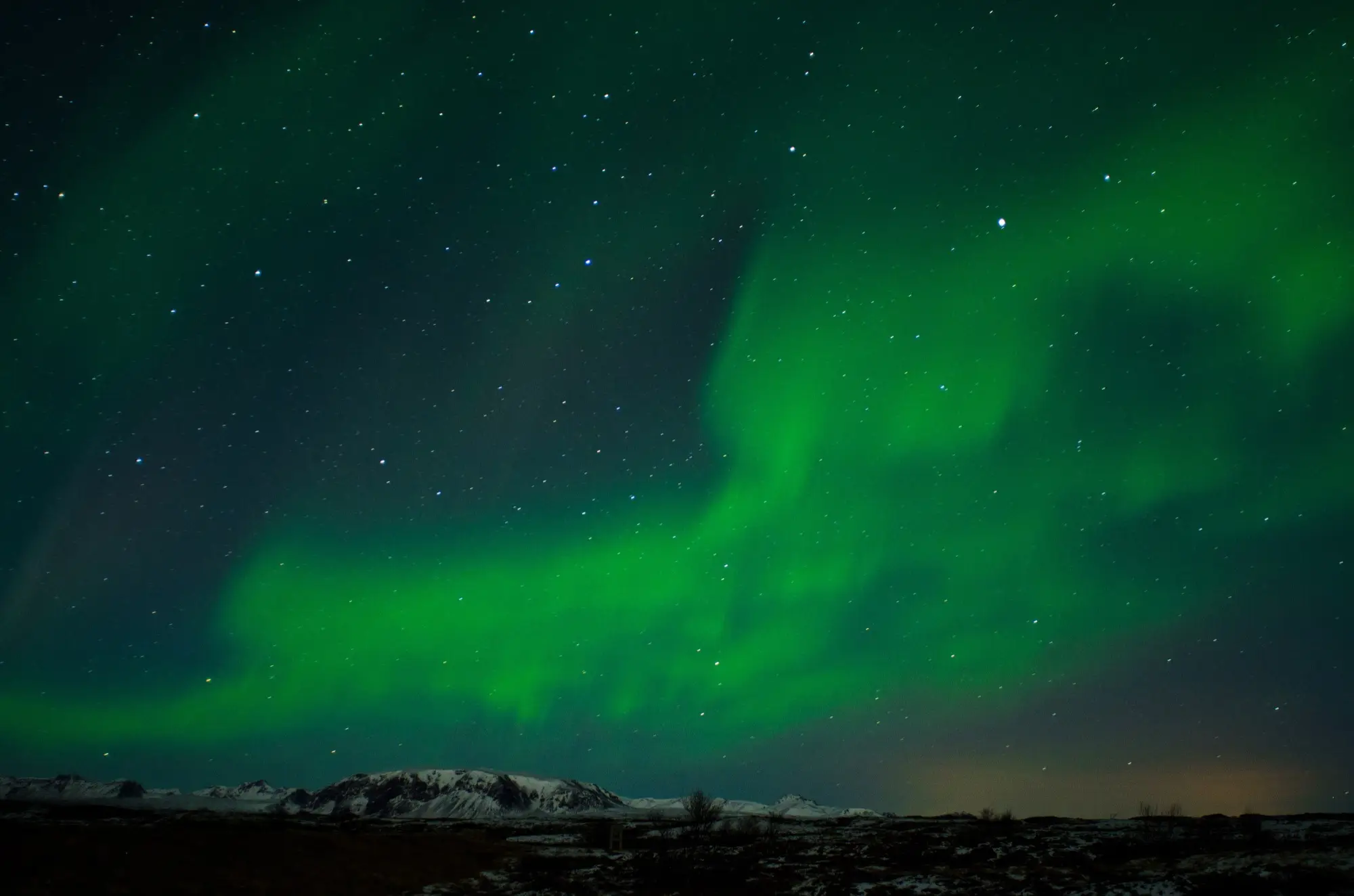
Photo: Carl Young, CC BY-SA 4.0

The evidence
- Geomagnetic activity
- Kp 0.67 (quiet) NOAA SWPC, estimated Kp,Forecast peak Kp 1.67 during the dark hours NOAA SWPC 3-day forecast, issued 00:30 GMT0% chance of aurora overhead NOAA SWPC OVATION,
- Cloud over the dark hours
- 79% cloud at best around 07:00, 100% at worst MET Norway Locationforecast, covering 19:26–06:54
- Darkness
- Astronomical dark 19:26–06:54 (11h 28m) computed here from the date and the coordinatesSunset 16:29, sunrise 09:50 computed here
- Moon
- Waxing crescent, 18% lit, below the horizon at the start of the dark hours computed here
Cloud forecast: MET Norway, under CC BY 4.0, reduced here to the clearest and cloudiest hour of the dark window. See where the data comes from.
How dark does it get in Þingvellir tonight?
It is astronomically dark — dark enough to see the aurora — from 19:26 to 06:54 local time, 11 hours and 28 minutes.
Dark hours by date, 2026–27 season
| Date | Dark from | Dark until | Hours of darkness |
|---|---|---|---|
| 1 September | Not dark enough for the aurora | ||
| 15 September | 22:58 | 03:44 | 4h 46m |
| 1 October | 21:38 | 04:52 | 7h 14m |
| 15 October | 20:46 | 05:38 | 8h 52m |
| 1 November | 19:54 | 06:26 | 10h 32m |
| 15 November | 19:22 | 07:00 | 11h 38m |
| 1 December | 19:00 | 07:30 | 12h 30m |
| 15 December | 18:54 | 07:48 | 12h 54m |
| 1 January | 19:04 | 07:54 | 12h 50m |
| 15 January | 19:26 | 07:42 | 12h 16m |
| 1 February | 20:04 | 07:12 | 11h 08m |
| 15 February | 20:42 | 06:36 | 9h 54m |
| 1 March | 21:24 | 05:50 | 8h 26m |
| 15 March | 22:14 | 04:54 | 6h 40m |
| 1 April | 23:38 | 03:18 | 3h 40m |
| 15 April | Not dark enough for the aurora | ||
Astronomical darkness (the sun more than 18° below the horizon), Þingvellir local time, computed here from the date and the coordinates.
Visit Reykjavík states that Þingvellir National Park offers wide plains and a clear horizon, making it ideal for viewing the lights. You can reach the park by car or organised tour, and the grounds remain open around the clock with designated parking areas.
When to see the northern lights at Þingvellir
According to Visit Iceland, the best time to see the northern lights is winter, between September and April, when dark and long nights replace bright summer nights. The lights are said to be most active around the September and March equinoxes, but chances also improve in mid-winter due to increased darkness. Visit Reykjavík calls November to February the peak season, offering the darkest skies and highest chances of activity, alongside cold weather and occasional snow. You can check how long the nights are in Reykjavík through the season to plan your timing.
Sightings require darkness and clear skies, or at least openings in the cloud cover. Visit Iceland notes that you can check weather conditions, cloud cover, and aurora activity on the Icelandic Met Office website. The Met Office explains that the aurora requires dark and partly clear skies; on its aurora forecast page, the map of Iceland shows a forecast of cloud cover, with green areas cloudy and white areas clear. Visit Iceland says there are no guarantees with the northern lights, so the more nights you have, the better your chances. Visit Iceland also states that in most cases sightings are greatly improved outside populated areas, especially away from the capital's light pollution. You can also compare the best places to see the northern lights.
How to get to Þingvellir
Þingvellir is one of the main attractions of the Golden Circle day tour and was established as Iceland's first national park in 1928, later becoming a UNESCO World Heritage Site. The park sits in a rift valley between the North American and Eurasian tectonic plates, partly filled with groundwater and containing Iceland's largest natural lake, Þingvallavatn. Visit Reykjavík states that within 30 to 60 minutes of Reykjavík you can reach viewing spots such as Þingvellir or Reykjanes, allowing access to open, dark skies within an hour's drive of the capital.
The national park is open around the clock and charges no entrance fee, though there is a parking fee for motor vehicles and an entrance fee for the exhibition. For independent travel, several car rental companies operate directly from Keflavík Airport. Visit Reykjavík notes that you can see the lights without a tour by renting a car, checking the forecast, and driving outside the city, but to be cautious on icy roads. Visit South Iceland says that before setting out on the Golden Circle in winter you should check road conditions at umferdin.is and the forecast at vedur.is.
Visit Reykjavík says northern lights tours from Reykjavík last 3 to 5 hours and pick you up in the city to drive you to the clearest skies of the night. Visit Reykjavík advises booking a tour early in your trip so there is time to rebook if conditions are not right, and says most operators offer free retries if the lights do not appear. For those travelling with campers, the park's campsite at Nyrðri-Leirar remains open year-round, offering toilets, showers, laundry, and motorhome electricity in winter, though parts may close during heavy snow or thaw.
Where to stand to see the aurora
Visit Reykjavík lists Þingvellir National Park among its northern lights day trips, stating that its wide plains and clear horizon make it ideal for viewing the lights where the continental plates meet. Þingvellir National Park operates designated parking areas, with car park P1 (Hakið) situated at the upper end of Almannagjá gorge, right by the visitor centre and the viewing platform before you walk down into the gorge. The visitor centre opens from 09:00 to 17:00 between November and March. Car park P5 (Valhöll) is situated nearest Þingvellir church and the Silfra fissure.
Parking a passenger car with five or fewer seats costs 1000 ISK. This fee covers parking for the day of payment across car parks P1, P2, and P5. At Hakið, cameras read vehicle number plates automatically, and the parking fee can be paid online at checkit.is.
Safetravel, run by the Icelandic Association for Search and Rescue, instructs visitors to park in a designated parking lot, never stop a car in the road or in an unsafe spot at the roadside, and never step into the street to take photographs. In the dark, it is easy to slip on ice or step into holes, so carry a headlamp or a torch rather than relying on a phone light. Clear nights are often cold; dress warmly in layers and bring food, warm drinks, and a fully charged phone.
Where to watch near Þingvellir
- Hakið (P1, visitor centre) in the centre. Reach this spot at car park P1 beside the visitor centre at the upper end of Almannagjá. Visit Reykjavík considers the park suited for aurora viewing because of its wide plains and clear horizon.
- Valhöll (P5, by the church) in the centre. Park here to follow Safetravel's advice to watch from a designated car park rather than stopping on the road. It sits nearest Þingvellir church and the Silfra fissure, with one day's fee covering every car park in the park.
What the numbers mean
Four things have to line up before you see anything, and three of them are on this page above. The fourth is your own eyes adjusting, which takes about twenty minutes in real darkness and does not survive a glance at a phone.
Darkness comes first because it cannot be argued with. The aurora is always there when the field is active; you can only see it once the sun is more than 18° below the horizon, which is what the dark band above marks. In Þingvellir that is 11 hours and 28 minutes tonight.
Kp is a global index of how disturbed the Earth's magnetic field is, from 0 to 9, published every three hours. It is a blunt instrument: it says the whole planet was disturbed, not that the aurora is over Þingvellir now. At 64°N the auroral oval usually sits overhead already, so a quiet Kp is no reason to stay in.
The local disturbance is the better number, and it is the one most aurora pages do not have. FMI runs magnetometers across Lapland; we take the rate of change of the horizontal field at the nearest one, in nanotesla per minute. Þingvellir has none within 120 km, so its verdict rests on Kp and OVATION. A field moving fast overhead means current flowing overhead, which is the aurora itself. Above roughly 40 nT/min it is usually visible; above 100 a substorm is running and it will be moving.
Cloud ends most attempts. The figure above is the total cloud cover MET Norway's Locationforecast forecasts for the dark hours, at these exact coordinates. Anything over about 70% and you will not see through it; under 30% and it stops mattering.
The moon does not stop the aurora. A full moon high in the sky washes out the faint green arcs that make up most displays, so a strong night still shows and a marginal one does not.
Plan the trip
- Best places to see the northern lights
- Daylight in Reykjavík through the year
- Daylight in Akureyri through the year
Nearby
Also on this site: how the daylight changes through the year, and the other 25 places.