Can you see the northern lights in Vík tonight?
Unlikely tonight — dark from 19:18 and the sky is clear, but the field is quiet (Kp 0.67).
Checked against NOAA SWPC and the MET Norway Locationforecast.
Tonight Vík is 12 of 26 on the ranked table of places.
Get an alert when Vík lights up
A heads-up in the hours before dark when tonight's forecast Kp reaches your choice and the cloud forecast leaves a gap, and an alert when the field is active over a clear enough sky at Vík. Two a night at most, nothing on the other nights.
Alerts come to this browser on this device. No email, no account; turn them off here or from any alert.
Aurora forecast for Vík: the next three nights
| Night | Dark, local time | Forecast Kp | Kp needed | Clearest hour |
|---|---|---|---|---|
| TonightFri 13 Nov | 19:18–06:46 | Kp 1.67 | Kp 2 | 26% at best |
| Unlikely — quiet field, Kp 0.67. | ||||
| Saturday nightSat 14 Nov | 19:16–06:48 | Kp 1.67 | Kp 2 | 1% at best |
| Unlikely — Kp up to 1.67 is forecast while it is dark, and Vík needs about Kp 2. 1% cloud at best. | ||||
| Sunday nightSun 15 Nov | 19:14–06:50 | not forecast yet | Kp 2 | not forecast yet |
| No Kp forecast reaches this night yet. | ||||
Checked . Kp from the NOAA SWPC three-day forecast, issued ; cloud from MET Norway Locationforecast, issued . Tonight's row is the verdict above, which also reads the Kp now, OVATION and the magnetometers; the nights after rest on the forecasts alone.
Key facts
- Astronomically dark in Vík tonight from 19:18 to 06:46 local time, 11 hours and 28 minutes, as of .
- Aurora outlook for the next three nights: Fri 13 Nov, Unlikely; Sat 14 Nov, Unlikely; Sun 15 Nov, Not known, as of .
- In the 2026–27 season, astronomical darkness returns between 15 August and 1 September and ends between 1 April and 15 April.
- Vík is at 63.42°N, 19.01°W.
Updated
Located in Iceland at 63.4°N, Vík has no polar night and requires geomagnetic activity of about Kp 2 to see the northern lights.
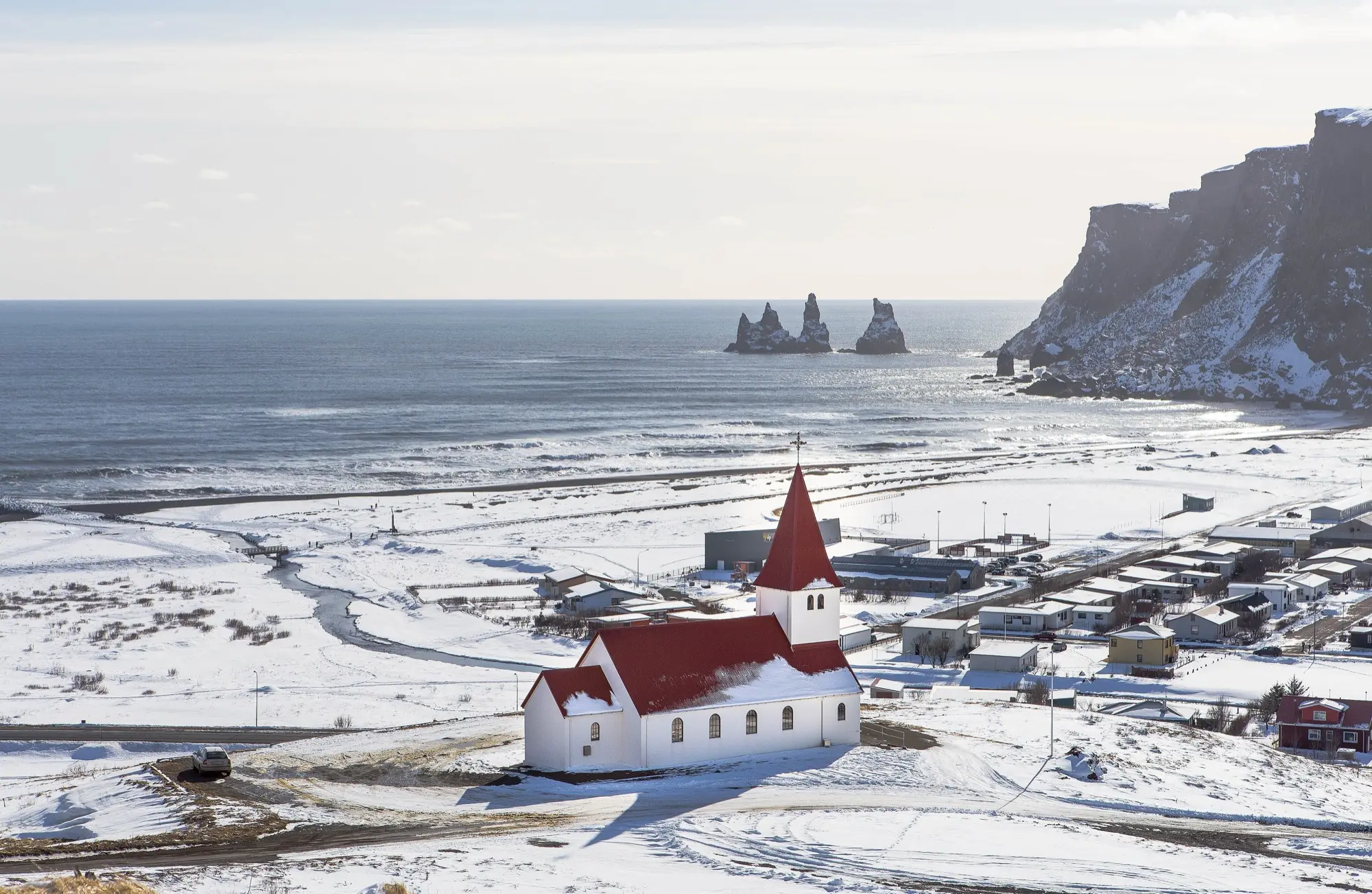
Photo: Jon Flobrant, CC0

The evidence
- Geomagnetic activity
- Kp 0.67 (quiet) NOAA SWPC, estimated Kp,Forecast peak Kp 1.67 during the dark hours NOAA SWPC 3-day forecast, issued 00:30 GMT0% chance of aurora overhead NOAA SWPC OVATION,
- Cloud over the dark hours
- 26% cloud at best around 04:00, 100% at worst MET Norway Locationforecast, covering 19:18–06:46
- Darkness
- Astronomical dark 19:18–06:46 (11h 28m) computed here from the date and the coordinatesSunset 16:27, sunrise 09:35 computed here
- Moon
- Waxing crescent, 18% lit, below the horizon at the start of the dark hours computed here
Cloud forecast: MET Norway, under CC BY 4.0, reduced here to the clearest and cloudiest hour of the dark window. See where the data comes from.
How dark does it get in Vík tonight?
It is astronomically dark — dark enough to see the aurora — from 19:18 to 06:46 local time, 11 hours and 28 minutes.
Dark hours by date, 2026–27 season
| Date | Dark from | Dark until | Hours of darkness |
|---|---|---|---|
| 15 August | Not dark enough for the aurora | ||
| 1 September | 00:28 | 02:06 | 1h 38m |
| 15 September | 22:40 | 03:46 | 5h 06m |
| 1 October | 21:26 | 04:48 | 7h 22m |
| 15 October | 20:34 | 05:32 | 8h 58m |
| 1 November | 19:44 | 06:18 | 10h 34m |
| 15 November | 19:14 | 06:50 | 11h 36m |
| 1 December | 18:52 | 07:20 | 12h 28m |
| 15 December | 18:48 | 07:38 | 12h 50m |
| 1 January | 18:58 | 07:42 | 12h 44m |
| 15 January | 19:20 | 07:32 | 12h 12m |
| 1 February | 19:56 | 07:04 | 11h 08m |
| 15 February | 20:32 | 06:28 | 9h 56m |
| 1 March | 21:12 | 05:44 | 8h 32m |
| 15 March | 22:00 | 04:50 | 6h 50m |
| 1 April | 23:18 | 03:22 | 4h 04m |
| 15 April | Not dark enough for the aurora | ||
Astronomical darkness (the sun more than 18° below the horizon), Vík local time, computed here from the date and the coordinates.
Visit Iceland states that the best time to see the northern lights is winter, between September and April, when long, dark nights replace bright summer skies. Visit South Iceland suggests checking cloud cover and aurora activity in the late afternoon and again after dinner, then driving to clearer skies. You can compare this region with other destinations in our guide to the best places to see the northern lights.
When to see the northern lights in Vík
According to Visit Iceland, the best time to see the northern lights is winter, between September and April, when dark and long nights have replaced the bright summer nights. Visit Iceland says the lights are said to be most active around the September and March equinoxes, but that the chances also improve in mid-winter, which brings more darkness. In South Iceland, the longer hours of darkness in September and October create more opportunities to see the northern lights when skies are clear. Visit Iceland says there are no guarantees with the northern lights, so the more nights you have, the better your chances.
Visit South Iceland says aurora viewing in Iceland is most promising from September through April, when nights are long and dark, and that the lights can be visible as early as August once the sky is dark enough. Visit South Iceland says what matters most is not the month but the combination of darkness, clear skies, low light pollution and aurora activity.
Visit Iceland says you need darkness and clear skies, or at least openings in the cloud cover, and that you can check weather conditions, cloud cover and aurora activity on the Icelandic Met Office website. The Icelandic Met Office says the aurora requires dark and partly clear skies. On the Icelandic Met Office aurora forecast page, the map of Iceland shows a forecast of cloud cover, with green areas cloudy and white areas clear. If you plan to travel across the rest of Iceland, you can check those same national forecasts.
How to get to Vík
Visit South Iceland says Vík lies at the centre of the Katla UNESCO Global Geopark and is Iceland's southernmost village, and its only seaside village with no harbour. Visit Iceland says that as a base, Vík breaks up the drive east and sits close to Reynisfjara.
Visit Reykjavík says several car rental companies operate directly from Keflavík Airport. Visit Iceland says Route 1 is the main road through South Iceland, with paved access to most major south coast stops. Visit South Iceland says the south coast route is accessible all year round, with the main roads regularly serviced and generally easy to drive in both summer and winter. However, Visit Iceland says that in South Iceland snow or ice can close roads or delay travel with little notice. If you are starting your drive from the capital, read our guide to the Reykjavík northern lights before departing.
Visit Iceland says bus services connect the larger towns in South Iceland, though schedules are more limited outside the summer season. Strætó's route 52 runs between Reykjavík and Höfn in Hornafjörður, four trips a week, on Tuesdays, Thursdays, Fridays and Sundays. Passengers travelling to Vík should check the timetable for service details.
Where to stand to see the aurora
Visit South Iceland suggests treating the aurora as a flexible evening activity, checking cloud cover and aurora activity in the late afternoon and again after dinner. Visit South Iceland says to drive to clearer skies, and that sometimes 20 to 60 minutes makes all the difference. Visit South Iceland says even a short drive away from town lights can make a big difference, and that South Iceland combines accessible roads with wide, open landscapes. Visit South Iceland advises staying out for a while, scanning the whole sky and being patient.
Safetravel, run by the Icelandic Association for Search and Rescue, provides clear instructions on roadside safety:
- Park at a designated parking lot and never stop your car in the road or in an unsafe place on its side.
- Do not step into the street to take pictures.
- Bring a headlamp or a flashlight other than your phone light, because in the dark it is easy to step into holes or slip on ice.
- Hunting for the northern lights takes time and patience, so bring food, warm drinks and a charged phone, and dress warmly in layers.
Visit South Iceland warns that the waves at Reynisfjara, near Vík, are deceiving and have caused the death of a number of visitors in recent years, even in the best of weather, and asks visitors to keep a good distance from the sea. Visit Iceland says sneaker waves can form at Reynisfjara even when the weather appears calm, and that you should never turn your back to the ocean. Visit Iceland states that there are no lifeguards or manned security at Reynisfjara. Visit Iceland says the beach is divided into zones; when the yellow light is on visitors must not enter the yellow zone, and when the red light is on they must not enter the red zone and should stay behind the light sign. Visit Iceland says the cliffs above the eastern part of Reynisfjara are steep and unstable, making rockfalls frequent, and advises checking the tide chart for Vík to avoid being trapped in a cave or on the eastern part of the beach.
What the numbers mean
Four things have to line up before you see anything, and three of them are on this page above. The fourth is your own eyes adjusting, which takes about twenty minutes in real darkness and does not survive a glance at a phone.
Darkness comes first because it cannot be argued with. The aurora is always there when the field is active; you can only see it once the sun is more than 18° below the horizon, which is what the dark band above marks. In Vík that is 11 hours and 28 minutes tonight.
Kp is a global index of how disturbed the Earth's magnetic field is, from 0 to 9, published every three hours. It is a blunt instrument: it says the whole planet was disturbed, not that the aurora is over Vík now. At 63°N the auroral oval usually sits overhead already, so a quiet Kp is no reason to stay in.
The local disturbance is the better number, and it is the one most aurora pages do not have. FMI runs magnetometers across Lapland; we take the rate of change of the horizontal field at the nearest one, in nanotesla per minute. Vík has none within 120 km, so its verdict rests on Kp and OVATION. A field moving fast overhead means current flowing overhead, which is the aurora itself. Above roughly 40 nT/min it is usually visible; above 100 a substorm is running and it will be moving.
Cloud ends most attempts. The figure above is the total cloud cover MET Norway's Locationforecast forecasts for the dark hours, at these exact coordinates. Anything over about 70% and you will not see through it; under 30% and it stops mattering.
The moon does not stop the aurora. A full moon high in the sky washes out the faint green arcs that make up most displays, so a strong night still shows and a marginal one does not.
Plan the trip
- Best places to see the northern lights
- Daylight in Reykjavík through the year
- Daylight in Akureyri through the year
Nearby
Also on this site: how the daylight changes through the year, and the other 25 places.