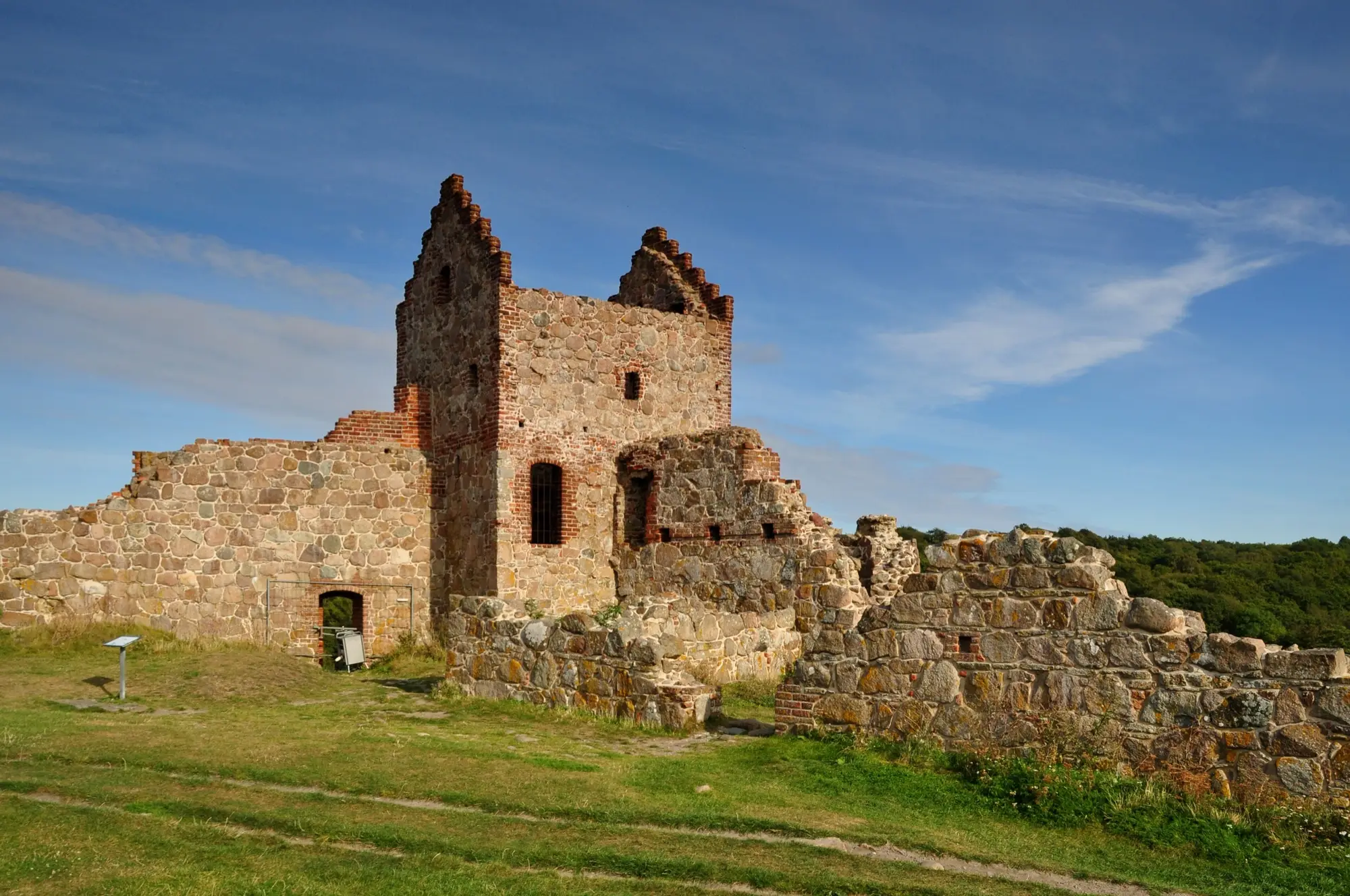

Hammershus on Bornholm's northern tip is, in the encyclopedia Lex's words, northern Europe's largest castle ruin, open 24 hours a day all year with a free exhibition in the visitor centre; Bornholm also has four of Denmark's seven surviving medieval round churches, Østerlars, Olsker (Sankt Ols), Nylars and Nyker (Ny Kirke), dated to the decades around 1200 and built to serve as forts as well.
Hammershus: northern Europe's largest castle ruin
According to Lex, Hammershus was one of the largest medieval castles in the Nordic countries and is today northern Europe's largest castle ruin. For almost 500 years, the fortress served as the operational base of Bornholm's changing rulers. Positioned on the northern tip of the island near Hammeren, the castle was probably built in the late 1200s, during an era marked by an intense power struggle between the Danish crown and the church. You can see where Bornholm sits on a map of Denmark.
The historical name appears in records from the 1200s as castrum Hamar, derived from the old term hammer (a rocky hill) and hus (a castle or fortified house). Lex records that its location close to Skåne and the archbishop's seat in Lund gave the fortress a central role in the struggle over Baltic trade and shipping routes. Lex notes that the castle lost its military importance in the 1600s and became a royal prison instead. The ruin has been protected since 1822.
Walking through the ruin
Naturstyrelsen, the Danish Nature Agency which manages the grounds, explains that the only access into the fortress from the land side was over Slotsbroen (the castle bridge). This bridge bends slightly along its course, an intentional design made to ensure a battering ram was hard to use directly against the main gate.
Inside the outer walls, several historic building footprints remain visible:
- The cellar of a house survives in the eastern outer bailey and is thought to be the Tinghuset, the local court house for northern Bornholm.
- Naturstyrelsen notes that many taxes paid to the lord of Hammershus were paid in salted Bornholm butter. These food reserves were kept cool in Smørkælderen (the butter cellar) until shipped off the island; you can learn more about traditional dairy staples across Danish food.
- The core fortification, Mantelgården, was a self-contained defence in its own right. Its mantle wall was three storeys high and up to two metres thick, reinforced at the north-east end by Manteltårnet, a six-storey solid tower.
- The finest quarters in the compound, the king's chamber and hall, were located on the upper floor of the church wing. Christian IV stayed the night there.
Naturstyrelsen calls one tower the best-preserved building at Hammershus, although it has stood without a roof for centuries. Across the entire site, Lex's map numbers 13 specific points of interest, running from the visitor centre and the castle bridge across to the central castle and the outer towers.
Visiting Hammershus: access, the visitor centre and parking
Most visitors start by looking into things to do in Copenhagen before travelling to Bornholm. You can plan the rest of the island using our guide to Bornholm: things to do and how to get there. Naturstyrelsen states that the ruins of Hammershus are open 24 hours a day all year.
In Mølledalen, about 200 metres east of the ruin, sits the visitor centre. Lex records that since 2018 the story of Hammershus has been told here, featuring large panorama windows facing the castle across a ravine. Naturstyrelsen notes that the centre holds an exhibition called Den Forhadte Borg (the hated castle), named because Bornholmers in the Middle Ages were far from fond of Hammershus. The exhibition is free, and the centre provides a shop, a restaurant and toilets.
Practical arrival points include:
- Address: Slotslyngsvej 9, 3770 Allinge, with road access via Slotslyngsvej and Langebjergvej.
- Parking: Paid parking is run by ParkZone. A free car park on Slotslyngsvej is reserved for disabled drivers' vehicles and tour buses.
- Public transport: There is a bus stop right at Hammershus. You can look up routes and current timetables on bat.dk or rejseplanen.dk.
- Cycling: The signed Bornholm Rundt cycle route (the round-Bornholm trail) runs from Rønne to Allinge and passes directly past Hammershus.
The Hammerknuden walk
Hammerknuden is a huge rock shaped by glaciers in the last ice age, cut off from the rest of Bornholm by a fissure valley. Its highest elevation is found at Hammerfyr lighthouse, 82 metres above the Baltic.
Naturstyrelsen outlines the Hammerknuden rundt route, a 7 km circular walk following the rocky coastline from Sandvigbugten to Hammerhavn, before looping back past three freshwater lakes: Krystalsøen, Opalsøen and Hammersøen. The route is marked along the terrain with blue pictograms and painted dots, and Naturstyrelsen specifies that it is hard to walk.
The agency highlights the panoramic view from Kongestolen, situated at the western end of Hammerknuden, which looks out over a bird cliff, the Baltic, and the ruins of Hammershus. Trailhead parking is available at Hammerhavn or by Opalsøen. For public transport users, bus route 2 runs from Rønne to Hammershus.
Bornholm's four round churches
In total, Lex notes that Denmark has seven surviving round churches (rundkirker). During medieval times, Denmark had 19 round churches, nine of which were situated on Zealand. Today, only one survives in Jutland, one on Funen, one on Zealand and four on Bornholm.
Bornholm's four round churches, Østerlars, Ols, Nylars and Ny Kirke, date from the decades around 1200. Unlike Denmark's other round churches, these four also served as storehouses and defensive forts. When enemies from the south-eastern Baltic appeared, local people could take refuge on the third and top storey of the nave. Lex classifies the Bornholm buildings as a distinct type of their own, characterised by multiple upper storeys and clear defensive features.
Østerlars Kirke
Østerlars Kirke is the largest of the four round churches on the island. Located as an active parish church south of Gudhjem, its defensive layout remains visible to visitors. Lex measures the circular rotunda at a little over 16 metres across from north to south.
The church was originally named after its medieval patron saint, Saint Laurence (Sankt Lars in Danish). Lex notes that the prefix Øster (eastern) was added from around 1600 to distinguish the building from Nylars.
Nylars, Olsker and Nyker
The remaining three round churches on Bornholm contain distinct architectural details:
- Nylars Kirke: Lex notes this church is said to have been dedicated to Saint Nicholas by 1335; the Danish form Nilaus later transformed into Nylars. The church structure contains an apse, a chancel, a three-storey Romanesque round nave originally built for military defence, and a porch built in 1879. Wall paintings survive inside.
- Sankt Ols Kirke (Olsker): Dedicated to Saint Olaf, this building stands alone on a hill. The structure is slimmer than the other three churches. Its once-fortified round nave can be seen far out to sea and has served as a seamark. The churchyard features a free-standing two-storey bell tower.
- Ny Kirke (Nyker): This parish church is said to have taken its name from the church after Ny Kirke became Nyker in everyday speech. Inside, the church contains wall paintings, including a scene depicting Christ before Herod or Pilate.
To explore more regional routes across the country, check the wider guide to Denmark.