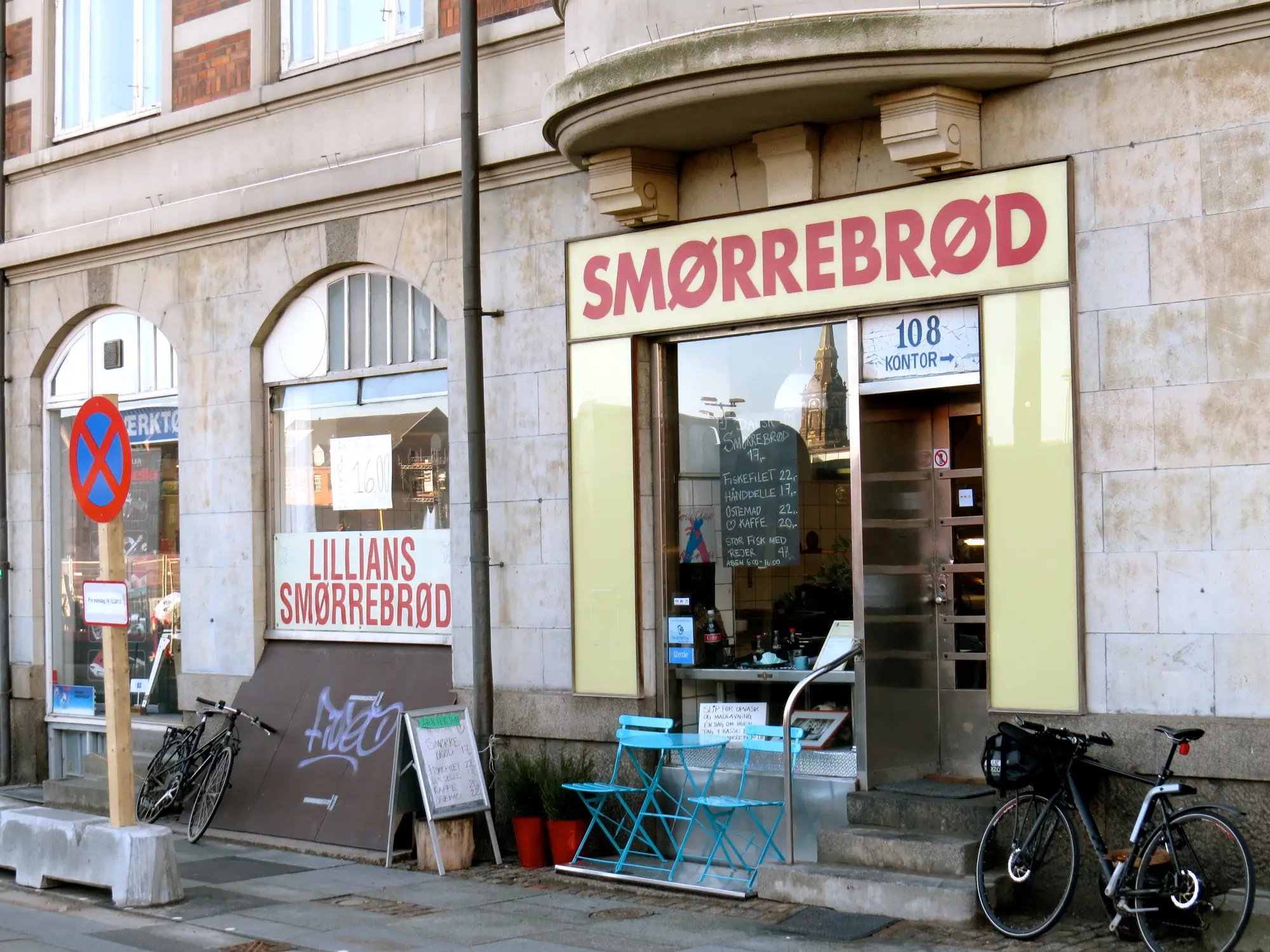

To taste authentic Danish food, you should try twelve core dishes: smørrebrød, wienerbrød, kanelsnegl, fastelavnsboller, hot dogs from the pølsevogn, stegt flæsk med persillesovs, frikadeller, flæskesteg, æbleskiver, risalamande, gløgg and rødgrød med fløde.
1. Smørrebrød: open rye sandwiches, mostly for lunch
Smørrebrød (open-faced sandwich) is a slice of dense rye bread loaded with toppings such as pickled herring, roast beef, or eggs paired with mayonnaise and shrimps. These piled rye-bread sandwiches date back to the 19th century and have had a facelift in recent years. The classic high-piled style comes from the Danish bourgeois kitchen of the late 1800s, featuring toppings like roast pork with red cabbage, and liver pâté served with pickled beetroot. According to advice from VisitDenmark, smørrebrød is eaten with a knife and fork.
A favourite combination is the stjerneskud (shooting star), which features rye bread with fried plaice fillet, topped with shrimp, lettuce and Limfjord caviar. Danes eat smørrebrød as everyday food, mostly at lunch but also for dinner, as well as festive party food at Easter, Christmas and New Year. The modern revival started when chef Adam Aamann opened his shop on Østerbro in 2006. Many Copenhagen restaurants serve open sandwiches on their lunch menus, and they are also sold across bakeries and inside market halls.
Key places in Copenhagen for smørrebrød include:
- Schønnemann: Operating at Hauser Plads 16, this is one of the city's oldest eateries and has served smørrebrød, herring and chilled schnapps since 1877. VisitCopenhagen classifies it as a lunch-only establishment, serving dishes like smoked eel with scrambled eggs and freshly breaded fried plaice. It opens Monday to Sunday, 11:30 to 17:00.
- Aamanns 1921: Adam Aamann's restaurant is situated at Niels Hemmingsens Gade 19-21 in central Copenhagen. VisitCopenhagen notes that its smørrebrød was named the best in 2019 by the Association of Danish Food Critics.
2. Wienerbrød: the Danish pastry Danes call Viennese bread
Wienerbrød (Viennese bread) is the collective term for the laminated pastries sold across Danish bakeries, all prepared from the same yeast dough. While the name translates to Vienna bread, bakers in Vienna call the exact same pastry Kopenhagener Gebäck or Dänischer Plunder. Den Store Danske traces the first Viennese bakery in Denmark to the 1840s on Købmagergade in Copenhagen, started by confectioner Niels Christian Albeck following a stay in Austria.
Classic pastries include the snegl (a cinnamon-roll pastry), the spandauer (with custard cream in the centre), and the tebirkes (filled with sweet remonce paste and topped with poppy seeds). Popular Copenhagen pastry queues cited by VisitDenmark include Juno the Bakery in Østerbro, Hart Bageri in Frederiksberg, Sankt Peders Bageri in the Latin Quarter and Lille Bakery on Refshaleøen. On its national list of venues for the best pastries, VisitDenmark highlights Hart, Andersen & Maillard, and Flere Fugle in Copenhagen.
Notable bakeries in town include:
- Hart Bageri: Richard Hart worked as the baker at Noma before opening Hart.
- Andersen & Maillard: A bakery, coffee roastery and café situated inside a former bank in Nørrebro.
- Meyers Bageri: Founded by chef Claus Meyer alongside a baker and a confectioner, this group operates three craft bakeries in Copenhagen and bakes exclusively with organic flour, with its first location at Jægersborggade 9.
- Lille Bakery: Located at Refshalevej 213b, Lille opens Wednesday to Sunday, 08:00 to 17:00, remaining closed on Mondays and Tuesdays. Lille closes from 21 December 2026 for a long winter break and reopens on 20 January 2027 at 08:00.
3. Kanelsnegl: the cinnamon swirl, and Wednesday's onsdagssnegl
When ordering at a counter, a frequent tip from VisitDenmark is to ask for a kanelsnegl (cinnamon snail) or a frøsnapper (seed snapper). Cinnamon rolls are available daily, but certain bakeries give them dedicated mid-week traditions.
- Sankt Peders Bageri: Situated at Sankt Peders Stræde 29 in the Latin Quarter, this shop calls itself Copenhagen's oldest bakery and is best known for its cinnamon rolls. Its Wednesday special, the onsdagssnegl (Wednesday snail), proves so popular that the bakery sells no less than 4000 every Wednesday according to its listing.
- Juno the Bakery: Located at Århusgade 48, Juno opens Tuesday to Saturday 7.30 to 18.00 and Sunday 7.30 to 16.00, staying closed on Mondays. VisitCopenhagen directs visitors here for one of Copenhagen's best cardamom rolls.
- Lille Bakery: Lille's daily baking ranges from berliners and sourdough bread to cinnamon rolls. In the lead-up to Christmas, the bakery also introduces stollen, Christmas cookies and Santa Lucia buns.
4. Fastelavnsboller: cream buns for Fastelavn, seven weeks before Easter
Seven weeks before Easter, typically in February, Denmark observes Fastelavn (Shrovetide). Right before Lent, Fastelavn is a children's holiday featuring costumes that usually culminates in attempting to smash open a hanging wooden cat barrel, which is now stuffed with candy. Buns have been eaten during the days preceding Lent since at least the 1500s, and they are now placed on sale from mid-January in bakeries and supermarkets everywhere.
The version prepared from wienerbrød dough and filled with custard, whipped cream or jam is a 1900s creation. Since the 2010s, gourmet bakeries have introduced modern flavours, including liquorice, pistachio and sea buckthorn. At Conditori La Glace, located in historic rooms at Skoubogade 3 in central Copenhagen, a brand new range of Fastelavn buns is prepared every year, becoming available about 4 weeks before Fastelavn.
5. Hot dogs from the pølsevogn, the sausage wagon
Danish hot dog stands are a genuine cultural institution and have fed locals for over a century. A familiar street scene across the country involves the vendor manually walking down a main road, pulling the mobile stand home. The pølsevogn (sausage wagon) dishes out hot sausages, particularly wienerpølser (Viennese sausages), paired with bread, mustard, ketchup and other condiments. While Denmark had over 700 sausage wagons in the 1970s, fewer than 100 remain in the 2020s. In a 2025 Ministry of Culture vote on living Danish heritage, the pølsevogn came second with 6952 votes, finishing behind only the folk high school.
- DØP: This dedicated organic hot dog stand is positioned by the Church of the Holy Ghost on Strøget and by the Round Tower on Købmagergade. If you are comparing attractions with a Copenhagen Card, the Round Tower stand makes a practical stop. Everything served at DØP is organic, from the fried onions to the remoulade, and a veggie hot dog is available.
- Harry's Place: Situated on the corner of Nordre Fasanvej and Nordvestpassagen, this stand has attracted visitors and neighbourhood locals since 1965. Its house specialty is the børge sausage.
6. Stegt flæsk med persillesovs: the national dish, voted in 2014
When Danes took part in a nationwide poll to choose an official national meal, the winner was stegt flæsk med persillesovs, slices of crispy pork paired with parsley sauce and boiled potatoes. This classic, long-established dish claimed victory in 2014 as Denmark's first official national dish, securing over 44% of the votes. Stegt flæsk ranks among the cheaper meals in traditional restaurants, and several dining spots offer all-you-can-eat pork servings.
Inside the Tivoli Gardens, Færgekroen, opened in 1934 and operated by Mikkeller since 2024, serves traditional Danish favourites including stegt flæsk and biksemad (meat and potato hash).
7. Frikadeller: fried meatballs of veal and pork
Frikadeller are pan-fried Danish meatballs eaten for lunch and dinner, as well as served cold as a smørrebrød topping. What defines a frikadelle is not its precise filling, but the fact that it is fried. Traditionally, they are prepared from equal parts veal and pork combined with flour, milk, eggs, onions and seasonings. They are routinely served alongside boiled potatoes, brown gravy and pickled sides, or with creamed white cabbage, and are often treated as an informal national dish.
Café Sorgenfri, an eatery dating back to 1797 at Brolæggerstræde 8, serves traditional open sandwiches alongside warm plates of frikadeller and flæskesteg (roast pork).
8. Flæskesteg: roast pork with crackling for Christmas Eve
Flæskesteg refers to pork cuts roasted whole in the oven, prized especially for crisp, salted crackling. It is regularly accompanied by sweet-and-sour pickled red cabbage or pickled beetroot. While roast duck is the single most eaten Christmas Eve main dish, eaten by an estimated three in four Danes on 24 December, flæskesteg is another widely consumed choice.
Danish Christmas is celebrated on the evening of 24 December with roast duck, roast pork or roast goose, served with caramelised potatoes and pickled red cabbage. According to Denmark.dk, most shops and restaurants are closed on 24, 25 and 26 December. If you are looking to dine out around the holidays, planning early is essential:
- Restaurant Kronborg: Located at Brolæggerstræde 12, this lunch restaurant opens every evening throughout the Christmas season with a traditional holiday menu that must be booked in advance.
- Schønnemann: From 12 November to 23 December 2026, the restaurant runs regular lunch daily and adds an evening julebord (Christmas buffet) Thursday to Saturday from 18:30 to 23:00. It closes completely from Christmas Eve, 24 December 2026, through to Tuesday 5 January 2027.
9. Æbleskiver: round pancake puffs for December
Æbleskiver translates literally as apple slices. In earlier centuries, they were stuffed with pieces of apple or apple puree, but that filling has long since vanished. Today they are spherical batter puffs fried in an æbleskivepande, a cast-iron pan containing seven round indentations. They are served warm, dusted with icing sugar and accompanied by fruit jam.
Æbleskiver are among Denmark's oldest known baked goods, although they have been closely tied to Christmas only over the last 100 years. The pastry has regional names, being called fedtnummer on the island of Møn and bublipan on Samsø. During winter outings, such as exploring Copenhagen's Christmas markets, gløgg is frequently served directly alongside a plate of æbleskiver.
10. Risalamande: the Christmas rice pudding with a hidden almond
The traditional dessert served across Denmark on Christmas Eve is risalamande, a cold pudding consisting of rice porridge folded with whipped cream, chopped almonds and vanilla, topped with warm cherry sauce. A single whole peeled almond is hidden in the serving bowl, and whoever discovers it in their portion receives a small mandelgave (almond gift), which is frequently a marzipan pig.
While the name is derived from the French riz à l'amande (rice with almond), the recipe is entirely Danish. It emerged around 1900, when upper-class households began serving rice pudding with cherry sauce for Christmas instead of plain hot porridge, spreading widely after the Second World War. Many families still prepare basic rice porridge on lillejuleaften (little Christmas Eve, the day before Christmas Eve) to eat with butter and cinnamon sugar for supper, saving the remainder to mix into risalamande the following night.
In Copenhagen:
- Conditori La Glace: Its Christmas range launches in early November, and its marzipan pigs remain its most sought-after holiday items.
- Collective Bakery: Sells an inventive holiday cookie on Nørrebrogade based on the flavours of risalamande, filled with cherries and finished with an almond.
- Grød: Torvehallerne lists rice porridge served with butter and cinnamon sugar at the porridge bar Grød on the 24th of every month, available from 24 March to 24 November.
11. Gløgg: mulled wine, launched on 11 November
Gløgg is hot spiced wine mixed with brandy and dried fruit, commonly served with a spoon so the soaked raisins and almonds resting at the bottom of the glass can be scooped up. For other seasonal choices, see our overview of Danish drinks. While similar to Alpine glühwein, the drink arrived from Sweden and became an established Danish Christmas tradition following the Second World War. If you are comparing holiday culinary traditions across the Sound, our guide to Swedish food explains how festive dishes developed across the wider region.
- Hviids Vinstue: Located on Kongens Nytorv, this historic bar dates to 1723. Every year on 11 November at 11:00, the pub launches its seasonal gløgg, an annual event run using the same recipe since 1954.
- Torvehallerne: Since 2014, the Copenhagen market hall has hosted an annual unofficial Danish gløgg championship.
12. Rødgrød med fløde: red berry pudding with cream, for summer
Rødgrød med fløde is Denmark's quintessential summer berry dessert. Red summer berries, typically strawberries, raspberries, redcurrants and cherries, are stewed briefly in water with sugar, thickened using potato starch, and chilled. It is served cold with a pour of fresh cream or milk.
During the 1600s, the pudding was cooked without fruit from a base of red wine, giving rise to its name (rød meaning red). Farm-grown berries replaced wine during the late 1800s as inexpensive beet sugar became widely available. In Danish rural history, rødgrød prepared with cherries was a festive food served at countryside weddings.
The Danish food calendar, from Fastelavn to New Year
Seasonal ingredients and holiday traditions dictate when specific foods appear across Denmark:
- Fastelavn (seven weeks before Easter): Usually falling in February, bakeries and grocery stores fill with cream-stuffed fastelavnsboller ahead of Lent.
- Sankt Hans and summer (23 June): On the evening of 23 June, Danes celebrate midsummer in Denmark with a meal at home with family and friends before gathering around a community bonfire. During summer, bakeries serve jordbærkage, a tart piled with fresh strawberries.
- Saint Morten's Day (10 November): Families traditionally gather to eat roasted duck or goose for dinner on Mortensaften.
- The gløgg launch (11 November): At 11:00 on 11 November, Hviids Vinstue taps its seasonal spiced wine, marking the start of winter drinking.
- Christmas Eve (24 December): The holiday feast consists of roast duck, roast pork (flæskesteg) or goose, served with caramelised potatoes and red cabbage, followed by chilled risalamande with warm cherry sauce. Bakeries stock traditional spiced biscuits like klejner and pebernødder throughout the season.
- New Year: As midnight strikes, Danes welcome the new year by eating kransekage, a tiered tower made of 18 or more baked almond, egg and sugar rings.
Where to graze: Torvehallerne market hall
If you want to sample multiple specialties in one central location, Torvehallerne operates as a premier destination at Frederiksborggade 21, and our guide to Copenhagen street food and food halls covers similar venues. Calling itself the larder of Copenhagen, the covered food hall attracts more than a hundred thousand Copenhageners each week.
The complex is open every day: 10 to 19 Monday to Friday and 10 to 18 at weekends, with morning coffee and bakery bread available from 7. Every Thursday from 13 to 19, smaller independent food producers set up stalls on the outdoor square between the glass halls. Inside, you will find smørrebrød counters, Grød serving monthly bowls of warm rice porridge, and the hall's own bakery, Albatross & Venner, where visitors can watch loaves and pastries being shaped and baked.