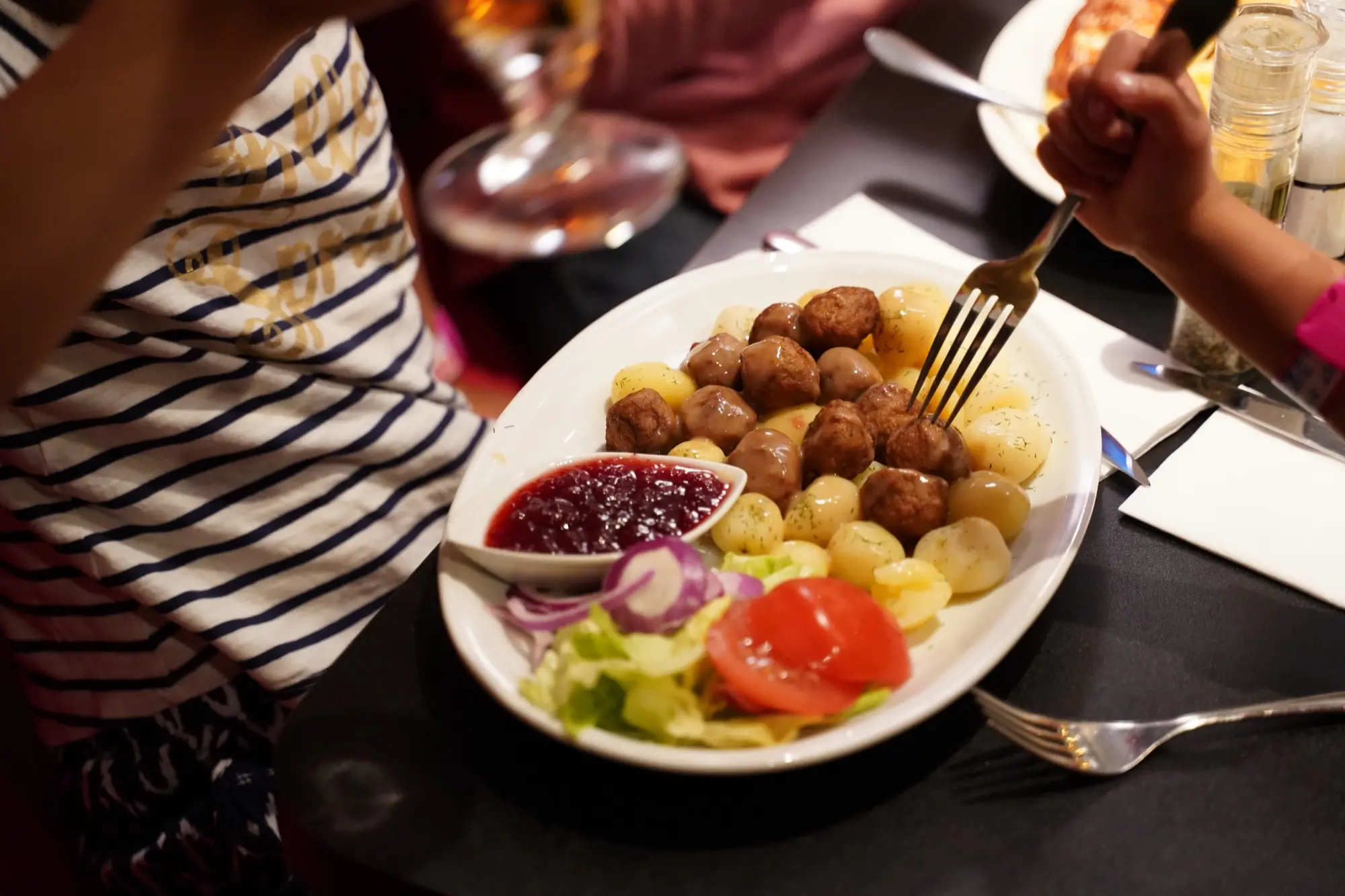

Traditional Swedish food follows the calendar closely. The twelve essential items to try across the year are kanelbulle (cinnamon bun), semla (cream bun), prinsesstårta (princess cake), köttbullar (meatballs), inlagd sill (pickled herring), gravad lax (cured salmon), toast Skagen, crayfish (kräftor), surströmming (fermented herring), lussekatter (saffron buns), julbord (the Christmas smörgåsbord), and waffles.
1. Kanelbulle: the fika bun, with its own day on 4 October
Kanelbullar (cinnamon buns) are wheat-flour buns filled with cinnamon, sugar and butter, sold in all bakeries and cafés. The Swedish bun is spiced with cardamom and topped with pearl sugar, and best with strong coffee during fika, the Swedish coffee break. For places to sit down for a coffee break, see our guide to fika in Sweden and 9 cafés to try it. For more baked specialities, see our guide to Swedish pastries: 10 buns and cakes to try.
The cinnamon bun appeared after the First World War and took off in the 1950s, when butter, sugar and spices became easier to find. Kanelbullens dag (Cinnamon Bun Day) is 4 October. The organisation Hembakningsrådet started the day in 1999 to mark its 40th anniversary. According to Visit Sweden's food guides, about 10 million cinnamon buns are sold or baked in Sweden on 4 October, with some 7 million sold and 3 to 4 million baked at home.
For visitors looking for notable examples, Visit Sweden points to the classic Café Saturnus in Stockholm for the city's most oversized cinnamon buns. In Gothenburg, Café Husaren has sold its giant hagabullen since 1985.
2. Semla: the Fat Tuesday bun, sold from Christmas to Easter
A semla (plural semlor) is a white-flour bun filled with whipped cream and almond paste and dusted with icing sugar. The semla only took its present form and became common in the mid-20th century. Its predecessor, the hetvägg, was an 18th-century upper-class pastry served in a bowl of hot milk. Legend has it that King Adolf Fredrik died on 12 February 1771 after a heavy meal that ended with a hetvägg.
The semla's primary day is Fettisdagen (Shrove Tuesday, Fat Tuesday); in 2027 it falls on 9 February. Once eaten only on the day before Lent, semlor are now eaten from Christmas until Easter. Visit Sweden's answer to where to get one is every bakery and café worth its salt.
3. Prinsesstårta: the green princess cake, for birthdays
Prinsesstårta is light sponge, vanilla custard and whipped cream wrapped in green marzipan and topped with a pink rose. Once called green cake (grön tårta), it is linked to Jenny Åkerström, the princesses' teacher, who published the recipe in the princesses' cookbook in 1948. It has been one of the most popular cakes in Sweden since the 1920s.
For birthdays, Swedes split between strawberry cake and princess cake. For a classic version, Visit Sweden names Konditori Hollandia in Malmö and Ryggåsstugan in Dala-Järna. For a modern take, Sturehof in Stockholm serves it in a coupe glass.
4. Köttbullar: meatballs with lingonberries, the near-national dish
Traditional köttbullar are made of ground pork and beef, cream, egg and onion. They are served with creamy mashed potatoes, a thick brown gravy, lingonberry jam and pickled cucumber. Visit Sweden calls meatballs about as close as Sweden gets to a national dish, and notes the recipe was brought back from Turkey in the early 18th century by King Charles XII.
Meatballs belong both to traditional holiday meals and to everyday home cooking. Lingonberries also accompany raggmunk, a potato pancake that is always served with fried salted pork and lingonberries. For more dining options, read our guide to Swedish meatballs: 10 places in Stockholm and beyond. For visitors comparing everyday dining expenses with other Scandinavian destinations, see our guide to the cost of living in Sweden.
Specific venues serving meatballs include:
- In Gothenburg: Café du Nord, known as Köttbullekällaren (the meatball cellar), opened in 1875 and serves giant meatballs with mash and lingonberry jam to a recipe as old.
- In Stockholm: Meatballs for the People on Södermalm serves 12 kinds of organic meatballs, moose and reindeer among them.
- In Malmö: Bullen, a pub and restaurant named by Visit Sweden, serves meatballs with boiled potatoes and gravy.
5. Inlagd sill: pickled herring for midsummer, Easter and Christmas
Inlagd sill (pickled herring) began as a medieval way to preserve the Baltic catch and is now on the table at every Swedish holiday. At Easter many Swedes eat much the same as at Christmas, herring and salmon included, alongside eggs and lamb as the Easter specialities.
The midsummer meal is a long lunch of pickled herring, new potatoes, sour cream and chives, accompanied by snaps and drinking songs. Midsummer's Eve is always a Friday between 19 and 25 June. For more holiday details, see our guide to midsummer in Sweden: dates and traditions. On the winter holiday buffet, herring comes pickled in mustard or dill, placed next to gravlax, smoked salmon, ham, sausages and meatballs.
6. Gravad lax: salt-and-sugar cured salmon from the smörgåsbord
Gravad lax is salmon cured with salt, sugar and dill, and is a must on the smörgåsbord, a buffet of small hot and cold dishes. The word grava means to dig, originating from the old method of burying fish near the shore to preserve it. The salmon is sliced thin and served with hovmästarsås, a sweet mustard and dill sauce.
Salmon appears at almost every traditional Swedish holiday, including Christmas, midsummer and Easter. For places to sample it, Visit Sweden suggests Näske Lax on the High Coast, or Buhres in Kivik on Österlen, which is a family-run fish restaurant with its own smokery.
7. Toast Skagen: the 1950s Stockholm prawn toast
Toast Skagen consists of prawns folded with mayonnaise and dill on butter-fried bread, finished with lemon and sometimes a spoonful of roe. It was first served in the 1950s at Riche, a Stockholm restaurant. Despite the Danish-sounding name, Visit Sweden notes that the prawn topping was invented in Stockholm by the restaurateur Tore Wretman in the 1950s.
Visit Sweden names Bengts Fisk in Lysekil, a fish shop and harbour restaurant on the west coast, and Bakfickan in Visby, situated just off Stora Torget. In Stockholm, the fishmonger Lisa Elmqvist in Östermalms saluhall sells its own skagenröra (the prawn topping mixture) by weight, listed at 72 kronor a hectogram.
8. Crayfish (kräftor): the kräftskiva in August
The kräftskiva (crayfish party) takes place in August, set with paper lanterns, silly hats and snapsvisor (drinking songs). The crayfish season starts in the first week of August, a habit rooted in an old prohibition on crayfish fishing between November and 7 August. That ban was lifted completely in 1994, but most Swedes still start eating crayfish at the beginning of August when they are at their plumpest.
Since the late 19th century, crayfish have been served cold in their own broth with flowering dill. The table carries Swedish schnapps, dill, Västerbotten cheese and Swedish flags. During the season, restaurants across the country serve dedicated crayfish menus. Stockholm's Spritmuseum on Djurgården allows visitors to practise snaps songs and sample aquavits; see our review of whether the Stockholm Pass covers your planned stops on the island. Lisa Elmqvist in Östermalms saluhall lists crayfish (kräftor) in its fish and shellfish calendar for July and August.
9. Surströmming: fermented herring from the third Thursday in August
Surströmming is fermented Baltic herring, not rotten fish, though the fermentation produces a smell that many find hard. The fish is caught in spring, kept in strong brine for about two days, fermented in barrels for six to eight weeks, and canned from early July.
Since 1940, the season has opened on the third Thursday in August, known as the surströmmingspremiär. This fixed opening date was established because commercial competition had previously led to unfinished, unfermented fish being sold. The tin is opened in a basin of water. The fish is then wrapped in buttered tunnbröd (flatbread) together with almond potatoes and diced onion, accompanied by beer or snaps.
The dish is closely tied to northern Sweden and especially to the Ulvön islands on the High Coast, where it has been made for over a hundred years. For the full experience, Visit Sweden suggests a surströmming supper at Ulvö Hotell during the season. In Stockholm, the restaurants Tennstopet, Sturehof and Knut usually serve it in season, while the town of Alfta holds a surströmming festival every August. Tins of surströmming are also sold in Swedish grocery stores and online. For more practical advice on trying it, read our dedicated guide to surströmming: what it is and where to try it.
10. Lussekatter: saffron buns for Lucia on 13 December
Lussekatter are saffron buns tied to 13 December, the feast of Lucia. They took the name when they became associated with that date. An S-shape is now the most common form, and saffron was introduced to the dough at the end of the 19th century. Their forerunner, the Dutch and north German duivekater, probably reached Gothenburg with Dutch settlers during the 17th century.
The holiday season begins in earnest on 13 December. The white-clad Lucia wearing a crown of candles became common in the 1950s, visiting schools, workplaces and care homes. In Stockholm, the open-air museum Skansen is a classic location to observe Lucia. For dates and customs, read about St Lucia day in Sweden.
11. Julbord: the Christmas smörgåsbord, from mid-November
Thousands of venues across Sweden serve julbord (the Christmas buffet) from mid-November through December, meaning the season is now getting underway. It is a long multi-course meal starting with glögg (mulled wine) and a gingerbread biscuit, moving through pickled herring, gravlax, smoked salmon, potatoes, ham, sausages, meatballs and short ribs, and finishing with dessert. The standard non-alcoholic drink is julmust, a sweet, spiced soft drink.
A central hot dish on the buffet is Janssons frestelse (Jansson's temptation), a baked casserole of potatoes, onion, pickled sprats, breadcrumbs and cream. The ansjovis used in the recipe are spiced sprats rather than true anchovies; this dish also frequently appears at Easter.
At home, families gather for the julbord on 24 December, Christmas Eve. Many businesses close on that day, including smaller and family-run hotels. Visitors planning a winter trip can read more about holiday closures in our guide to Stockholm in December. In Stockholm, Visit Sweden names the Grand Hôtel, Gamla Riksarkivet and Vaxholm's Kastell for a traditional julbord.
12. Våfflor: waffles on Våffeldagen, 25 March
Våffeldagen (Waffle Day) is celebrated on 25 March, when waffles are usually served topped with jam and whipped cream. The custom arose from a linguistic confusion: the religious feast day Vårfrudagen (Our Lady's Day) sounds similar to Våffeldagen in spoken Swedish.
The Swedish food calendar, month by month
Visit Sweden counts 18 days in the national calendar dedicated to specific pastries. To see how these food celebrations fit into broader annual customs, explore our guide to Swedish traditions: 12 days through the year. Key seasonal markers across the year include:
- 9 February (2027): Fettisdagen (Fat Tuesday), the official day for eating semlor.
- 25 March: Våffeldagen, marked by eating waffles with cream and jam.
- 19 to 25 June (Friday): Midsummer's Eve, celebrated with pickled herring, new potatoes, sour cream and chives.
- First week of August: The start of the crayfish party season (kräftskiva).
- Third Thursday in August: The surströmmingspremiär, opening the fermented herring season.
- August: The annual surströmming festival in Alfta.
- 20 September onwards: Lobster season on the west coast.
- 4 October: Kanelbullens dag, when roughly 10 million cinnamon buns are eaten.
- 10 November: Mårtensafton (St Martin's Eve), celebrated before St Martin's Day on 11 November with roast goose and svartsoppa (a spiced soup made from goose blood), dishes especially associated with Skåne.
- 17 November: The dedicated day for the napoleonbakelse, a cream-and-custard pastry.
- Mid-November through December: Public julbord buffets served across Sweden.
- 13 December: Lucia, marked by singing processions and eating saffron lussekatter.
- 24 December: Christmas Eve, when families hold their home julbord.
Where to shop: Östermalms saluhall and the grocery store
Visit Sweden's general advice for dining is to seek out patisseries, food halls and casual bistros where locals go. For buying ingredients directly, food halls and standard supermarkets provide the widest access to traditional items.
Östermalms saluhall in Stockholm has operated as a food market hall since 1888. Its merchants are arranged into categories covering fish and seafood, fruit and vegetables, konditori (cake shop) and café, meat and poultry, and cheese, alongside seated restaurants and take-away counters. The market hall is open Monday to Friday from 09:30 to 19:00 and Saturday from 09:30 to 17:00, while its restaurants remain open into the evening.
Among the long-standing vendors in the hall is the fishmonger Lisa Elmqvist, which moved into the building in 1926 and is operated today by the family's fourth generation. Beyond market halls, ordinary Swedish grocery stores and online shops stock staples year-round, including retail tins of surströmming.