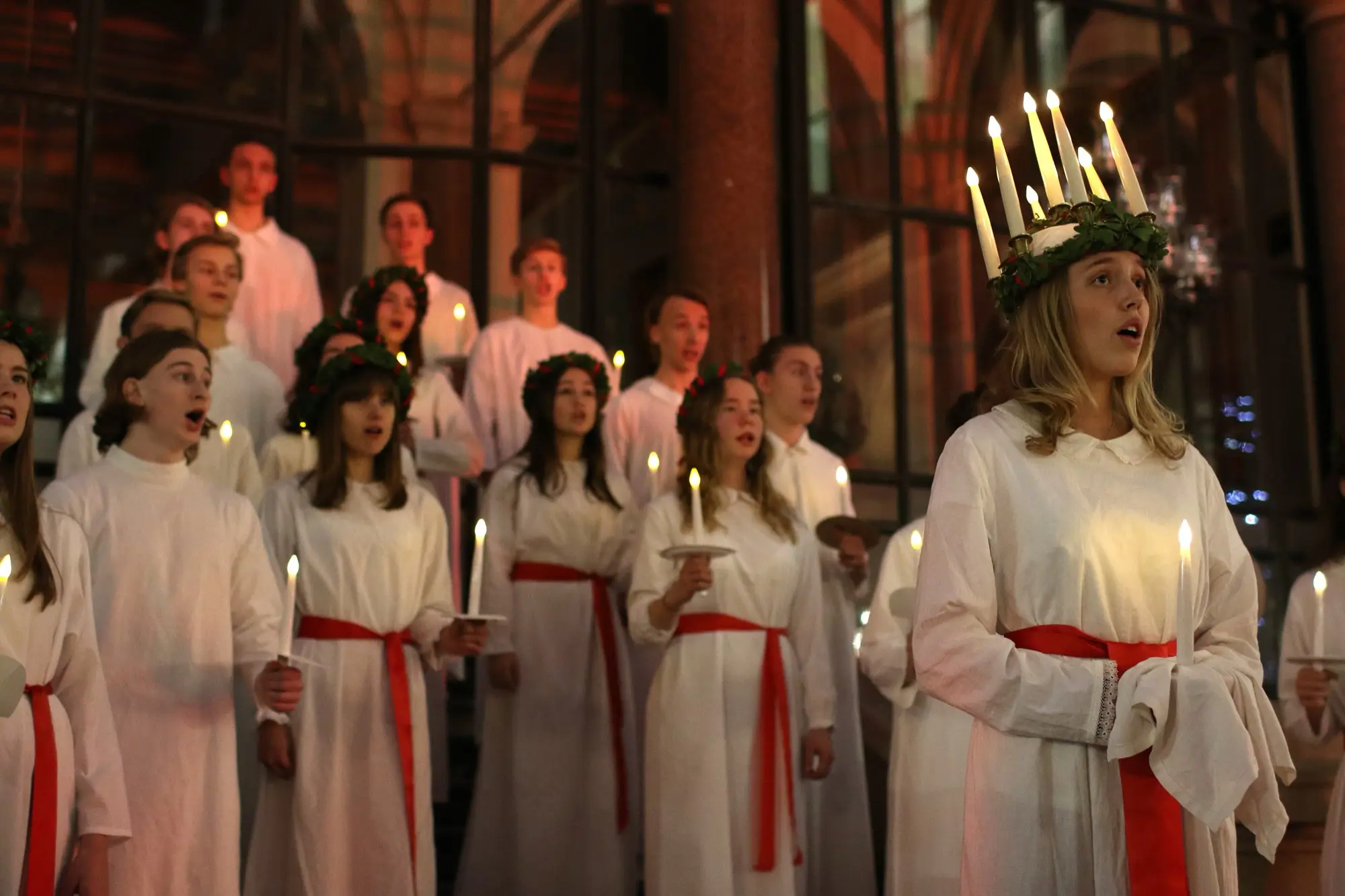

On 13 December Sweden celebrates Lucia with candlelit processions (luciatåg) led by Lucia in white with a crown of lights, followed by handmaidens, star boys and gingerbread men, singing "Sankta Lucia". Spectators eat saffron buns (lussekatter), gingerbread and glögg (mulled wine). In 2026 Skansen holds public celebrations on 12 and 13 December.
When and what Lucia is
Sweden celebrates Lucia Day, also called Saint Lucy's Day, on 13 December. According to Visit Sweden, the Lucia tradition is as integral to Swedish culture as Midsummer and crayfish parties. Lucia forms a central part of wider Swedish traditions observed across the country. It stands for light in a dark winter.
The luciatåg processions, led by Lucia, are broadcast on national television and performed across the country in kindergartens, schools, care homes, churches and offices.
Where to see Lucia in 2026
Visitors can see Lucia in churches, town halls and even restaurants. Celebrations in schools and workplaces are generally private, but several major public events take place across the country in 2026.
Many Lucia concerts are popular and need booking in advance. If you plan to spend time in Stockholm in December, the open-air museum Skansen hosts several Lucia celebrations on 12 and 13 December; read our practical guide to Skansen before your visit. Further south, you can explore things to do in Gothenburg, where the city holds a public Lucia parade with vehicles from different eras along the main boulevard, Avenyn, ending with a performance at Götaplatsen.
Churches and cathedrals stage some of the largest choral events:
- Lund Cathedral, one of Sweden's most visited churches and dating from the 12th century, holds Lucia concerts from 11 to 13 December.
- Uppsala Cathedral, the largest cathedral in the Nordic countries, holds several concerts on 13 and 14 December, including one adapted for children.
There are also regional traditions. Dalarna's lussibrud (Lussi bride) is a local version featuring folk costumes and music. It is performed in towns across Dalarna and at Nordiska museet in Stockholm in November and December, though the 2026 performances are sold out.
If you cannot attend an event in person, the national televised Lucia celebration is traditionally broadcast on 13 December, and the public broadcaster's streaming service, SVT Play, carries the programme.
Who walks in the procession
By tradition Lucia appears before dawn, but for practical reasons many events are held at dusk. Most Swedes know the main Lucia song, "Sankta Lucia", by heart.
Lucia leads the procession, followed by several traditional figures:
- Lucia wears a white gown and a crown of lights. Real candles have given way to battery-powered ones for safety.
- Handmaidens (tärnor) wear white, with glitter or a wreath without candles in their hair, and glitter or a red ribbon at the waist.
- Star boys (stjärngossar) wear white with cone-shaped hats and carry sticks with stars.
- Gingerbread men (pepparkaksgubbar) carry lanterns and wear full gingerbread costumes, which are sold in many Swedish shops.
- Children taking part may also dress as Christmas elves (tomtenissar).
Lussekatter, gingerbread and glögg
Lucia also brings treats. The Swedish painter Carl Larsson is among the artists who painted her carrying a tray of treats for fika, the Swedish coffee break. The festivities tie closely into broader customs for celebrating Christmas in Sweden.
The classic baked items are crisp gingerbread biscuits and the S-shaped saffron bun, known as a lussekatt. These saffron buns are a staple of Swedish food traditionally kept for the weeks before Christmas. Lucia often brings vegan versions of the baking now.
To drink alongside the pastries, people serve glögg with almonds and raisins, or coffee.
Where Lucia comes from
Lucia Day goes back to the 4th century. It commemorates Lucia of Syracuse, who, by legend, brought food to Christians hiding in the Roman catacombs, lighting her way with a crown of candles.
The timing also links to the seasonal calendar. Under the old Julian calendar, 13 December was the shortest day. In Swedish folklore the long night was dangerous, so people stayed awake and ate to keep safe.
Lucia's first recorded appearance in a Swedish country home took place in 1764, but the custom only took hold across the country in the 1900s. As documented by Skansen, the open-air museum held its first Lucia procession in 1893, when founder Artur Hazelius wanted to bring old folk customs to a wider public.
Today at Skansen, Seglora church, which was built in the 1700s, hosts a traditional procession and Lucia concerts around 13 December. Nearby, the museum's Ordenshuset shows a Lucia celebration as it could look in the 1920s.
The selection of Lucia has also changed over time. Newspapers once had readers vote for a national and local Lucia from photographs. That practice is gone, and many schools now choose to share the role among participants.