
The main things to do in Gothenburg are visiting Liseberg amusement park, walking Haga, viewing Skansen Kronan, browsing Feskekörka and Stora Saluhallen, visiting Universeum science centre, exploring Röhsska and the Gothenburg Museum of Art, relaxing in Slottsskogen, strolling the Botanical Garden, discovering Majorna, and taking ferries to the car-free southern archipelago islands from Saltholmen. Haga, Skansen Kronan from the outside, Feskekörka, Stora Saluhallen, Slottsskogen, Majorna and the islands are free to explore, while the Botanical Garden has a voluntary SEK 30 fee, and under-20s get free entry to Röhsska and the art museum. If you are comparing cities or planning onward travel, see our guide to things to do in Stockholm or the wider Sweden travel guide.
1. Liseberg: the amusement park, in its Christmas season until 30 December
Liseberg is an amusement park in central Gothenburg that charges an admission fee. Christmas at Liseberg runs from 14 November to 30 December, followed by a Christmas break in Kaninlandet from 31 December to 10 January, while the 2027 summer season runs from 17 April to 26 September. Admission to Christmas at Liseberg costs from SEK 125 online, and admission with a ride pass during Christmas at Liseberg costs from SEK 285 online. Daily opening times are published in Liseberg's own calendar. Children under 110 cm tall get free admission to the park. Göteborg & Co calls Christmas at Liseberg Sweden's largest Christmas market, and the park features the five million lights of Liseberg alongside winter rides, markets, and Luma Celestia, a starlit illuminated trail that Göteborg & Co describes as a new kilometre-long light trail. For a full breakdown of dates and ride passes, consult our guide to Liseberg tickets, prices and opening dates. To compare holiday markets across the country, see our overview of Swedish Christmas markets. Tickets for summer and Halloween 2027 have not been released yet, and Liseberg's Oceana water world opens in 2027. Korsvägen is the nearest public transport interchange.
2. Haga and Café Husaren: cobbled streets and the giant Hagabullen
Haga is a historic central neighbourhood that is free to explore, with shops and cafés charging individually. Haga was planned as Gothenburg's first suburb in the middle of the 17th century, on the orders of Queen Kristina, and was once home to many seamen. The district is known for its landshövdingehus (governor houses), which have a ground floor in stone and two wooden floors on top, built between 1870 and 1940. Haga Nygata is the neighbourhood's main shopping street, located just south-west of the moat (Vallgraven), where the closest tram stops are Hagakyrkan and Järntorget. In winter, you can explore neighbourhood stalls alongside other festive stops across town in our guide to Gothenburg Christmas markets. At Haga Nygata 28 stands Café Husaren, which keeps one of very few preserved glass roofs from 1896. The café baked the first Hagabulle in 1985; its giant kanelbulle (cinnamon bun) is, in the words of Göteborg & Co, large enough to hide a child's face behind. To learn more about Swedish baked traditions, read about traditional Swedish food.
3. Skansen Kronan: the fortress above Haga, seen from the outside
Skansen Kronan is a stone redoubt set on a hill above Haga at Leijonsparres väg 15, free to view from the outside. The former fortress is not open for spontaneous visits, serving as a venue for weddings, parties and conferences, though it is worth seeing from the exterior and offers a view over the city. Designed by Erik Dahlbergh, it was completed in 1700 and equipped with 23 cannons, though it was never attacked. The fortress is reached on foot up the hill paths from Haga, with Hagakyrkan and Järntorget serving as the closest tram stops below.
4. Feskekörka: the fish church by the canal
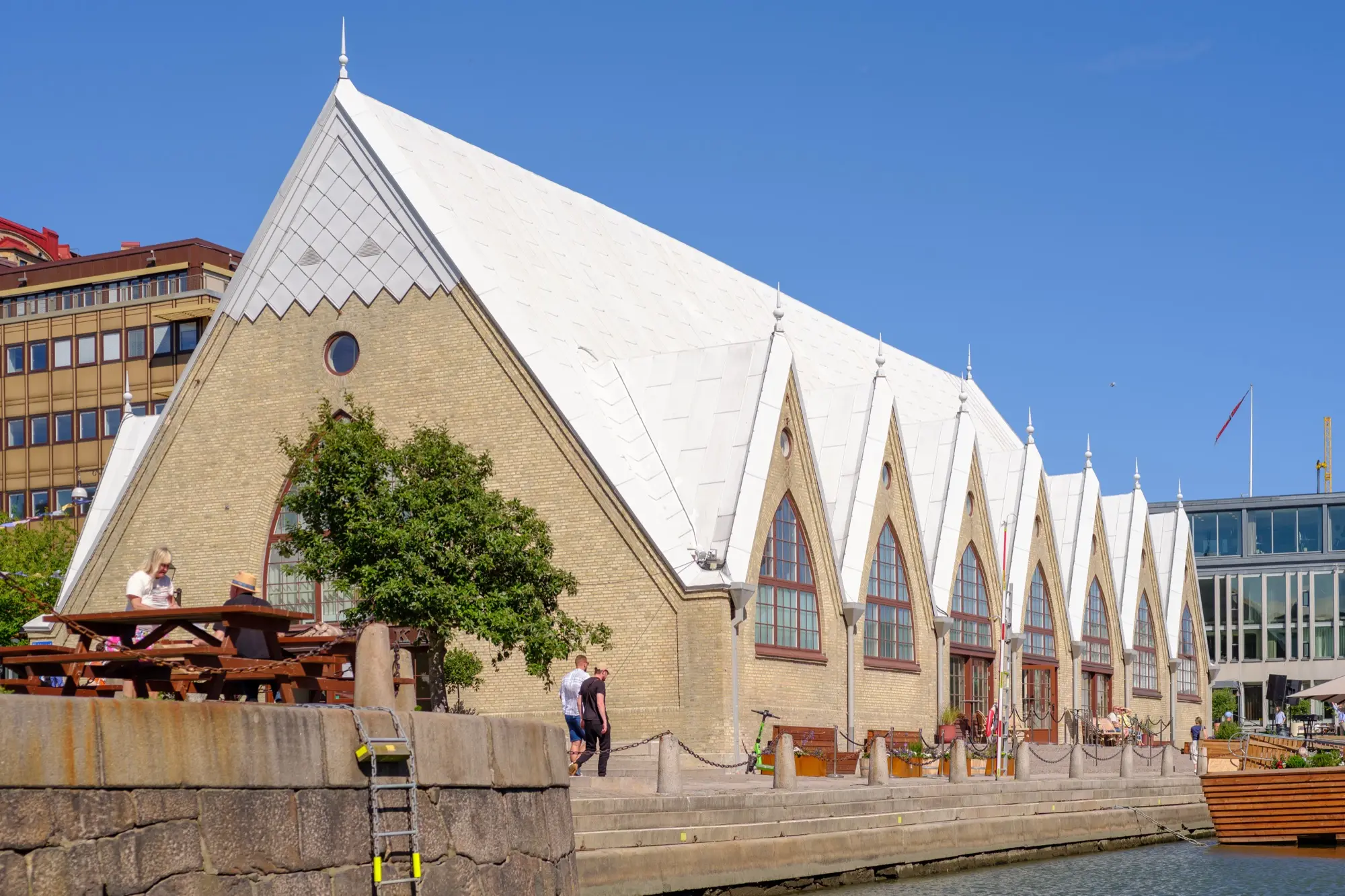
Feskekörka is an indoor seafood hall on Fisktorget 4 beside the canal that is free to enter, with purchases paid at the counters and restaurants. It has been a seafood destination since 1874, taking its name from its church-like style featuring pointed arched windows and no interior partitions or pillars. Following a few years of renovation, Feskekörka has reopened with fish counters alongside new restaurants and bars. The fish counters are open Tuesday to Thursday 10:00-18:00, Friday 10:00-18:30 and Saturday 10:00-17:00. Haldis kök & Ekmans bar inside is open Monday to Wednesday 11:30-20:00, Thursday 11:30-21:00, Friday 11:30-22:00, Saturday 12:00-22:00 and Sunday 12:00-20:00. The nearest tram stop is Grönsakstorget.
5. Stora Saluhallen: the market hall on Kungstorget, closed on Sundays
Stora Saluhallen is a covered market hall located on Kungstorget in the city centre, free to enter with goods and meals paid individually. It has operated as Gothenburg's market hall since 1888. Regular opening hours are Monday to Wednesday 10.00-18.00, Thursday and Friday 10.00-19.00 and Saturday 10.00-17.00, with doors closed on Sundays. Over the holiday period, it opens 11.00-16.00 on 20 December, is closed 24-26 December, opens 10.00-15.00 on New Year's Eve, and is closed on New Year's Day and 6 January. From the new year (2027) it opens 10.00-18.00 on Thursdays. Kungsportsplatsen and Grönsakstorget are the closest tram stops.
6. Universeum: the science centre at Korsvägen, open every day
Universeum is a national science centre located at Södra vägen 50 next to Liseberg, requiring paid admission. It is open Monday to Sunday 10:00 am-6:00 pm, operating every day of the year. Adult tickets vary as prices follow demand, meaning the most popular days are the most expensive, and tickets bought at the door cost SEK 30 more than the online price. Children under 3 enter free but need their own free admission ticket, while a Wisdome dome film requires a separate Wisdome ticket. The centre is cash-free and takes cards only. The North Sea aquarium is closed for a renovation lasting just under a year, while all other aquariums remain open as usual. From 13 November to 14 March, Universeum runs its space weeks featuring space adventures and hands-on experiments. The nearest stop is Korsvägen, which sits about 20 minutes' walk from the Central Station.
7. Röhsska: the museum of design and craft, free under 20
Röhsska is Sweden's museum of design and craft, situated at Vasagatan 37-39, charging an entrance fee for adults. It is open Tuesdays-Wednesdays 11 am - 6 pm, Thursdays 11 am - 8 pm and Fridays-Sundays 11 am - 5 pm, while remaining closed on Mondays and on Christmas Eve, Christmas Day, New Year's Eve and New Year's Day. Adult admission is SEK 75, or visitors can buy the museum card for SEK 150. Admission is free for visitors under 20 and for students with ID. The museum card is valid at Röhsska, the Gothenburg Museum of Art, the Museum of Gothenburg and the Maritime Museum and Aquarium. Inside, the permanent collection includes more than 500 chairs, and from 7 November 2026 to 5 June 2027 the exhibition Ilona Sagar: Omsorgens arkitektur examines Alvar and Aino Aalto's tuberculosis sanatorium in Paimio, Finland. St Agnes, the café inside Röhsska, bakes vegan cinnamon buns. The nearest bus and tram stop is Valand.
8. Göteborgs konstmuseum: the art museum at Götaplatsen, free under 20
Göteborgs konstmuseum is an art gallery at Götaplatsen, at the top of Kungsportsavenyn, charging entry for adults. The museum is open Tuesday 11 am to 6 pm, Wednesday 11 am to 8 pm, Thursday 11 am to 6 pm, and Friday to Sunday and holidays 11 am to 5 pm; it is closed on Mondays, Christmas Eve, Christmas Day, New Year's Eve and New Year's Day. A single-entry ticket costs SEK 75; the museum card costs SEK 150, or SEK 130 for seniors, and is valid for one year from purchase. Children and young people under 20 get in free to all exhibitions, and students with a valid student ID get in free except to exhibitions with a higher admission fee. The museum is cashless; you pay by card or Swish. Its collection shows works by Rembrandt, Picasso and Van Gogh alongside contemporary artists. The nearest bus stop is Götaplatsen, while the Valand and Berzeliigatan tram stops are also nearby.
9. Slottsskogen: the free city park, with elk and penguins
Slottsskogen is an expansive public park located south-west of the city centre that is free to enter. The grounds have been Gothenburg's park since 1874 and are always open. Its open-air park zoo is open all year round with completely free admission, housing elk, sheep and Humboldt penguins. A children's petting zoo and pony rides operate within the grounds seasonally from April to September. For seasonal weather and trip timing advice, see our guide on the best time to visit Gothenburg. The nearest tram stops providing access to the perimeter include Linnéplatsen, Botaniska Trädgården and Majvallen.
10. The Botanical Garden: open around the clock, SEK 30 voluntary
The Gothenburg Botanical Garden (Göteborgs botaniska trädgård) is a public botanical institution at Carl Skottsbergs gata 22A with voluntary admission. The outdoor grounds are open every day of the year, around the clock, with a voluntary entrance fee of SEK 30. The visitor centre is open weekdays 11.00-17.00 and at weekends 12.00-16.00. First inaugurated in 1923 for Gothenburg's 300th anniversary, the grounds hold 20,000 unique plants from 130 countries. New greenhouses and a visitor centre are currently being built, meaning the main greenhouses are closed during construction until the new houses are ready in 2028 and open to the public in 2030; however, the finished Bergshuset and bulb garden can be visited, with Bergshuset open from 10:00 to 16:00. The nearest tram stop is Botaniska Trädgården.
11. Majorna: vintage shops, landshövdingehus and Stigbergstorget
Majorna is a residential and cultural neighbourhood west of the centre that is entirely free to wander. The district includes Stigberget, which holds many concert venues and restaurants, alongside the historic Klippan area situated along the Göta älv. Majorna holds the city's largest collection of preserved landshövdingehus timber-and-stone tenements. It has many vintage shops, including several in a row between the tram stops Stigbergstorget and Majvallen, though these small shops keep varying opening hours. On Mariagatan, the organic artisan bakery Cum Pane bakes classic cinnamon rolls. Stigbergstorget, Chapmans Torg and Majvallen are the primary tram access points.
12. The southern archipelago from Saltholmen: car-free islands on a zone A ticket
The southern archipelago consists of car-free islands accessible by scheduled passenger ferries from Saltholmen. The islands are car-free and reached all year round on the Styrsöbolaget ferries, which run as part of Västtrafik's regular transit network. Because the islands belong to the main zone, a zone A ticket is all you need for both the tram or bus to Saltholmen and the ferry ride itself. Single adult tickets cost SEK 38 at the regular price in the Västtrafik To Go app (valid for 90 minutes across trains, buses, trams and ferries), or you can tap a bank card on board in zone A. A Västtrafik zone A day ticket gives unlimited travel in Gothenburg, Mölndal, Partille and Öckerö for 24 or 72 hours, and allows three people under 20 to travel free alongside an adult holding an app ticket.
Saltholmen is reached from the city by tram 11 (and line 9 in summer) in about 35 minutes, or by bus 114 (Ö-snabben) in about 25 minutes. Parking at Saltholmen terminal is restricted strictly to people with reduced mobility. From Saltholmen, line 281 runs via Styrsö Bratten and Donsö to Vrångö, line 282 via Styrsö Tången to Brännö Husvik, and line 283 via Asperö to Brännö Rödsten. Asperö is a 10-20-minute ride from the terminal, where flatbed mopeds are used for local transport. Line 281 and 282 ferries also offer direct city departures from Stenpiren to Styrsö, Donsö and Vrångö, which take about 1 hour and 35 minutes, limited to two departures a day Monday to Friday plus weekends in summer. Ferries usually leave once an hour for the larger islands, running more frequently during peak season. Some services have onboard cafés taking bank card or Swish; bicycles are transported only if there is room on board. Check daylight in Gothenburg when organising winter outings.
13. Styrsö: the hub of the southern islands
Styrsö is an inhabited, car-free island in the middle of the southern archipelago, free to explore beyond ferry transit fares. It is home to around 1400 inhabitants and functions as an island hub with a post office, shops, cafés, guesthouses and restaurants. The island contains four small villages, including its oldest, Byn, which retains a church dating from 1752. Kusthotellet Styrsö, located near the Bratten pier, opened in August 2025 with 50 rooms, including 10 suites. Walkers can ascend Stora Rös, the island's highest elevation point, which provides a view over the whole archipelago. A short road bridge connects Styrsö directly to neighbouring Donsö, which features swimming spots and sits 15 minutes by ferry from Saltholmen. Ferries serve Styrsö Bratten and Styrsö Tången.
14. Vrångö: the southernmost island, with sandy beaches
Vrångö is the southernmost island of the Gothenburg archipelago, free to visit aside from the ferry journey. Around 380 year-round residents live here, supported by an active fishing trade with six fishing boats operating from its port. The island is best known for its nature reserves, walking trails and sandy beaches. It has operated as a pilot station since the 17th century, and the old pilot house still stands, providing a panoramic view. In the marina, visitors can access the small hotel Kajkanten Vrångö alongside the restaurant Hamnkrogen Lotsen. Line 281 docks at the Vrångö ferry pier.
15. Brännö: summer dances at the pier and two ferry stops
Brännö is an island of just over 900 inhabitants in the car-free southern archipelago, free to wander on foot. It is known for its traditional summer dances and child-friendly beaches. Ferries call at two ports: Brännö Husvik on the southern side and Brännö Rödsten on the northern side. During the summer season, traditional outdoor dances take place on the pier at Rödsten, known as Brännö Brygga. Bikes can be hired on the island at Aroniagården. A sandy beach and bathing piers are located at Gröna vik, about a kilometre from Rödsten pier. Off the western shore, a small bridge leads to Galterö, an uninhabited former military reserve known for untouched nature and birdlife.
Frequently asked questions
Which Gothenburg archipelago islands are car-free?
All islands in the southern archipelago are entirely car-free, including Styrsö, Vrångö, Brännö, Asperö and Donsö. In the northern archipelago, Grötö is also car-free, with only about 100 year-round residents and no cars.
How do you get to Grötö?
To reach Grötö in the northern archipelago, take the free road ferry from Lilla Varholmen to Björkö (Grönevik), which runs every 30 minutes between 5 am and 10 pm. From Grönevik, walk across to the Framnäs ferry terminal and board passenger ferry 296 out to Grötö. The passenger ferry ticket costs the same as standard public transport tickets in Gothenburg.
What public transport ticket covers the southern archipelago ferries?
The passenger ferries to the southern archipelago operate as part of Västtrafik's regular public network. A standard zone A ticket covers the journey. An adult single ticket costs SEK 38 at the regular price in the Västtrafik To Go app and remains valid for 90 minutes. A zone A day ticket covers 24 or 72 hours of travel.
What are the top free sights in Gothenburg?
Slottsskogen city park and its zoo are open all year round with completely free admission. Skansen Kronan can be viewed freely from the outside. The Botanical Garden grounds are open around the clock every day with an optional voluntary entry fee of SEK 30. Visitors under 20 and students with ID also receive free admission to both Röhsska and Göteborgs konstmuseum.
What are the dates for Christmas at Liseberg?
Christmas at Liseberg runs from 14 November to 30 December. This is followed immediately by a Christmas break in the Kaninlandet section from 31 December to 10 January. The park then pauses operations before the 2027 summer season opens on 17 April.