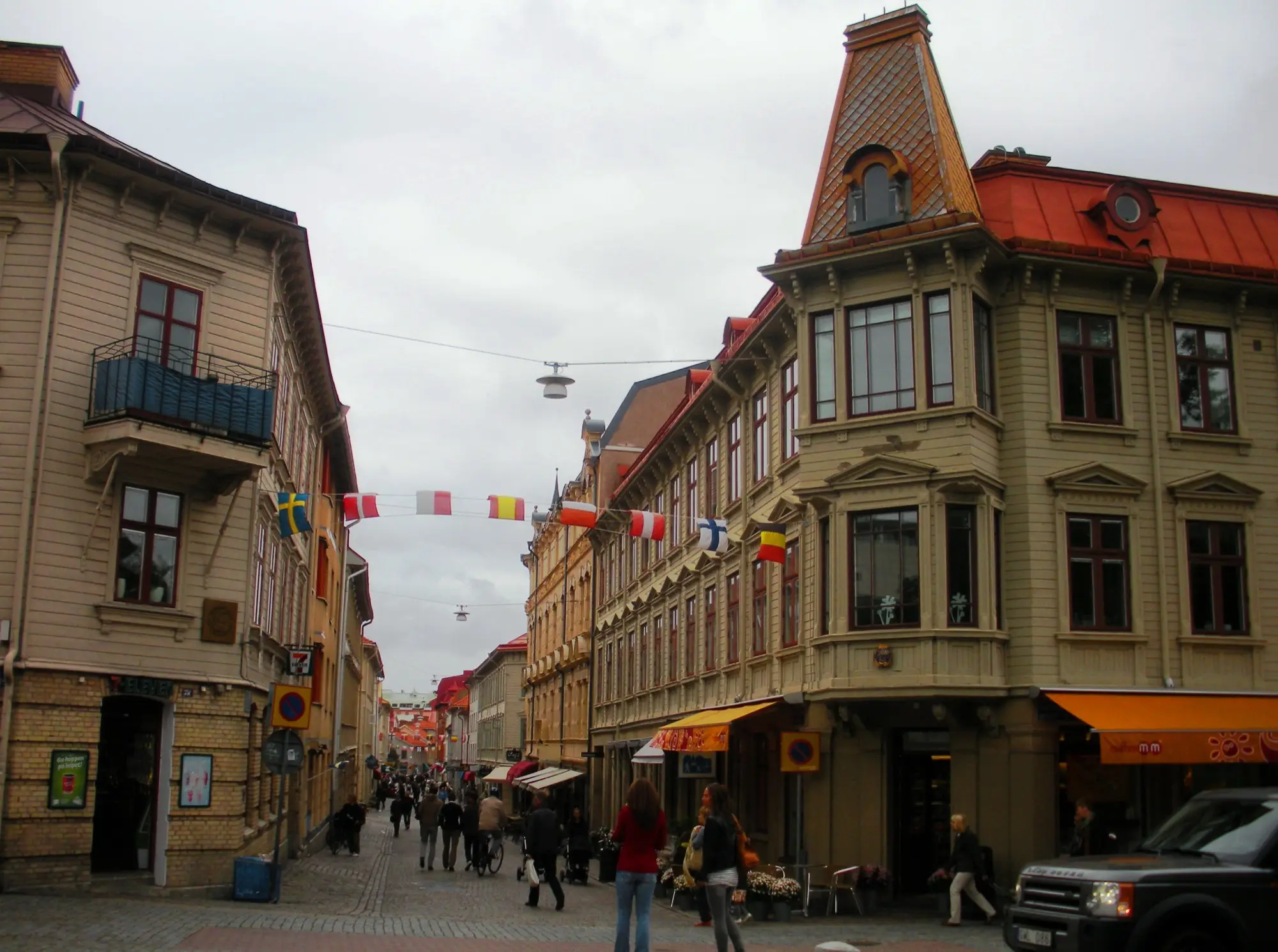

Gothenburg is mild and wet, recording an annual mean temperature of 8.9 °C and 912.0 mm of precipitation, making it the wettest of five key Swedish meteorological locations. Visit between mid-April and September for the summer opening of Liseberg and ferry trips around the car-free southern archipelago. Alternatively, plan a trip from mid-November onward to see the city's seasonal displays and Christmas markets.
Gothenburg's weather, in short
Sweden's meteorological and hydrological institute (SMHI) provides official normal values based on the standard 1991–2020 reference period established by the World Meteorological Organization (WMO). You can view the full figures on SMHI's data series page.
At the Göteborg A weather station, monthly normal mean temperatures run from 0.8 °C in January and 0.7 °C in February up to 18.3 °C in July, producing an annual mean of 8.9 °C. Rainfall is frequent throughout the year. Normal yearly precipitation reaches 912.0 mm at Göteborg A, which is higher than the other monitored Swedish locations: Malmö A records 658.1 mm, Stockholm records 546.4 mm, and Kiruna airport records 561.3 mm. October is Gothenburg's wettest month at 102.9 mm, whereas Stockholm peaks in August at 66.2 mm and Kiruna airport peaks in July at 103.9 mm. To see how these conditions compare across the country, see our overview of how cold Sweden gets.
Gothenburg month by month
The table below details the 1991–2020 normal mean temperatures, mean daily highs, and normal monthly precipitation recorded at the Göteborg A station.
| Month | Normal mean temperature (°C) | Mean daily high (°C) | Normal precipitation (mm) | Seasonal notes |
|---|---|---|---|---|
| January | 0.8 | 3.0 | 83.0 | Christmas break in Kaninlandet ends 10 January |
| February | 0.7 | 3.2 | 61.0 | Lowest monthly normal mean temperature |
| March | 3.0 | 6.4 | 54.0 | |
| April | 7.7 | 12.1 | 51.3 | Average last spring frost 18 April; Walpurgis Night parade |
| May | 12.4 | 16.9 | 54.3 | |
| June | 15.7 | 20.0 | 73.7 | Summer solstice brings 18h 06m of daylight |
| July | 18.3 | 22.4 | 81.3 | Warmest month of the year |
| August | 17.7 | 21.8 | 92.8 | |
| September | 14.0 | 17.7 | 80.0 | Summer theme park season concludes |
| October | 9.0 | 12.0 | 102.9 | Wettest month; average first autumn frost 27 October |
| November | 5.1 | 7.2 | 84.7 | Christmas season begins mid-November |
| December | 2.1 | 4.2 | 93.0 | Winter solstice brings 6h 32m of daylight |
Daylight
Because of the city's latitude, day length varies substantially between seasons. On the summer solstice on 21 June, sunrise is at 04:11 and sunset is at 22:16, providing 18h 06m of daylight. Gothenburg experiences neither the midnight sun nor polar night.
By the winter solstice on 21 December, daylight shrinks to 6h 32m, with the sun rising at 08:54 and setting at 15:26. Detailed schedules throughout the year are outlined in our guide to Gothenburg's daylight.
Spring and Walpurgis
Spring temperatures climb gradually from an average high of 6.4 °C in March to 16.9 °C in May. At Göteborg A, the final spring frost arrives on 18 April on average.
Every year on 30 April, the city celebrates Walpurgis Night (Valborgsmässoafton, spring welcome eve). Gothenburg marks the occasion with the Cortègen, an annual parade of home-made vehicles that has run through the city streets every year since 1909.
Spring also marks the reopening of the city's main amusement venue. The 2027 summer season runs from 17 April to 26 September. Summer and Halloween 2027 tickets are not on sale yet.
Summer: Liseberg and the archipelago
Summer brings the warmest weather of the year, with July mean daily highs reaching 22.4 °C. Days reaching 25 °C or higher average 20.7 a year at Göteborg A, occurring almost entirely across June, July, and August. By comparison, Stockholm averages 23.9 such days, Malmö A averages 19.6, Östersund-Frösön records 6.2, and Kiruna airport averages 2.8.
Liseberg operates across three separate seasons each year: summer from April to September, Halloween over the school autumn break, and Christmas from mid-November to New Year. Most summer music is included in standard admission, though concerts staged on the main stage (Stora scenen) require a separate ticket.
Summer is also prime time to explore the coastline, and taking a ferry is one of the classic things to do in Gothenburg. The islands of the southern archipelago are car-free and remain accessible all year on the Styrsöbolaget passenger ferries. These vessels operate under Västtrafik's standard transit network, meaning a regular zone A ticket is all you need to board.
To reach the ferry terminal at Saltholmen from central Gothenburg, take tram 11 (joined by tram line 9 in summer), which takes about 35 minutes. You can also take bus 114 (Ö-snabben, the island express bus) in roughly 25 minutes. Ferries depart about once an hour for the larger islands, running more frequently during the peak season.
Autumn and Christmas
Precipitation increases in autumn, culminating in October, which is the wettest month of the year with 102.9 mm of rain. November follows with 84.7 mm, and December receives 93.0 mm. Gothenburg's first autumn frost falls on 27 October on average.
Despite the darker days and damp weather, tourism picks up again in mid-November for the holidays. At Christmas, Liseberg sets up lit-up areas, outdoor Christmas markets, winter ride operations, and seasonal food stalls. Admission to Christmas at Liseberg costs from SEK 125 online.
For 2026, Christmas at Liseberg runs from 14 November to 30 December. The park is open 14–15, 20–22, and 27–29 November, as well as 2–6, 9–13, 16–23, and 26–30 December 2026. This is followed by a winter break opening in the children's area, Kaninlandet (the Rabbit Land), from 31 December to 10 January. You can explore the rest of the seasonal stalls across town in our guide to Gothenburg's Christmas markets.