Sweden has a reputation for high prices, but official data reveals a divided picture. Day-to-day supermarket staples, capped childcare and subsidised local travel contrast with dining out, alcohol and the Stockholm rental queue. What you spend depends on where you secure housing and your stage in the relocation process, as outlined in the guide to moving to Sweden.
How Swedish prices compare with the rest of the EU
In 2025, Sweden's price level for household consumption was 121, against an EU average of 100, according to Eurostat comparative price data. Finland also stood at 121 in 2025. Sweden remained below Norway (129) and Denmark (140), the latter being the highest in the EU at 40% above the average.
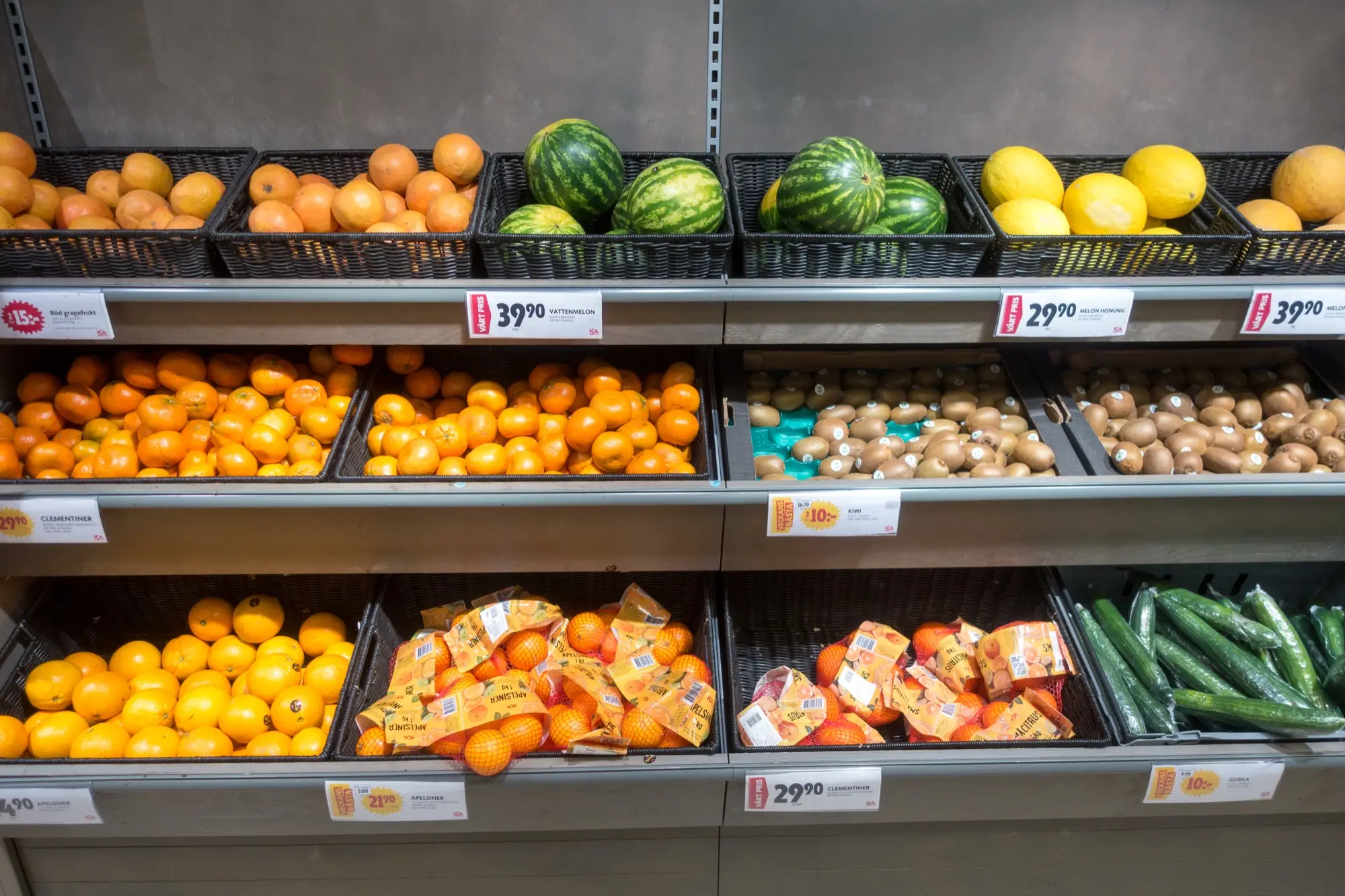
In 2025, food and non-alcoholic drinks in Sweden were priced at 109.9 against an EU average of 100, which is much closer to the average than prices overall. By contrast, restaurants and accommodation stood at 123.4, and alcoholic drinks at 149.8, against the EU baseline of 100.
In September 2026, inflation measured by Sweden's consumer price index (KPI, or konsumentprisindex) was 1.1%. Measured by KPIF (consumer price index with a fixed interest rate), which is the target measure used by the central bank (Riksbanken), it was 1.5%.
Rent in Sweden and in Stockholm
According to official figures from Statistiska centralbyrån (SCB), the average monthly rent for a flat in Sweden in 2026 was:
- One room: SEK 5,640
- Two rooms: SEK 7,742
- Three rooms: SEK 9,528
- Four or more rooms: SEK 12,158
A three-room rental averaged SEK 10,600 a month in Greater Stockholm in 2026. By comparison, a flat of the same size averaged SEK 9,346 in Greater Gothenburg, SEK 10,825 in Greater Malmö and SEK 8,470 in municipalities with fewer than 75,000 residents. A household in a municipality with fewer than 75,000 residents pays approximately SEK 2,100 a month less for a three-room flat than one in Stockholm.
Per square metre, monthly rent in 2026 averaged SEK 148 in Greater Stockholm, SEK 133 in Greater Gothenburg, SEK 142 in Greater Malmö, SEK 112 in smaller municipalities and SEK 129 nationally. Overall, rents across Sweden rose by an average of 3.3% between 2025 and 2026. While this was down from 4.6% in 2025 and 5.0% in 2024, it stayed above the 2010–2022 level.
The Swedish rents reported by SCB include heating and water, but not household electricity or a paid parking space. A newly built three-room rental flat averaged SEK 13,571 a month in 2025; new-build rents were SEK 2,565 per square metre a year, which was about 10.3% higher than in 2024.
In 2024, Swedish households spent a median of 23% of their disposable income on housing. Renters spent 27%, owners of a cooperative flat (bostadsrätt) spent 21% and homeowners spent 18%, primarily because renters typically have lower average incomes. To set these figures against earnings, see the guide to Sweden's minimum wage and salaries.
The rental queue in Stockholm
Stockholm's municipal housing queue allocated 20,861 homes in 2025. The average queue time for a standard rental was 9.0 years, rising to 12.4 years within the City of Stockholm.
Securing a rental in Stockholm's inner city required an average of 21 years of queueing in 2025; most people who obtain a flat have queued for roughly 4 to 13 years. In Södertälje, Sigtuna, Salem, Österåker, Tyresö, Upplands-Bro and Sollentuna, the average queue time was under 5 years in 2025.
Queue times in 2025 also varied across flat categories:
- Newly built flats: 5.8 years on average (against 9.6 years for older flats)
- Student housing: about 4.5 years
- Senior flats: about 10 years
- Short-term contracts (korttidskontrakt): about 12.5 years
On 31 December 2025, there were 894,592 people registered in the queue, but only 88,918 (10%) were actively applying. Registration in Bostadsförmedlingen's queue costs SEK 200 a year, and missing a payment results in losing your queue time. Because of these waiting times, newcomers realistically have to look at new builds or the second-hand market. You can also read how to apply for a Swedish personal identity number.
Food and groceries
Konsumentverket's 2026 calculations put food costs at about SEK 2,730 a month for an adult and SEK 8,440 for two adults and two children (aged 4–6 and 7–10), with an extra SEK 50–250 for a special diet.
Konsumentverket's 2026 food figures are lower than the previous year's mainly because the agency changed its menu and methodology, rather than because food prices are expected to fall significantly. Value added tax (moms) on food was temporarily cut from 12% to 6% between 1 April 2026 and 31 December 2027. Konsumentverket found the VAT cut was passed on in full by grocery shops—food prices fell by 5.5% when the cut took effect in April 2026—but only to a limited extent for takeaway food from restaurant chains.
According to SCB price statistics, food in September 2026 was 6.5% cheaper than a year earlier, whereas restaurant and café prices were 2.6% higher, and rents for flats were 3.3% higher.
Electricity and household bills
Sweden is split into four electricity price areas, from SE1 (Luleå) in the north to SE4 (Malmö) in the south; Stockholm is in SE3. Electricity is typically cheaper in areas with high generation and low consumption, which is why the north is usually cheaper than the south.
As a single-week example of this north–south divide, in week 42 of 2026 the average wholesale spot price, before grid fees, tax and VAT, was:
- SE1: 35.4 EUR/MWh
- SE3 (Stockholm): 85.3 EUR/MWh
- SE4: 154.7 EUR/MWh
On top of the electricity price, the 2026 energy tax (energiskatt) is 45 öre per kWh including VAT, and is billed on the grid invoice. This amounts to SEK 900 a year for 2,000 kWh. Electricity prices in September 2026 were 17% higher than a year earlier, having risen by 11.7% between August and September.
Getting around Stockholm
From 1 July 2026 to the end of the year, SL's adult 30-day ticket costs SEK 530 and the reduced ticket is SEK 325 (half price). This half-price rate is funded by a temporary government subsidy aimed at 30-day tickets. It applies to 30-day tickets bought from 1 July to 1 December 2026, including monthly subscriptions, while 90-day, annual and single tickets are not covered.
The full adult prices set by SL from 8 January 2025 were SEK 1,060 for 30 days, SEK 11,130 for a year and SEK 43 for a single 75-minute ticket. SCB recorded local public transport as being 25.8% cheaper in September 2026 than a year earlier, a drop it attributes to these reforms.
Childcare, healthcare and the public service fee
From 1 July 2026, the maximum preschool (förskola) fee is 3% of household income, capped at SEK 1,547 a month for the first child, SEK 1,031 for the second and SEK 516 for the third. The highest fee is charged for the youngest child, and no fee is paid from the fourth child onwards. From 1 July 2026, the first SEK 10,000 of household income is ignored when setting the fee; households earning under SEK 10,001 pay nothing, and the fee stops rising at SEK 51,560 a month of fee-assessed income (the income after this deduction). The background to these public charges is detailed in the overview of income tax in Sweden.
In Stockholm County (Region Stockholm), adults (aged 18–84) pay SEK 275 for an outpatient visit, SEK 375 at an urgent-care clinic (närakut) and SEK 400 at a hospital emergency department. A hospital stay costs a maximum of SEK 130 a day. Over a twelve-month period, you pay at most SEK 1,450 for outpatient visits and SEK 3,800 for prescription medicines. In Stockholm County, children and young people aged 0–17 pay no fees at health centres, urgent-care clinics or emergency departments, and people aged 85 or over pay no outpatient fees.
The public service fee (public service-avgift) that funds SR, SVT and UR is at most SEK 1,184 per person in 2026 (1% of taxable earned income below SEK 118,300). This is deducted alongside tax, meaning there is no separate bill.
Building a monthly budget
Konsumentverket's 2026 household cost figures are reasonable-standard estimates, rather than statistics, and cover only about 40% of a household's costs. The figures exclude housing, dental and healthcare, transport, childcare, holidays, cafés and restaurants.
Konsumentverket's 2026 example of a 20-year-old in their own two-room flat in a mid-sized town lists these baseline expenses:
- Rent: SEK 7,450 a month
- Household electricity: SEK 400
- Internet and mobile: SEK 1,000
- Home insurance: SEK 150
- Food: SEK 2,200 (weekday lunches not included)
In SCB's latest household budget survey from 2021, Swedish households spent an average of 21.9% of their outgoings on housing, 14.9% on transport and 13.6% on food and non-alcoholic drinks.