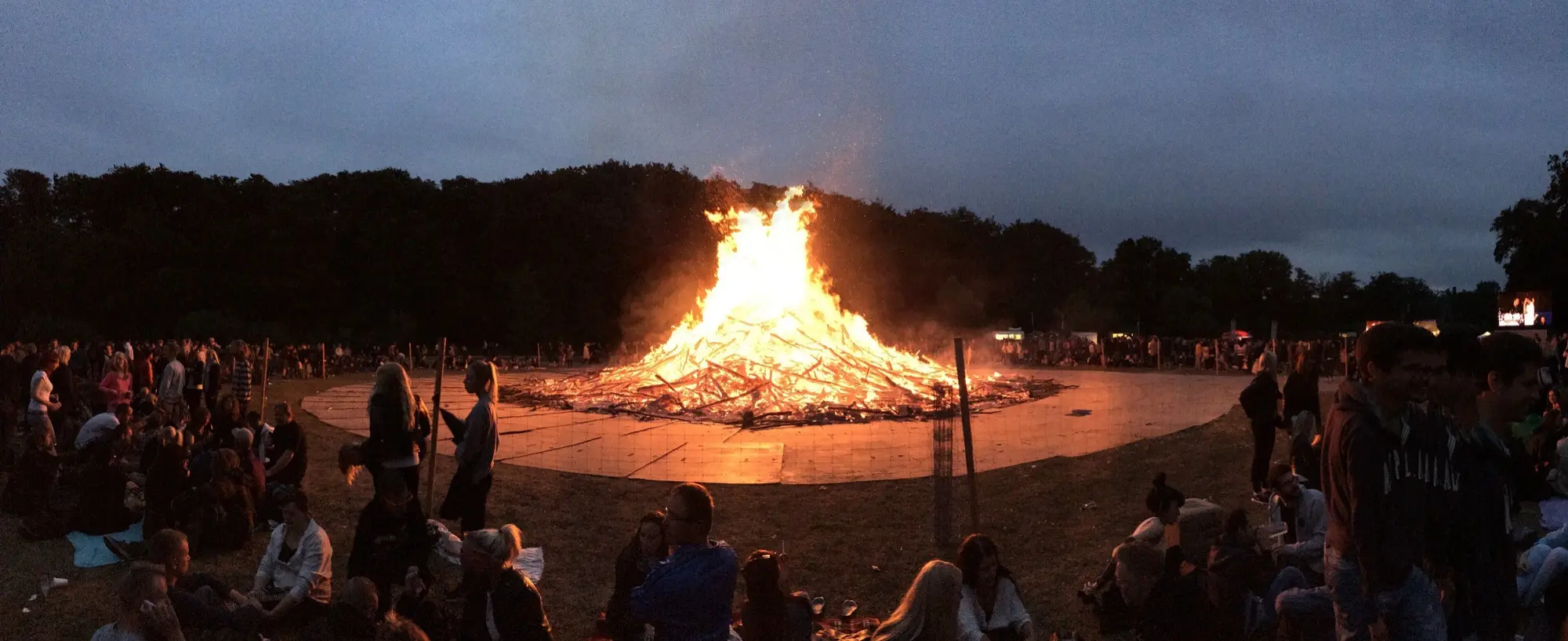

Sankthansaften, Saint John's Eve, is the evening of 23 June. Danes gather at bonfires at dusk, often by a beach or a lake, hear a speech and sing Midsommervisen, Holger Drachmann's song from 1885. It is celebrated across the country but is not a public holiday.
What Sankt Hans is
According to Lex (Den Store Danske), Sankthansaften (Saint John's Eve) is the evening of 23 June, which is the evening before Sankthansdag (Saint John's Day), said to be the birthday of John the Baptist. Sankt Hans is an old Danish name for John the Baptist.
Lex records that the modern celebration has roots both in pagan midsummer feasts and in the later Christian feast of John the Baptist. The occasion is celebrated all over Denmark, but it is not an official public holiday.
How the evening goes
The official portal denmark.dk explains that the height of the Danish summer is celebrated on the evening of 23 June. The evening usually begins with dinner at home with family and friends, before people take a walk to a community bonfire. You can prepare for the evening by reading about traditional Danish food for your meal.
Lex notes that people gather at bonfires around the country at dusk and sing Midsommervisen (The Midsummer Song). Bonfire sites are often in scenic places by woods or beaches. The celebration takes place at both public and private events, featuring bonfires, singing together and speeches. As described by denmark.dk, there are speeches, and the community sings Midsommervisen, written by the poet Holger Drachmann in 1885, as the bonfire burns. For June weather, see Denmark weather by month.
Midsommervisen
According to Lex, Midsommervisen is a Danish song from the fairy-tale play Der var engang (Once Upon a Time). The words were written by Holger Drachmann and the music was composed by P.E. Lange-Müller. The play opened in 1885.
The song has been a fixed part of the Sankt Hans bonfires on 23 June since the early 1900s. Lex notes that many think the song is hard to sing together. In 1980, the pop group Shu-bi-dua recorded their own tune to Drachmann's words, and that version has since been used as an alternative during the celebrations.
The witch on the bonfire
Folk belief held that evil forces were about on this night, and that witches flew past on their broomsticks on the way to Bloksbjerg or Hekkenfeldt, according to Lex. People around the country lit the witches home with bonfires, preferably on high ground. The idea of keeping evil away runs through many of the songs and bonfire speeches today.
Putting a witch figure on the bonfire only became common in Denmark in the 1900s, at the time when bonfire speeches and Drachmann's song also became usual. Lex notes that the custom of putting a doll on the bonfire most likely came from Germany, with the first documented burnings in Denmark occurring in the 1920s. In recent years, the witch figure has caused debate because it recalls the witch burnings of the past and can be seen as misogynistic. Because of this, many places have dropped the figure from their fires.
Healing springs and Dyrehavsbakken
Lex records that until the 1800s, many believed healing herbs picked on this night were stronger, and that the dew on the grass had healing power. The same power was believed of holy springs, so the sick made pilgrimages to them that evening and night.
Spring markets with tents, stalls and entertainment grew up around these pilgrimage sites. The best known of these sites is Dyrehavsbakken, the amusement park north of Copenhagen, which began in the 1700s.
How light is midsummer in Copenhagen
Although the summer solstice falls on 21 June, Lex notes that Sankthansaften has been regarded in Denmark as midsummer's eve and so the shortest night of the year.
Daylight lengths for the capital across this period, as computed on this site's Copenhagen daylight page, are Copenhagen's figures:
- On 1 June, the sun rises in Copenhagen at 04:33 and sets at 21:41, giving 17h 08m of daylight, and it is never dark enough for the aurora.
- On 21 June, the sun rises in Copenhagen at 04:25 and sets at 21:57, giving 17h 32m of daylight, and it is never dark enough for the aurora.
- On 1 July, the sun rises in Copenhagen at 04:31 and sets at 21:56, giving 17h 26m of daylight.