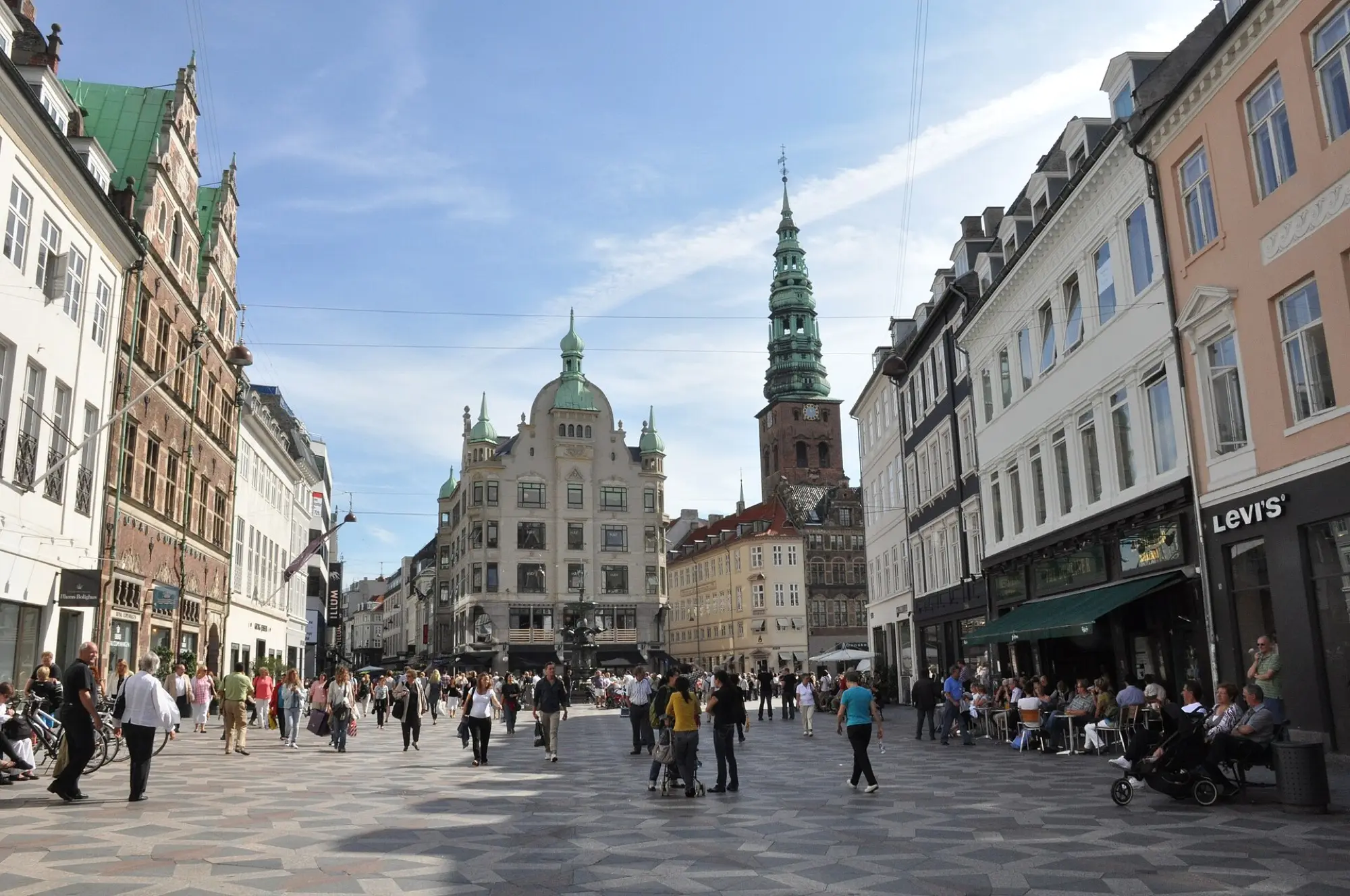

To explore Danish design in Copenhagen, visit Illums Bolighus, Royal Copenhagen, Georg Jensen, Hay House, Normann Copenhagen, Muuto, Klassik, Louis Poulsen, Fritz Hansen, Bang & Olufsen, Designmuseum Danmark, and Frama with Stilleben. Georg Jensen, Royal Copenhagen and Illums Bolighus are all on Amagertorv, on Strøget.
1. Illums Bolighus: the interior store on Amagertorv
The Danish-owned store dates back to 1925, is purveyor to the Royal Danish Court and offers tax refunds through Global Blue. Its flagship store is at Amagertorv 10. VisitCopenhagen calls Illums Bolighus the must-visit interior store in Copenhagen. The store sells Danish, Scandinavian and international design, from furniture and lighting to porcelain, silver and glassware. VisitDenmark says that for classic Danish design on Strøget you can visit Georg Jensen, Royal Copenhagen or Illums Bolighus.
2. Royal Copenhagen: porcelain since 1775
Royal Copenhagen was founded in 1775 as the Royal Porcelain Factory. The flagship store is at Amagertorv 6 on Strøget, in a three-storey Renaissance house from 1616, one of Copenhagen's oldest; Royal Copenhagen has been there since 1911, and the store includes The Royal Café. Its Flora Danica dinnerware, decorated with drawings of Denmark's plants, was made in 1790 to 1803. The Royal Copenhagen Factory Outlet, at Søndre Fasanvej 9 in Frederiksberg, 4 km from the Town Hall Square, has two floors of second-quality porcelain and discontinued products at special prices.
3. Georg Jensen: silver since 1904
Georg Jensen was founded in 1904 by the master silversmith Georg Jensen. Its Copenhagen store is at Amagertorv 4. The company has more than 100 stores in 13 countries. It makes jewellery, sterling silverware, watches and a home collection, and designers who have worked with it include Henning Koppel, Arne Jacobsen, Vivianna Torun Bülow-Hübe and Zaha Hadid.
4. Hay House: a second floor on Strøget
Hay has been going since 2002. Its co-founders and creative directors, Mette and Rolf Hay, set out to make high-quality products available to a wide audience. Hay House is on the second floor at Østergade 61 on Strøget, with furniture and smaller things for the home, from cushions and towels to wall clocks and vases.
5. Normann Copenhagen: a showroom open to the public
Normann Copenhagen was founded in Denmark in 1999 by Jan Andersen and Poul Madsen and makes furniture, lighting and accessories for the home. Its Copenhagen showroom, at Niels Hemmingsens Gade 12, is open to the public, while its showrooms in Barcelona and Stockholm are by appointment only.
6. Muuto: new perspectives, by appointment
Muuto takes its name from the Finnish word muutos, meaning new perspective, and says it is rooted in the Scandinavian design tradition. Muuto Space HQ Copenhagen, at Østergade 36-38, is a showroom open by appointment only. Muuto lists its own stores in Paris, Tokyo, Taipei and Seoul, and points other visitors to its store locator for local retailers.
7. Klassik: used classics on Bredgade
Klassik Moderne Møbelkunst, at Bredgade 3, is a specialist shop for used Danish furniture classics that VisitCopenhagen says has been dealing in them for more than 20 years; every item is selected and restored. Klassik keeps a large selection by Danish designers such as Poul Kjærholm, Arne Jacobsen, Hans J. Wegner and Finn Juhl.
8. Louis Poulsen: the lamps of Poul Henningsen
Louis Poulsen was established in Copenhagen in 1874, began by importing wine, and had turned to lighting by 1892. Its work with Poul Henningsen began in 1924, and his PH lamp won gold at the Paris Exposition in 1925. The Louis Poulsen store in Copenhagen is at Kuglegårdsvej 19-23 in the Holmen area and is open Monday to Friday from 8:00 to 17:00.
9. Fritz Hansen: furniture since 1872
Fritz Hansen was founded in Copenhagen in 1872 as a small cabinetmaker's workshop. The Fritz Hansen store at Valkendorfsgade 4 sells furniture, lighting and accessories by designers including Arne Jacobsen, Poul Kjærholm, Piet Hein and Cecilie Manz.
10. Bang & Olufsen: sound from Struer
Bang & Olufsen says its products have been made since 1925 and that it comes from a small town in western Denmark. It began with two young engineers, Peter Bang and Svend Olufsen, who met in 1925. Working from the attic of the Quistrup manor, they invented the Eliminator in 1925, which let people plug a radio into the wall without a battery. Bang & Olufsen runs factory tours on set dates in Struer, where its products are still made; a day ticket costs EUR 200 per person and includes no transport or accommodation, and a package with two nights at a hotel costs EUR 1,350 per person.
11. Designmuseum Danmark: the story of Danish modern
Designmuseum Danmark is at Bredgade 68 in the building that was once Royal Frederik's Hospital, Denmark's first public hospital, where the philosopher Søren Kierkegaard died in 1855. Its permanent exhibition Danish Modern tells the story of Danish design from the 1920s to the year 2000.
Admission costs DKK 140 for adults and DKK 90 for under-27s and students; under-18s go free, and it is free with the Copenhagen Card. The museum is open Tuesday to Sunday from 10 to 18 and on Thursday from 10 to 20; ticket sales close an hour before closing. Café Format, at the centre of the museum, needs no ticket and is open every day except Monday.
12. Frama and Stilleben: an old pharmacy and a ceramicists' shop
Frama's studio store, at Fredericiagade 57 near Nyboder, is in the old St. Pauls Apotek (apotek, pharmacy), dating from 1878. Frama designs furniture, lighting, kitchens, books and clothing and has stores in seven cities. The store is also home to Apotek 57, a café serving house-made seasonal food.
Stilleben, at Christian IXs Gade 10, sells interior design, ceramics, glassware, textiles and jewellery by Danish and foreign designers. Its two owners are both ceramic designers.
| Brand or venue | Address | Year |
|---|---|---|
| Illums Bolighus | Amagertorv 10 | 1925 |
| Royal Copenhagen | Amagertorv 6 | 1775 |
| Georg Jensen | Amagertorv 4 | 1904 |
| Hay House | Østergade 61 | 2002 |
| Normann Copenhagen | Niels Hemmingsens Gade 12 | 1999 |
| Muuto | Østergade 36-38 | |
| Klassik | Bredgade 3 | |
| Louis Poulsen | Kuglegårdsvej 19-23 | 1874 |
| Fritz Hansen | Valkendorfsgade 4 | 1872 |
| Bang & Olufsen | Struer | 1925 |
| Designmuseum Danmark | Bredgade 68 | |
| Frama | Fredericiagade 57 | |
| Stilleben | Christian IXs Gade 10 |
The architecture centre in BLOX
The Danish Architecture Centre costs DKK 135 for adults; under-18s go free, and it is free with the Copenhagen Card. Its first permanent exhibition, So Danish!, covers 1,000 years of Danish architecture from the Viking Age to the present day. BLOX, the harbourside building at Bryghuspladsen 10 that houses the Danish Architecture Centre, was designed by the architecture firm OMA and has a café, the design shop and a playground outside. The DAC design shop, with Danish design, architecture books and home accessories, is open to everyone without a ticket, while the DAC café needs an entrance ticket or annual pass. You can read more about planning a trip in the Copenhagen guide and find where to base yourself across Copenhagen's neighbourhoods.