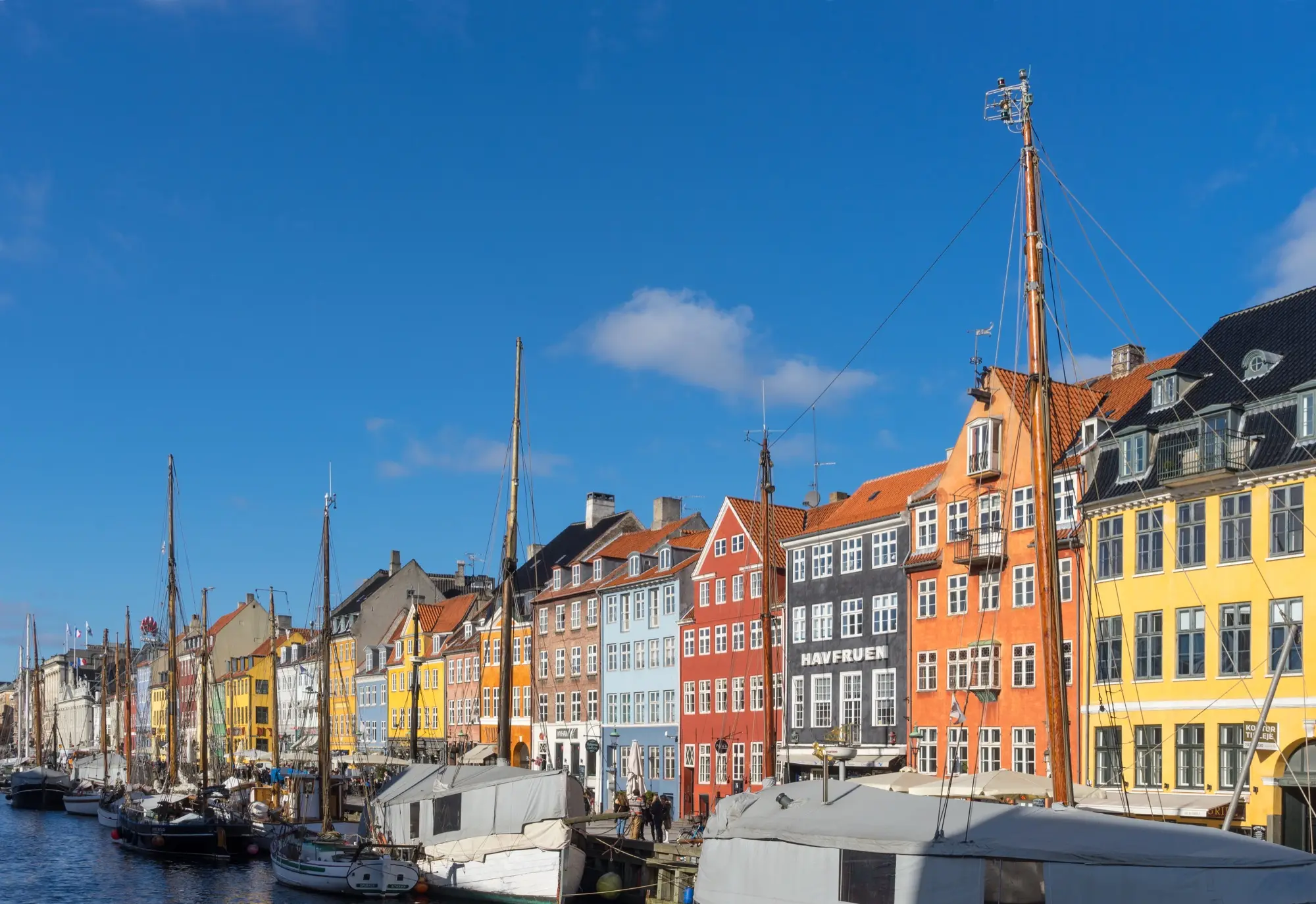

The eight main areas to base yourself in Copenhagen are Indre By and Nyhavn, Christianshavn, Vesterbro and Kødbyen, Nørrebro, Frederiksberg, Østerbro, Islands Brygge, and Refshaleøen. Indre By suits first-time visitors walking to classic sights, Christianshavn offers canals and hygge, Vesterbro combines food with nightlife, Nørrebro provides diverse street culture, Frederiksberg offers a calm municipality of parks, Østerbro suits families, Islands Brygge caters to harbour swimming, and Refshaleøen suits those seeking street food and contemporary art.
1. Indre By and Nyhavn: the classic sights on foot, for a first visit
VisitCopenhagen describes Copenhagen as divided into very different neighbourhoods, each with its own vibe, from gritty, industrial Refshaleøen to posh, classy Frederiksberg. Indre By suits first-time visitors because most of Copenhagen's top attractions are within walking distance of the city centre. Within 10 minutes' walk in the historic centre, 15 museums and cultural institutions make up the Copenhagen Cultural District.
Several landmark attractions define the area:
- Nyhavn, once a busy port of sailors' pubs, is the harbour of brightly painted 17th-century houses, cafés and canal tours, where canal tours leave from its quay. Hans Christian Andersen lived in three Nyhavn houses, numbers 20, 67 and 18. In December, one of the city's seasonal Christmas markets fills it.
- Rosenborg Castle was built in 1606-34 by Christian IV as a pleasure palace. The Danish crown jewels are in its basement, and it is free with the Copenhagen Card.
- Christiansborg Palace, once home to kings and queens, now houses the Danish parliament, the Supreme Court and the Ministry of State.
- Tivoli Gardens, founded in 1843, is a two-minute walk from Copenhagen Central Station.
The district is served by Kongens Nytorv station on lines M1, M2, M3 and M4, which is the only station where you can change between all four metro lines; the old harbour canal Nyhavn is next to it. Denmark's busiest station, Nørreport, sits on lines M1 and M2 plus S-trains and regional trains, with the Torvehallerne food market and its more than 60 stalls situated 100 metres away. Gammel Strand station, on lines M3 and M4, is about 150 metres from Christiansborg, and the pedestrian street Strøget runs from Rådhuspladsen to Kongens Nytorv nearby.
For green space, Parkmuseerne forms the city centre's green museum district, consisting of six museums in and around three historic Copenhagen parks: the Botanical Garden, Kongens Have, and the grounds around Rosenborg.
2. Christianshavn: canals and houseboats beside the centre
Christianshavn has hygge (cosiness) all year and a down-to-earth atmosphere, functioning technically as part of the city centre while retaining its own neighbourhood feel. It suits travellers looking for water views and a relaxed maritime pace, formed as a group of small islands with coloured houses and canals best explored by bike, on foot along the quays or from the water.
Christian IV built Christianshavn just over 400 years ago between the city centre and Amager, and its canals now hold houseboats, tourist boats and cafés. Its most famous landmark is the Church of Our Saviour, featuring a serpentine spire dating from 1752. The climb involves 400 steps, the last 150 of them on the outside, leading to a view from 86 metres. Entry to the church itself is free, while the tower climb is listed at DKK 70 for an adult and DKK 20 for a child under 15, and is free with the Copenhagen Card Discover & Hop. Booking ahead is recommended, and the tower closes for safety in rain and strong wind.
Christianshavn station provides access on metro lines M1 and M2. Christianshavns Vold, a 17th-century rampart, is a green area open all year with walking paths and water views, part of which runs directly through Christiania.
3. Vesterbro and Kødbyen: the old red-light district, now food and nightlife
Vesterbro was once Copenhagen's red-light district, but today it is very popular with young families and creatives, mixing an everyday hip lifestyle with nightlife, fashion boutiques and restaurants. It suits visitors who want immediate access to dining, independent shops, and evening entertainment.
Istedgade is Vesterbro's main street, lined with boutiques, restaurants and bars. Towards the Central Station end of Istedgade there are still sex shops and strip bars, which are easy to steer around. The Meatpacking District, Kødbyen, is part of Vesterbro and has two parts: the brown from 1878 and the white from 1934. Once the home of Copenhagen's meat businesses, Kødbyen is now a cluster of galleries, nightlife and restaurants, where Kødbyens Fiskebar was among the first establishments to open. Between Vesterbro and Frederiksberg lies Værnedamsvej, a small, busy shopping street with flea markets and vintage shops nearby.
The København H metro station, on lines M3 and M4 beside the Central Station's S-trains and regional trains, is close to Istedgade and Kødbyen. From København H, Tivoli, the Ny Carlsberg Glyptotek, and Rådhuspladsen are a few minutes' walk. Enghave Plads station, on line M3, sits at the end of Istedgade among cafés, bars, restaurants and speciality shops. Enghave Park, which includes a manned playground, is right next to Enghave Plads station, a few minutes' walk from the Vega music venue and Carlsberg Byen.
4. Nørrebro: the most culturally diverse, for food and independent shops
Nørrebro is Copenhagen's most culturally diverse neighbourhood, known for its food, street culture and independent shops. It suits visitors looking for energetic street life and varied dining options, beginning just across the lakes from the city centre and easy to reach on foot or by cycling in Copenhagen over Dronning Louises Bro.
Places to eat and drink cluster in the side streets around Nørrebrogade, Jægersborggade and Blågårdsgade, all within walking distance of each other; Jægersborggade has turned from dodgy to hip. Superkilen, at Nørrebrogade 208, is a public park designed by Bjarke Ingels Group, Superflex and Topotek1 that opened in 2012 and remains open all year. It features three areas: the Red Square, the Black Market and the Green Park. It holds objects from around the world, including fountains from Morocco, swings from Iraq, benches from Brazil and a black octopus slide from Japan.
Nørrebros Runddel station, on line M3, is situated just off Nørrebrogade in one corner of Assistens Cemetery. Nørrebro station, also on line M3, sits where Nordre Fasanvej, Lygten, Frederikssundsvej and Nørrebrogade meet, connecting the metro with local buses and S-trains. Assistens Cemetery serves as Nørrebro's main green space; Copenhageners have buried their dead here for more than 250 years, including Hans Christian Andersen and Søren Kierkegaard, and people use the grounds to walk, cycle, run and picnic.
5. Frederiksberg: its own municipality, green and calm
Frederiksberg is its own municipality, described by VisitCopenhagen as one of the calmest, most laid-back parts of Copenhagen, full of parks, green areas and squares. It is a city within a city in the centre of Copenhagen, with broad tree-lined boulevards, gardens, pavement cafés, culture and royal history, making it suited to travellers seeking a quiet, elegant base.
Key sights highlight the area's heritage and green landscape:
- Frederiksberg Garden features a statue of King Frederik VI at its main entrance and a Chinese pavilion built in 1799 as a royal teahouse. Boat tours run on its canals all summer, passing Frederiksberg Palace on its hill.
- Cisternerne, the city's former water reservoirs under Søndermarken park across from Frederiksberg Palace, once held 16 million litres of drinking water and now operates as an underground art space. Admission is listed at DKK 115 for an adult, and it is free for visitors under 18 or those using the Copenhagen Card Discover & Hop.
Frederiksberg station, located next to Frederiksberg Centre, serves lines M1, M2 and M3, with the two station platforms joined by a pedestrian tunnel. Frederiksberg Allé station, on line M3, sits on the lime-tree avenue running from Frederiksberg Have to Vesterbrogade, located a few minutes' walk from Værnedamsvej.
6. Østerbro: the greenest and most family-friendly, by Kastellet and Fælledparken
VisitCopenhagen calls Østerbro the greenest neighbourhood in Copenhagen and an elegant part of town, ranking as one of the city's most family-friendly neighbourhoods with green spaces, playgrounds and safe streets. It suits families and travellers seeking wide avenues near the coast.
The Citadel, Kastellet, was founded by King Christian IV in 1626 and lies on the border of inner Copenhagen and Østerbro. Its historic buildings still serve as military barracks and offices, but the ramparts are open to the public for walks and runs. A short distance away, the yellow Nyboder houses provide another historic landmark. For coastal recreation, Østerbro got its beach, Svanemøllestranden, in June 2010.
Trianglen station, on line M3, is a few steps from Fælledparken and a few hundred metres from Parken stadium, where FCK and the Danish men's national team play. Østerport station serves lines M3 and M4 as well as S-trains and regional trains, positioned a few minutes' walk from Kastellet. Fælledparken, laid out between 1908 and 1914 as a park for the people, is the second largest park in Copenhagen, open all year with a 3.5 km path, a traffic playground for children, and the largest skatepark in Northern Europe.
7. Islands Brygge: the harbour bath and the summer waterfront
Islands Brygge is one of the areas of Amager, alongside East Amager and Ørestad, consisting of a former industrial area turned harbour hangout and waterfront living district that serves as a summer favourite for its harbour bath and lawns. It suits travellers who want outdoor waterfront recreation right beside the city centre.
Key points of interest focus on the waterside and contemporary architecture. The cubic Bikuben and the circular Tietgenkollegiet stand near the metro as examples of experimental architecture, close to the University of Copenhagen's Amager campus, DR Byen, and the nature reserve at Amager Fælled. Islands Brygge station is on line M1, located between the harbour promenade and the university campus; during summer it fills with swimmers.
The Islands Brygge harbour bath sits directly across the bridge from the city centre and remains open all year. It features five pools, including two for children, alongside diving towers measuring one, three and five metres. Lifeguards watch the harbour bath from 1 June to 31 August, between 10 and 18. Water quality is checked daily and must be approved before swimmers are let in; if it fails testing, a red flag is raised and swimming is banned. Harbour swimming in Copenhagen is strictly restricted to designated harbour baths and established bathing zones, while local winter bathers use the facility during the colder months.
8. Refshaleøen: the former shipyard island of art and street food
Refshaleøen is a former industrial district that has become one of Copenhagen's hippest areas, acting as a hub for creativity, festivals and food. It suits visitors interested in large-scale modern art, waterside street food, and industrial harbour spaces.
The area's main venues include:
- Reffen, Northern Europe's largest street food market, which opened in 2018 on a former industrial site by the water. Built mostly from shipping containers across 12,000 square metres, it contains around 35 food stalls, 10 bars and 4 creative workshops.
- Copenhagen Contemporary, an international centre for installation art, which fills 7,000 square metres of the former B&W welding hall. Standard admission is listed at DKK 140 for an adult and DKK 25 for a child aged 3 to 17, and entry is free with the Copenhagen Card Discover & Hop.
- Baghaven, one of the Mikkeller craft beer bars situated on the island.
Refshaleøen has no metro station; it is reached by bike, bus, or harbour bus. The yellow electric harbour buses operate up and down the harbour on a regular bus ticket, serving 9 stops including the Royal Library, Islands Brygge and Refshaleøen.
Christiania: the free town inside Christianshavn, and what it asks of visitors
Christiania has existed as a free town and alternative community inside Christianshavn since the early 1970s. In 1971, young people cut down the fence of the empty military barracks on the Christianshavn rampart, occupied the abandoned buildings, and named the site Fristaden Christiania. Pusher Street represents only a small part of its history. After several violent incidents, Christiania decided in 2023 to end the open hash trade, and on 6 April 2024 residents, politicians and friends dug up Pusher Street's cobblestones. Today, Pusher Street houses bakeries, cafés, small art shops, and one of Thomas Dambo's wooden trolls.
Residents run guided tours covering the community's history, architecture and everyday life. The community and public authorities work together to maintain safety. Danish law bans dealing, buying and possessing illegal drugs, and buying cannabis remains illegal in Christiania and everywhere else in Denmark; visitors are advised not to enter looking for drugs.
Because Christiania is an active residential area, residents set clear guidelines for visitors:
- Respect residents, treating the area as an active home rather than just an attraction, and do not peer into people's windows.
- Follow local signs and instructions, which are posted for everyone's safety.
- Be considerate when taking photographs and respect the areas where photography is prohibited.
- Keep the grounds clean, dispose of rubbish in bins, and look after the green spaces.
Getting between the neighbourhoods
According to Metroselskabet, the Copenhagen Metro runs around the clock, every day. Kongens Nytorv station serves lines M1, M2, M3 and M4, functioning as the only station where you can change between all four metro lines, situated beside Nyhavn. Gammel Strand station serves lines M3 and M4, placed about 150 metres from Christiansborg Palace, with the pedestrian high street Strøget running between Rådhuspladsen and Kongens Nytorv nearby.
On the water, the yellow electric harbour buses operate nine stops along the harbour waterway using a standard bus ticket. Route 991 sails south towards Teglholmen, while route 992 sails north towards Orientkajen, stopping at key destinations including the Royal Library, Islands Brygge, and Refshaleøen. For travel further out across Denmark, regional trains depart regularly from the Central Station, Nørreport, and Østerport.
Frequently asked questions
Can I walk between the main sights in Copenhagen?
Yes. Most of Copenhagen's top attractions are located within walking distance of the city centre. Metro lines M1, M2, M3 and M4 run around the clock, every day, to connect the surrounding outer neighbourhoods.
Is Copenhagen safe for tourists?
Copenhagen is in general a safe city to visit, but standard precautions apply. Watch for pickpockets in crowded transit hubs, particularly around the Central Station, City Hall Square (Rådhuspladsen), and the start of the Strøget pedestrian street.
What are the rules on buying cannabis in Christiania?
Danish law strictly bans dealing, buying, and possessing illegal drugs. It is illegal to buy cannabis in Christiania or anywhere else in Denmark. Following joint work between the community and public authorities to improve safety, visitors are advised not to look for illegal substances.
Where can I swim in Copenhagen harbour?
Harbour swimming is only permitted inside established harbour baths and authorized bathing zones. The harbour bath at Islands Brygge is open all year, with lifeguards stationed on site from 1 June to 31 August between 10 and 18. Daily water tests must be approved before swimming is permitted; a red flag indicates unsafe water and bans bathing.