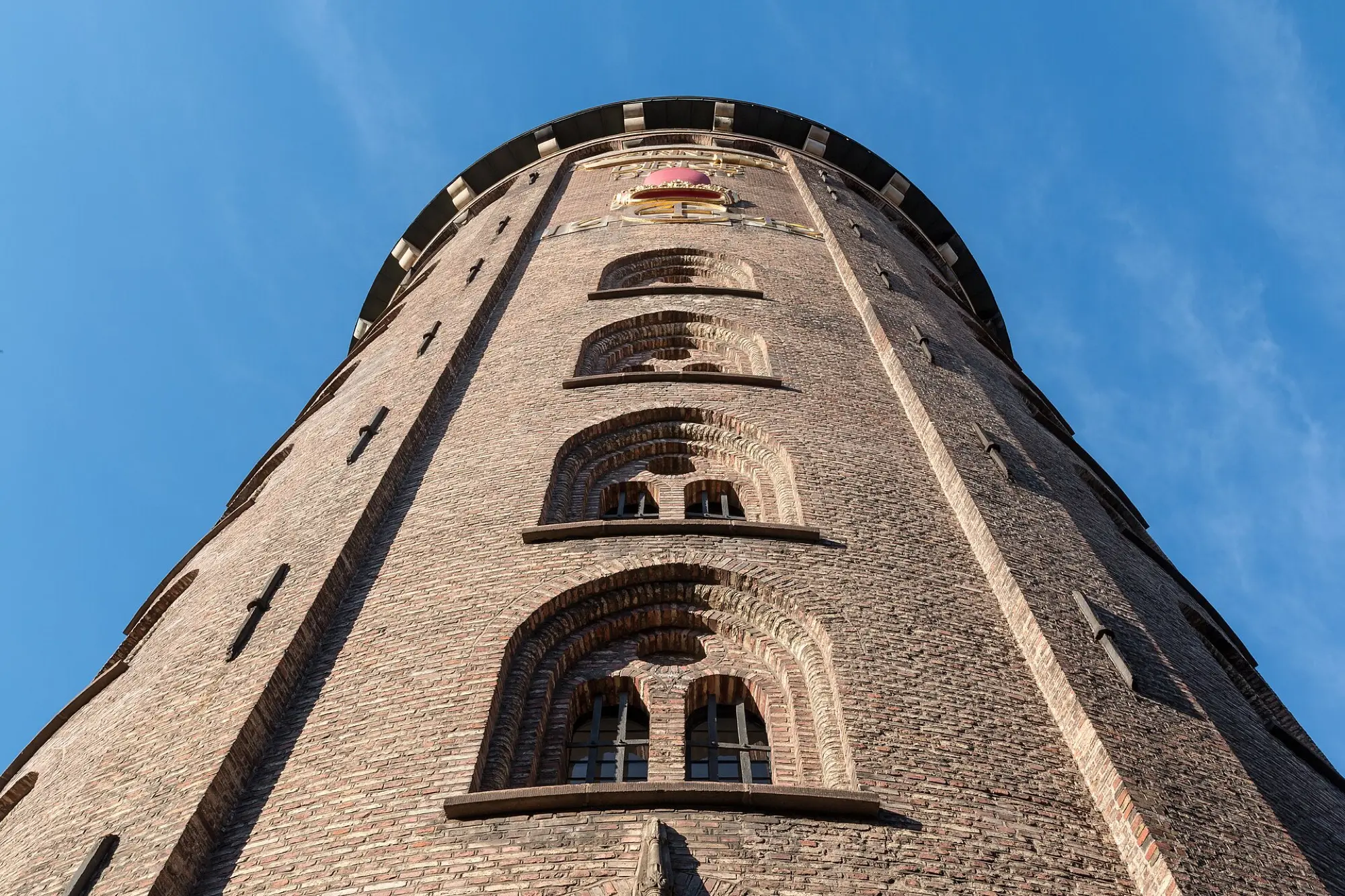

The Round Tower (Rundetaarn) on Købmagergade was finished in 1642 under King Christian IV. You reach the viewing platform by walking up a spiral ramp with no steps until the last two staircases. Entry costs DKK 60 for an adult, under-18s enter free, and tickets are sold only at the door.
The Round Tower in short
The Round Tower front page calls the site a living landmark of Copenhagen since 1642. The viewing platform is 34.8 metres above the street. The Round Tower says it is Europe's oldest functioning observatory building. For other city sights, read about things to do in Copenhagen.
Christian IV's tower and the Trinitatis complex
The foundation stone was laid on 7 July 1637, and five years later the Round Tower was finished as the first part of the Trinitatis complex. The complex was designed for three things, the observatory at the top of the tower, the university library above the church and the church itself below.
King Christian IV built the tower in the royal colours, yellow and red, and sketched the golden rebus on its front himself. Christian IV had the tower built so that astronomers from the University of Copenhagen could study the sky above the city's lights and smoke; the observatory flourished under Ole Rømer, known for his discovery of the speed of light. For another royal site, consult the Rosenborg Castle guide.
During the King's guard, the daily parade from the Life Guard's barracks on Gothersgade leaves at 11:27 and passes the Round Tower on its way to Amalienborg.
The spiral ramp and the way to the top
The only way to the top is the spiral ramp, about 200 metres long, followed by two staircases, a wide wooden one and a smaller winding one of stone, up to the viewing platform; there is no lift.
The tower's measurements page gives the ramp's length as 281 metres along the outer wall and 93.5 metres along the inner wall, with a gradient of 10% on the outside and 33% on the inside. The wooden staircase has 28 steps and the stone staircase 31.
The platform has a 360-degree view all the way to Sweden, and in the summer months a kiosk at the top sells ice cream, coffee and souvenirs. The tower's history pages say the Russian tsar Peter rode up and down the ramp in 1716. You can compare the city views with the Christiansborg Palace guide.
The observatory and the winter evenings
The public observatory at the top has been open to visitors since 1929. The main telescope is a 1929 refractor, three metres long, built by the company Cornelius Knudsen, magnifying 80 to 450 times.
The observatory, its dome and telescope were restored in 2026, and King Frederik X re-inaugurated the observatory on 12 August 2026, during a solar eclipse visible over Denmark. During Copenhagen in winter, from 5 October 2026 to 31 March 2027 you can look through the telescope every Monday and Tuesday from 18:00 to 21:00; it is included in the entrance fee, and if the sky is cloudy the astronomers talk about the dome, the universe and the telescope instead. Sunspots are observed every Sunday during the Danish school summer holidays.
The Library Hall, the glass floor and the bell loft
Halfway up, above Trinitatis Church, the Library Hall holds changing exhibitions, concerts and events, and sells souvenirs and coffee; it opened for exhibitions in 1987. The hall held the University of Copenhagen's book collection from its inauguration in 1657 until it moved out in 1861 for lack of room. The Library Hall's area is 811 square metres.
Hans Christian Andersen visited the tower soon after arriving in Copenhagen and was allowed to use the books in the university library. The entry ticket includes the current exhibition except when the Library Hall is closed for special events or exhibition changes, so the tower asks you to check its website before you visit.
One recess off the ramp opens onto the hollow core, where you can step onto a glass floor and look into the depths. When surveyors began mapping Denmark in the 1760s, the hollow core was the starting point of their network of triangles and so became Denmark's geographical zero point. On 27 June 1880 a 12-year-old choir boy fell 25 metres down the hollow core during a game of hide-and-seek and survived.
The bell loft, one floor above the Library Hall, was rebuilt after the Copenhagen fire of 1728, with the work completed in 1731, and holds a small exhibition on the history of the tower and the church.
Tickets and the Copenhagen Card
Entry costs DKK 60 for an adult and DKK 40 for a student; children aged 0 to 17 go free, and those aged 11 and under must be with an adult. Two adults pay DKK 120 between them; children with them go free. The observatory is included.
| Ticket category | Price |
|---|---|
| Adult | DKK 60 |
| Student | DKK 40 |
| Child (aged 0 to 17) | Free |
| Two adults | DKK 120 |
Entry tickets are sold only at the Round Tower's own ticket office on arrival; only event and concert tickets can be bought in advance. The tower prefers card payment but takes cash in Danish kroner or euro notes (no euro coins), with change given only in kroner. The Round Tower has not been included in the Copenhagen Card since 1 April 2024.
Because the tower has a maximum capacity, ticket sales may pause at peak times, but the wait rarely exceeds 20 minutes; a traffic light controls the flow to and from the platform.
Opening hours by season
The tower says it is open 362 days a year. The tower is closed on 24 and 25 December and 1 January, and closes at 15 on 31 December. You can plan around daylight in Copenhagen across the seasons.
| Season | Days | Opening hours |
|---|---|---|
| Winter season (1 October to 31 March) | Monday and Tuesday | 10-21 |
| Winter season (1 October to 31 March) | Wednesday to Sunday | 10-18 |
| Summer season (1 April to 30 September) | Every day | 10-20 |
In the winter season, 1 October to 31 March, the observatory is open for observations 18-21 on Mondays and Tuesdays.
Trinitatis Church below the tower
Trinitatis Church was commissioned by Christian IV in 1637 as part of a complex with a church for the university's students, the Round Tower as an observatory and a university library above the church. The tower was finished in 1642-3, the last capstone was set in the church in 1651, and the church was consecrated on Trinity Sunday, 1 June 1656.
Inside, the church is about 50 m long, 20 m wide and 18 m tall. The fire of 1728 badly damaged the church, which was closed for 3 years and reopened in 1731; the university library in it was lost, and most of the baroque furnishings date from about 1730.
The church is open from Monday to Saturday 9.30-16.30, and on Sunday only during the service, 9.30-12.00.
Getting there and what you can bring
The Round Tower's address is Købmagergade 52 A, 1150 Copenhagen K. The Metro's page for Nørreport station puts the Round Tower 5 min. away on foot, which can fit into a 3 days in Copenhagen schedule.
The visit page sets out rules for access:
- Because of the staircases near the top, the tower is not very accessible in a wheelchair; the Library Hall can be reached, though the incline is hard for a non-electric wheelchair.
- Prams and pushchairs cannot reach the viewing platform because of the stairs; they can be parked after the ticket booth or before the wooden stairs.
- Larger luggage and suitcases cannot be brought in, and the tower offers no luggage storage.
- You may bring your own food and drink but not eat it in the Library Hall or the café; dogs other than guide and service dogs are not allowed.