
A 3-day itinerary covers Vágar, Tórshavn and Eysturoy across days 1 to 3, while 5 days adds Klaksvík, Kalsoy and Sandoy on days 4 and 5. A 7-day visit includes Suðuroy by ferry and Mykines or Nólsoy on days 6 and 7. Most of the Faroe Islands are joined by road and subsea tunnels with tolls, and the outer islands require a ferry.
Getting around: tunnels, tolls and ferries
The Faroe Islands have four subsea tunnels: Vágatunnilin, Norðoyatunnilin, Eysturoyartunnilin and Sandoyartunnilin. All four charge a toll. Vágatunnilin links Vágar, where the airport is situated, with Streymoy and Tórshavn, and you pay only when driving from Vágar. Eysturoyartunnilin links Streymoy with Eysturoy, and you pay in both directions. Sandoyartunnilin links Streymoy with Sandoy, and you pay only on the way to Sandoy. Norðoyatunnilin links Borðoy and Klaksvík with Eysturoy, and you pay only when driving from Klaksvík.
Tunnil lists prices for a car with no toll subscription. According to Tunnil, a one-way trip through the Eysturoy tunnel costs DKK 175 for a car without a toll subscription (DKK 75 with one). A one-way trip through the Sandoy tunnel is DKK 175 without a subscription (DKK 75 with one). Tunnil lists Vágatunnilin at DKK 50 for a car without a toll subscription (DKK 10 with one), charged only when driving from Vágar. Norðoyatunnilin costs DKK 50 without a subscription (DKK 10 with one), charged only when driving from Klaksvík. Rental companies have their own arrangements, and Visit Faroe Islands says to ask your car rental company how it handles tolls. There are no pay stations at the tunnels; tolls are paid online within three days, or the bill goes by post to the car's owner.
The general speed limit is 50 km/h in towns and 80 km/h on rural roads, whether paved or gravel. Headlights must be on at all times, day and night. Some roads and tunnels are single-lane, and you may need to reverse to the nearest passing place. The lay-bys are strictly for passing, not for parking. Some villages with narrow roads, including Tjørnuvík and Múli, do not allow camper vans, and camper vans may stay overnight only at designated campsites. Parking in Klaksvík, Tórshavn, Runavík and at Vágar airport is restricted and requires a parking disc showing when you parked. A parking offence costs DKK 200.
Day 1: Vágar, Gásadalur and Trælanípan
Vágar has the country's only international airport. Visit Faroe Islands puts the airport barely 45 km from Tórshavn, reached through the first subsea tunnel. Past Bøur, another 5 km brings you to Gásadalur and the Múlafossur waterfall. Looking out from Sørvágur and Bøur, the islet Tindhólmur rises sheer from the sea to 262 metres and features five needle-shaped peaks.
The hike to Trælanípan is run by an operator and charges a fee. Hiking to Trælanípan on your own costs DKK 200 per adult, with no booking needed; children aged 0 to 15 go free. The operator gives the Trælanípan route as 3.5 km each way, taking about 45 minutes each way, though most people take 2.5 to 3 hours with photo stops. You can consult details on Faroe Islands hikes before heading out onto the trails. The old village path from Bøur to Gásadalur is graded difficult by Visit Faroe Islands and listed as 3 km and 1 hour 5 minutes. Above Sandavágur, the Trøllkonufingur (witch's finger) trail is about three kilometres, generally considered easy, with an average time of 48 minutes, ending at a sea stack rising 313 metres from the sea.
Day 2: Tórshavn and the walk to Kirkjubøur
Tórshavn is one of the smallest capitals in the world, with around 20,000 residents. Tinganes in Tórshavn is where one of the world's oldest parliaments was established, around AD 825, and its red wooden buildings are still in use today. Visit Faroe Islands suggests starting an exploration at Tinganes, then seeing the old town, Á Reyni, with its turf-roofed houses, followed by the cathedral, the harbour at Vágsbotn, the park and Skansin, the fort above the harbour.
From the capital, the walk from Tórshavn to Kirkjubøur is graded medium and listed as 6 km and 1 hour 40 minutes. Kirkjubøur church, dating from the 13th century, is the oldest church in the Faroe Islands still in use, standing beside the ruins of a cathedral from around AD 1300. If you do not wish to walk both ways, Tórshavn's municipal buses go to Kirkjubøur on route 6 on weekdays and route 8 at weekends. Visit Faroe Islands says the city buses are free of charge.
Day 3: Saksun, Eysturoy and Gjógv
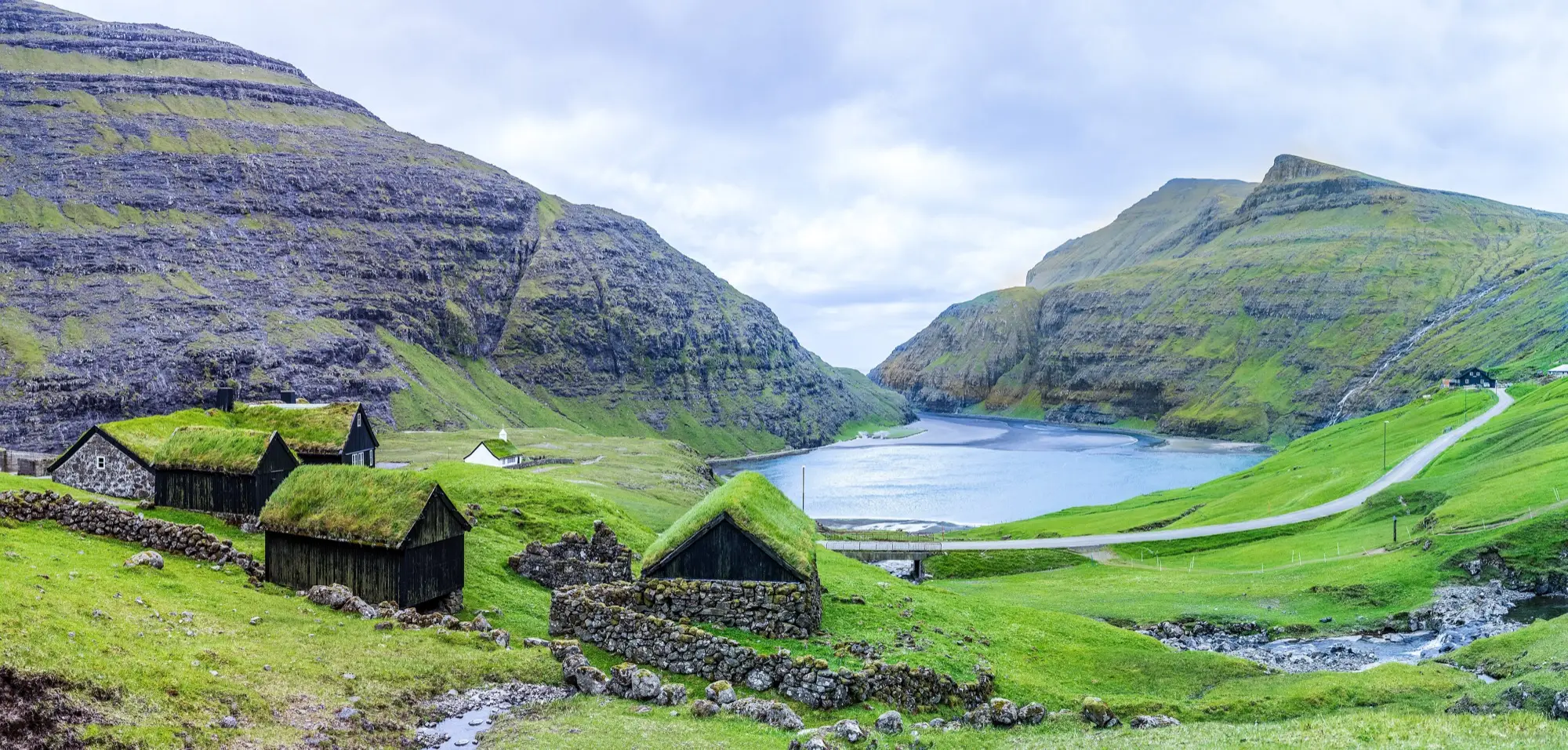
On Streymoy, the road leads to Saksun. At Saksun the lagoon, Pollurin, was once a natural harbour until a storm in the 1600s blocked the fjord with sand. From Streymoy, crossing to Eysturoy runs through the Eysturoy tunnel. The Eysturoy tunnel, the longest in the country, is 11.2 km long, reaches 189 metres below the seabed, and opened in late 2020. Inside it is the world's first underwater roundabout, known as the jellyfish roundabout, lit in colour and displaying a steel installation of people holding hands by the artist Tróndur Patursson. Tuning the car radio to 97.0 FM plays a dedicated soundscape by the musician Jens L. Thomsen for the drive under the sea.
On Eysturoy, Gjógv takes its name from its natural harbour, a gorge filled with seawater running from the village to the ocean. The road to Gjógv descends from Slættaratindur, the highest peak in the Faroes, from whose summit you can see all 18 islands on a clear day. Funningur, located below the mountain pass, may be the oldest village in the Faroe Islands, having been first settled around AD 825.
Day 4: Klaksvík, Kalsoy and the Kallur lighthouse
Klaksvík is the second-largest town in the Faroe Islands, serving as an active fishing town and the base for the northern islands. From here, the ferry Sam, which is more than 40 years old, sails for Kalsoy several times a day from Klaksvík harbour. Strandfaraskip Landsins (SSL) lists ferry fares for route 56 to Kalsoy as return fares paid on the outward sailing: DKK 131 for an adult at departure or DKK 105 online, and both directions must be booked. Transporting a passenger car on the Kalsoy ferry costs DKK 336 return at departure or DKK 269 online.
On Kalsoy, a 17-km road through four tunnels runs from the ferry landing at Syðradalur to Trøllanes. Visit Faroe Islands recommends taking the bus because the roads are narrow and parking is limited. The hike from Trøllanes to the Kallur lighthouse is moderately easy, and the return trip usually takes one and a half to two hours. The Kallur hike requires a mandatory fee of DKK 200 for adults and DKK 100 for children aged 13 to 17, while children under 13 go free. You can also rent a bicycle on Kalsoy next to the harbour at Syðradalur; Kalsoy has four tunnels, so wear a reflective vest and bring a light. In the settlement of Mikladalur on Kalsoy stands the statue of Kópakonan, the seal woman from local village folklore.
Day 5: Sandoy through the newest tunnel
The Sandoy tunnel, 11 km long, opened in December 2023. It runs from just north of Sandur under the Skopunarfjørður strait to Gamlarætt on Streymoy, replacing an older 30-minute ferry crossing. Tunnil lists a one-way trip through the Sandoy tunnel at DKK 175 for a car without a toll subscription (DKK 75 with one).
Sandoy is noticeably more pastoral than Streymoy, characterised by softer, rounder mountains, sandy dunes, lakes and what Visit Faroe Islands calls one of the Faroes' most idyllic beaches, beside Sandur. On the eastern shore of Sandoy, Húsavík has 115 residents, most of whom live in old stone houses with turf roofs. Over on the west coast, the bay of Søltuvík provides a coastal spot where you may see seals off the beach.
Day 6: Suðuroy by ferry
Suðuroy is the southernmost island of the Faroe Islands. Visit Faroe Islands describes the crossing aboard the ferry Smyril to Suðuroy as a two-hour journey south. On route 7 from Tórshavn to Tvøroyri, each direction is paid separately. An adult foot passenger pays DKK 109 at departure or DKK 88 online. Bringing a passenger car on the Suðuroy ferry costs DKK 229 each way at departure or DKK 183 online.
From the ferry terminal at Tvøroyri, bus 700 runs to Vágur, and Visit Faroe Islands recommends the 2.5-hour hike from Vágur to Fámjin, using bus 701 for the return leg. The church in Fámjin holds the historic first Faroese flag. This flag, Merkið, was originally designed by students in 1919, and the original piece hangs directly on the church wall. Near Tvøroyri, the lake and meadow at Hvannhagi can only be reached on foot, requiring roughly a 3 km hike from town. In the far south, the sea cliffs at Beinisvørð rise 470 metres, representing the second-highest cliffs in the islands, while the southernmost tip at Akraberg features a lighthouse.
Day 7: Mykines in summer, or Nólsoy
From 1 May to 31 August, everyone over the age of 15 travelling to Mykines by ferry pays DKK 500 (or DKK 400 if booked online before arrival) in addition to the ferry ticket. This mandatory fee includes a local guide. Visit Faroe Islands notes that the hiking path to the Mykines lighthouse is closed following a landslide, though hikes to other parts of the island are available. The route 36 ferry from Sørvágur to Mykines charges fares each way: DKK 153 for an adult purchased at departure or DKK 123 online. The SSL travel card is not valid on route 36 to Mykines.
As an alternative outer island, Nólsoy is reached by boarding the route 90 ferry from Tórshavn, leaving the car behind. Route 90 to Nólsoy uses the same return fares as the Kalsoy ferry, charging DKK 131 for an adult at departure or DKK 105 online. The hike from Nólsoy village out to the Borðan lighthouse is graded difficult, listed at 14 km and 4 hours. The Nólsoy lighthouse itself, named Nólsoyar viti, was built in 1893.
Doing it without a car
If you prefer not to hire a car, SSL sells a tourist travel card providing 4 or 7 days of transport on its bus and ferry network. It is issued without seat reservations and cannot be used for vehicles. An adult travel card costs DKK 700 for 7 days and DKK 500 for 4 days; for a child, it costs DKK 350 for 7 days and DKK 250 for 4 days. The travel card is not valid to Mykines or for prebooked sailings. You can buy the card at the ferry terminal in Tórshavn, the information centre at Vágar airport, or aboard bus route 300.
Key sights can be reached by combining scheduled services:
- To reach Gásadalur from Tórshavn, take bus 300 to Sørvágur and change there to bus 350.
- To reach Kallur by public transport, take the bus from Tórshavn to the harbour in Klaksvík, take the ferry across to Kalsoy, and then board bus 506 from Syðradalur to Trøllanes.
- To reach Gjógv or Tjørnuvík, SSL operates bus 201 from Oyrarbakki to Gjógv and bus 202 from Oyrarbakki to Tjørnuvík; Visit Faroe Islands warns that both routes run infrequently.
- Within the capital, Visit Faroe Islands notes that the city buses run free of charge.
Before you book
Many hotels are fully booked in summer, and Visit Faroe Islands advises booking early, especially from May to August when demand is highest. If you plan late autumn hikes, note that the hare-hunting season runs every year from 2 November to 31 December, and Visit Faroe Islands advises against hiking during this period. Ferry transport to Mykines is seasonal: the Mykines ferry sails twice daily in season, whereas outside summer the island is reached by helicopter, which serves it for six months of the year. For visitors trying to compress their journey, Visit Faroe Islands notes that by car you can see Múlafossur in Gásadalur, the gorge in Gjógv and the Kallur lighthouse in one day, depending on how many photos you take.
The Denmark hub covers the rest of the kingdom, and the Iceland Ring Road itinerary is the neighbouring North Atlantic road trip.