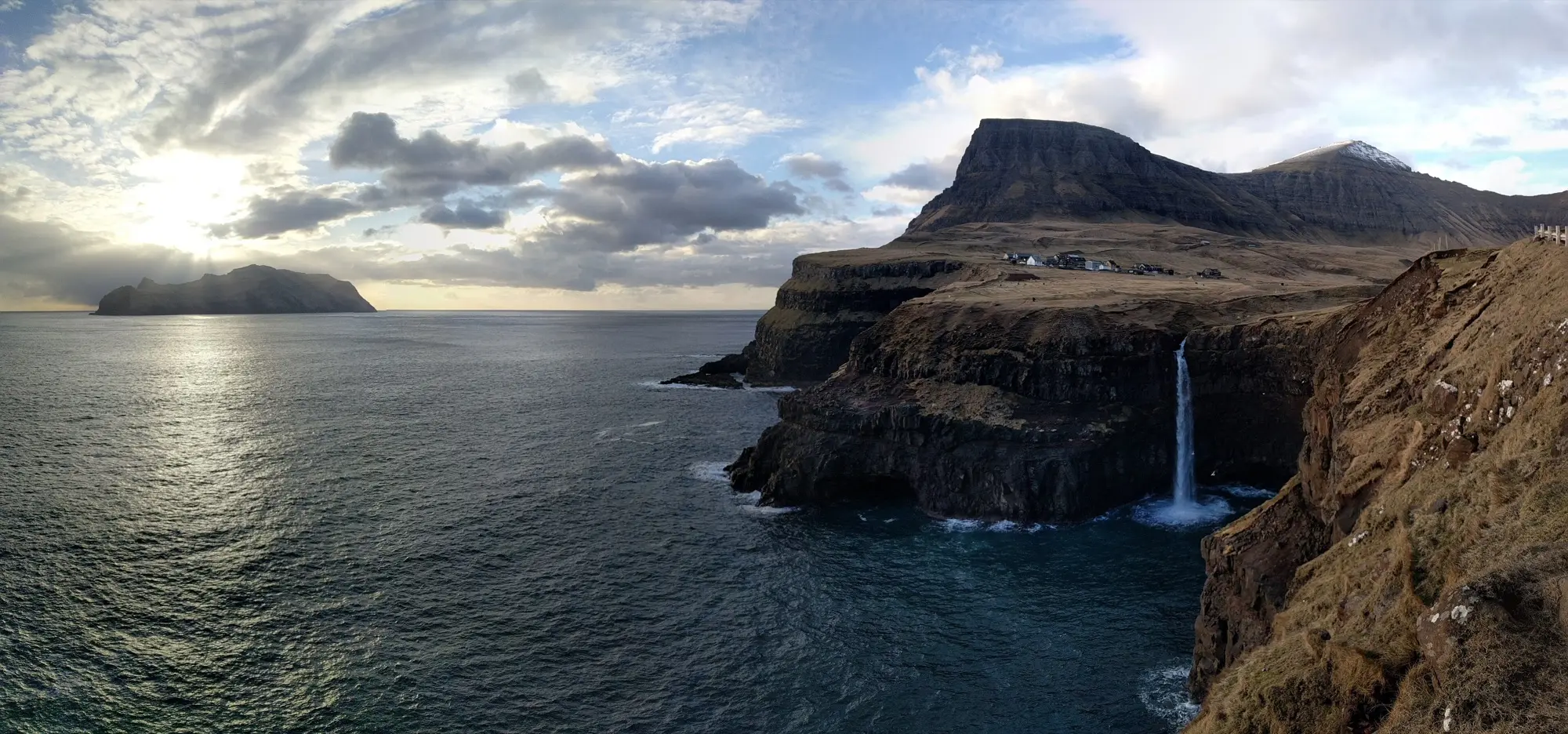

The Faroe Islands comprise 18 islands halfway between Scotland and Iceland, 17 of which are inhabited, with a population of 56,365 recorded in February 2026. Self-governing within the Kingdom of Denmark since 1948, the archipelago offers 15 key sights: Tinganes, Skansin, Kirkjubøur, Gásadalur, Trælanípa, Drangarnir, Mykines, Vestmanna bird cliffs, Fossá with Tjørnuvík and Saksun, Slættaratindur, Gjógv, Risin and Kellingin, the Eysturoy undersea tunnel, Kallur lighthouse, and Kópakonan.
The Faroe Islands in short: Danish, but not in the EU
Visit Faroe Islands places the islands in the North Atlantic, halfway between Scotland and Iceland. There are 18 volcanic islands, and all but one are inhabited. The population was 56,365 in February 2026.
Since the Home Rule Act of 1948 the Faroe Islands have been a semi-autonomous region under the external sovereignty of the Kingdom of Denmark. Visit Faroe Islands gives the status as a self-governing region within the Kingdom of Denmark. Unlike Denmark, the Faroe Islands are not part of the European Union. Denmark is still responsible for policing, defence and justice. The language is Faroese, and Danish has equal status in all official affairs.
Entry and money: a separate visa, two equal currencies
The Faroe Islands are not part of the Schengen Area, so a Schengen or Danish visa does not let you in. A visa must specifically state that it is valid for the Faroe Islands, and it is applied for at a Danish embassy or consulate. Citizens of EU and Schengen countries do not need a visa or other permit to visit. Citizens of Nordic countries do not need a passport but do need a photo identity document.
The Faroese króna (króna, the local currency) and the Danish krone (krone, the Danish national currency) are two currencies of equal value, and Danish notes are accepted everywhere. The Faroese government prints its own banknotes, but only Danish coins are used. Most shops, restaurants, petrol stations, hotels and taxis take credit cards, and Visit Faroe Islands does not recommend bringing cash. Most places do not accept American Express.
Tinganes and the old town in Tórshavn
Tórshavn, the capital, had 22,711 people in February 2026. Visit Faroe Islands calls Tinganes one of the world's oldest parliamentary sites, with historic turf-roofed buildings. The Løgting (parliament), which Visit Faroe Islands says may well be the oldest parliament in the world, has 33 members elected for four years. The old town, Á Reyni, has 14th-century black-tarred wooden houses with white-framed windows and turf roofs.
Skansin, the fort above the harbour
Skansin, the fort, was a British Royal Navy base in the Second World War and looks out over Tórshavn.
Kirkjubøur: a medieval cathedral and a farmhouse from 1100
In Kirkjubøur, around 1300, a cathedral was built at the behest of the Faroese bishop Erlendur. Roykstovan in Kirkjubøur is, in Visit Faroe Islands' words, one of the oldest inhabited timber farmhouses, lived in since 1100. Kirkjubøur can be reached by the bus that runs around Tórshavn.
Gásadalur and the Múlafossur waterfall
Gásadalur is a village on Vágar, about 5 km on from Bøur, below a row of mountains, where you find the Múlafossur waterfall. Visit Faroe Islands lists the waterfall (spelled Møllafossur on its sightseeing page) first among the must-see places. By bus from Tórshavn you take route 300 to Sørvágur and change to route 350 for Gásadalur.
Trælanípa: the lake above the ocean
Trælanípa is a 142 m rock wall rising from the sea, with the optical illusion of a lake hanging over the ocean. The walk along Sørvágsvatn (Leitisvatn) to Trælanípa takes about 45 minutes one way and is relatively easy. The Trælanípa hike costs DKK 450 per adult and DKK 150 for children aged seven to fourteen; children six and under walk free. The fee includes a guide and an information brochure, and a packed lunch costs DKK 100 more. There are three guided hikes a day, at 9:00, 12:00 and 15:00. Without a guide the Trælanípa fee is DKK 200 per person.
Drangarnir: the sea stacks by guided hike only
Drangarnir are two sea stacks, Stóri Drangur and Lítli Drangur, between Vágar and the islet of Tindhólmur. Guided tours to the sea stacks run on Wednesdays, Saturdays and Sundays at 11:00 and 13:00 from 1 April to 1 October. The Drangarnir hike costs DKK 600 per person and can only be done with a guide.
Mykines: puffins, a guide and a fee
Visit Faroe Islands calls Mykines a birdwatchers' paradise, home to puffins and other seabirds. Between 1 May and 31 August everyone taking the ferry to Mykines pays DKK 500 (DKK 400 if booked online before arrival) on top of the ferry ticket. The Mykines fee includes a mandatory guide who goes with you on the island. The Mykines prices apply to everyone over 15. The path to the Mykines lighthouse is closed because of a landslide; other parts of the island can still be walked. SSL's tourist travel card is not valid for the Mykines ferry (route 36).
The Vestmanna bird cliffs by boat
Vestmanna, on Streymoy, has bird cliffs and grottoes just north of the town. Boat trips from Vestmanna take you to see the seabirds that nest on the cliffs. SSL's bus route 100 runs between Tórshavn and Vestmanna.
Fossá, Tjørnuvík and Saksun on north Streymoy
Fossá is the highest waterfall in the Faroe Islands at 140 m. Tjørnuvík is an end-of-the-road village popular with visitors and surfers, at the foot of a circular glacial valley. Saksun has turf-roofed houses, a white church and a tidal lagoon, Pollurin, almost enclosed by cliffs; Visit Faroe Islands calls it a contender for the prettiest village. SSL's route 202 runs from Oyrarbakki to Tjørnuvík.
Slættaratindur: the highest peak at 880 m
Slættaratindur is the highest peak at 880 m, and on clear days you can see all 18 islands from it.
Gjógv: a village with a gorge for a harbour
Gjógv's natural harbour is a gorge filled with seawater that runs from the village to the ocean. SSL's route 201 runs from Oyrarbakki to Gjógv.
Risin and Kellingin: the giant and the witch
In the local legend Risin and Kellingin, a giant and a witch from Iceland, set out to steal the Faroe Islands. The giant and the hag are the two sea stacks off Eysturoy named in the legend.
The Eysturoy tunnel and its jellyfish roundabout
The Eysturoy undersea tunnel has what Visit Faroe Islands calls the world's first illuminated subsea jellyfish roundabout. SSL's route 450 runs from Tórshavn to Eysturoy by the jellyfish roundabout.
The Kallur lighthouse on Kalsoy
The red and white Kallur lighthouse at the northern tip of Kalsoy dates from 1927. The Kallur hike has a mandatory fee without a guide of DKK 200 for adults and DKK 100 for children aged 13 to 17; under-13s go free. Credit cards are accepted on site for the Kallur fee. The ferry Sam, over 40 years old, sails to Kalsoy several times a day from Klaksvík. On Kalsoy, bus 506 runs north from Syðradalur, where the ferry arrives, to Trøllanes for the lighthouse walk.
Kópakonan, the seal woman of Mikladalur
Kópakonan, the statue in Mikladalur on Kalsoy, comes from the local legend of the seal woman. Café Eðge in Mikladalur looks out on the statue and is the only café on Kalsoy.
Hiking fees: what you pay, and the law that is changing them
Visit Faroe Islands warns that the Faroese government has passed new legislation on sustainable tourism that will affect the mandatory hiking fees. Visit Faroe Islands says the Faroese authorities have introduced a sustainability fee to support nature, local communities and tourism. Visitors should check before going. You can inspect the hiking trails and fees across the islands.
- The Trælanípa hike costs DKK 450 per adult and DKK 150 for children aged seven to fourteen; children six and under walk free.
- The Drangarnir hike costs DKK 600 per person and can only be done with a guide.
- Between 1 May and 31 August everyone taking the ferry to Mykines pays DKK 500 (DKK 400 if booked online before arrival) on top of the ferry ticket.
- The Kallur hike has a mandatory fee without a guide of DKK 200 for adults and DKK 100 for children aged 13 to 17; under-13s go free.
Full guidance on local routes is detailed on Visit Faroe Islands.
Getting to the Faroe Islands and getting around
The airport (code FAE) is on Vágar, around 45 km west of Tórshavn, with car hire at the terminal; you drive on the right. If you are deciding how to get there, four airlines fly to the Faroe Islands: Atlantic Airways, Icelandair, SAS and Widerøe. Atlantic Airways' main route is from Copenhagen, with at least two flights a day all year. Smyril Line's ferry Norröna sails all year from Hirtshals in northern Jutland and docks in the centre of Tórshavn. You can consult the best time to visit along with the monthly weather before booking, or check what is open in the Faroe Islands in winter. Practical planning details appear in our wider Denmark travel guides.
SSL's tourist travel card covers buses and ferries for 4 days (DKK 500 adult, DKK 250 child) or 7 days (DKK 700 adult, DKK 350 child). The travel card is sold at the Tórshavn ferry terminal, the information centre at Vágar airport and on route 300. Visit Faroe Islands calls the road network, with land and undersea tunnels, excellent, and recommends exploring by car. Visit Faroe Islands says most visitors spend 3 to 5 days to see the main sights. To organise your days, consult the suggested island itinerary and decide where to stay.