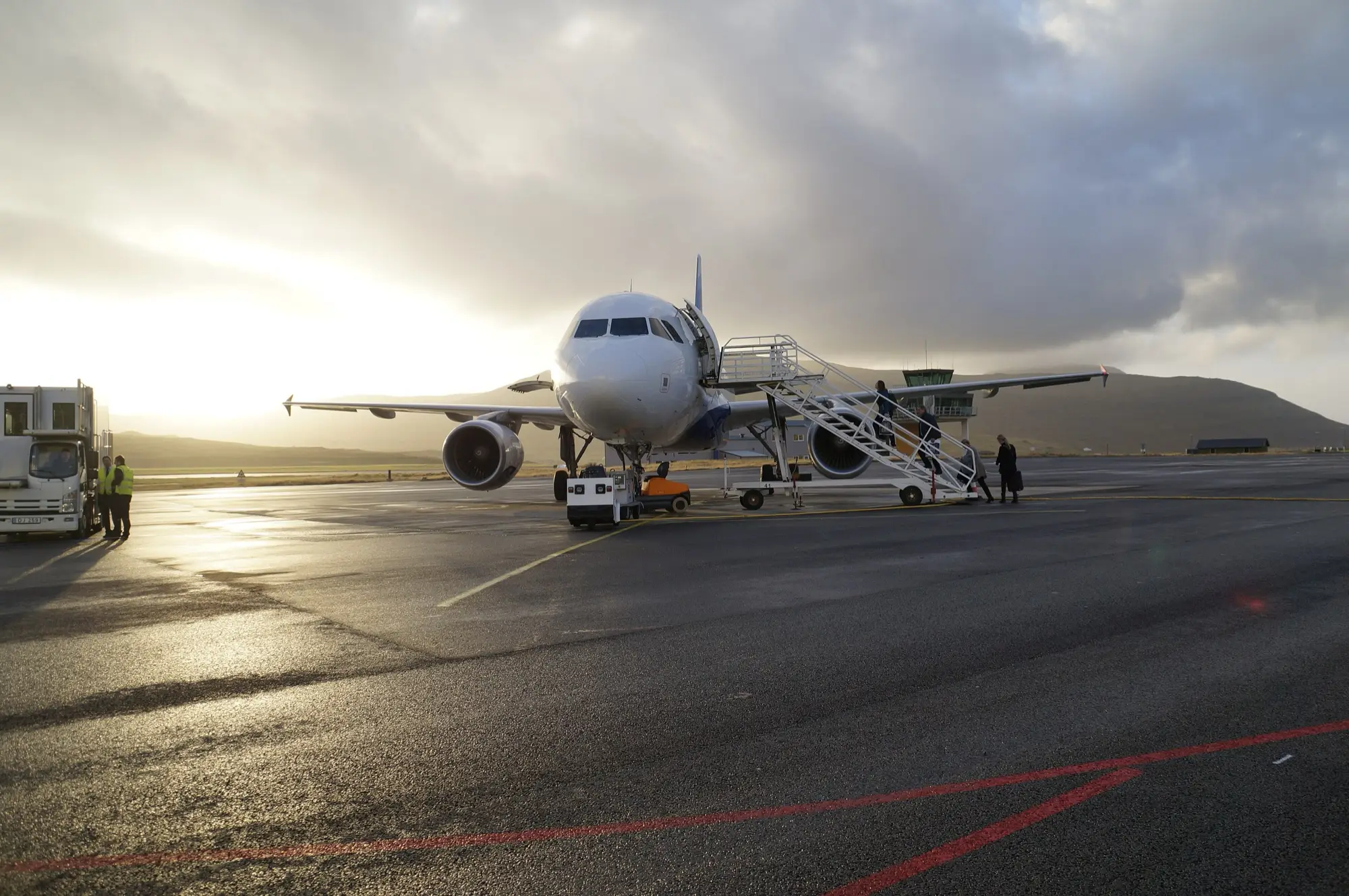

To reach the Faroe Islands, fly into Vágar airport or take Smyril Line's Norröna ferry from Hirtshals in Denmark. Four airlines serve the airport, led by daily flights from Copenhagen, while the ferry docks directly in Tórshavn after a 30-hour crossing. Because the archipelago sits outside the Schengen Area, check entry requirements before travelling.
Getting to the Faroe Islands in short
Four airlines fly to the Faroe Islands: Atlantic Airways, Icelandair, SAS and Widerøe. Atlantic Airways operates the primary route from Copenhagen, maintaining at least two flights a day all year.
The airport, Vágar Airport (code FAE), is on Vágar, around 45 km west of Tórshavn, with car hire at the terminal; you drive on the right.
For sea travel, Smyril Line's ferry Norröna runs year-round from Hirtshals in northern Jutland and docks in the centre of Tórshavn.
Before booking, verify your travel documents. The Faroe Islands are not part of the Schengen Area, meaning a standard Schengen or Danish visa does not grant you entry.
Atlantic Airways: the national airline
Atlantic Airways, the national flag carrier, flies direct to Vágar from destinations in Denmark, Scotland, Iceland and Norway. The carrier's core scheduled link runs from Copenhagen, offering at least two flights every day throughout the year.
According to Atlantic Airways, the airline's destination network includes:
- Mainland Europe: Copenhagen, Billund, Aalborg, Paris, London, Hannover and Katowice
- The North: Reykjavík, Edinburgh and Oslo
- Sun routes: Barcelona, Gran Canaria and Milan
How often Atlantic Airways flies to each destination varies by season. The airline runs direct seasonal flights to holiday destinations such as Barcelona, so consult the schedule when planning around the best time to visit.
SAS, Icelandair and Widerøe
Three other regional airlines maintain scheduled services to Vágar Airport, as detailed by Visit Faroe Islands:
- SAS: Operates direct flights from Copenhagen every day except Tuesdays and Wednesdays.
- Icelandair: Connects North America to the Faroe Islands via Reykjavík, running flights 5 to 6 times a week between May and October.
- Widerøe: Connects Norway to the archipelago. Its main route departs from Bergen, operating at least two flights a week on Mondays and Fridays.
The Norröna ferry from Hirtshals
Smyril Line operates the passenger and vehicle ferry Norröna, which sails year-round between Hirtshals in northern Jutland and central Tórshavn. Travellers driving through Denmark can connect to Hirtshals, located at the same northern tip of Jutland as Skagen.
The sailing takes around 30 hours between Hirtshals and Tórshavn, though the crossing takes longer outside the summer season. Visit Faroe Islands notes that the North Atlantic waters can be rough, particularly during winter sailings.
During the summer season, the Norröna continues onward from the Faroe Islands to Iceland before returning along the identical route. Between June and August, this complete crossing takes two days: the ship departs Hirtshals on Tuesday mornings and reaches Seyðisfjörður in Iceland on Thursday mornings.
The vessel, refurbished in 2020/21, provides 366 passenger cabins and can carry up to 1,482 passengers and 800 vehicles. On the Norröna you can bring your own vehicle. Smyril Line sells ferry transit alone as well as holiday packages that include accommodation. Passengers travelling along the Iceland route can also reserve an extended stopover in the Faroe Islands.
Entry rules: a visa must name the Faroe Islands
Because the Faroe Islands do not belong to the Schengen Area, a standard Schengen visa or Danish visa does not allow you to enter the country. Any visa in your passport must specifically state that it is valid for the Faroe Islands. You must apply for this specific document at a Danish embassy or consulate abroad. A Danish residence permit does not replace this requirement.
Entry criteria differ by citizenship:
- Nordic citizens: Do not require a passport to enter, but you must carry a valid photo identity document.
- EU and Schengen citizens: Do not need a visa or other permit to visit, and can pass border control using a national identity card with a photograph.
- Other international visitors: Travellers from outside the EU and Schengen Area usually need a passport valid for at least three months beyond the stay. The specific nationalities required to obtain a visa match the visa list for Denmark.
If your transit takes you through Denmark or another Schengen member state on your way to the islands, you may be required to register your fingerprints and a digital facial image under the European Union's Entry/Exit System, which started on 12 October 2025.
Arriving by yacht
Private sailors must follow maritime border protocols. Every pleasure craft arriving from abroad must be reported to Faroese customs before arrival.
Visiting crews staying on sailing boats and motorboats are subject to the national sustainability fee. The local harbour says how it is collected.
From the airport and around the islands
Visit Faroe Islands recommends exploring the country by car, whether planning a driving itinerary or travelling between towns. Rental vehicles can be reserved online in advance, booked via a travel agent, or hired upon arrival at the airport terminal before heading to where to stay.
Public transit connects the terminal to the capital. The national transport company, Strandfaraskip Landsins (SSL), operates bus route 300 connecting Tórshavn, Vágar Airport and Sørvágur. Route 350 also provides scheduled service to the airport.
For public transport users, SSL sells a tourist travel card valid on regional buses and domestic ferries:
- 4-day pass: DKK 500 for adults, DKK 250 for children
- 7-day pass: DKK 700 for adults, DKK 350 for children
You can buy the travel card at the Vágar Airport information centre, inside the Tórshavn ferry terminal, or on bus route 300. The travel card does not cover transport for vehicles, cannot be applied to prebooked tickets, and is not valid on the ferry to the island of Mykines.
The helicopter service is subsidised for residents of remote islands; visitors can book one-way trips only, two days before departure.