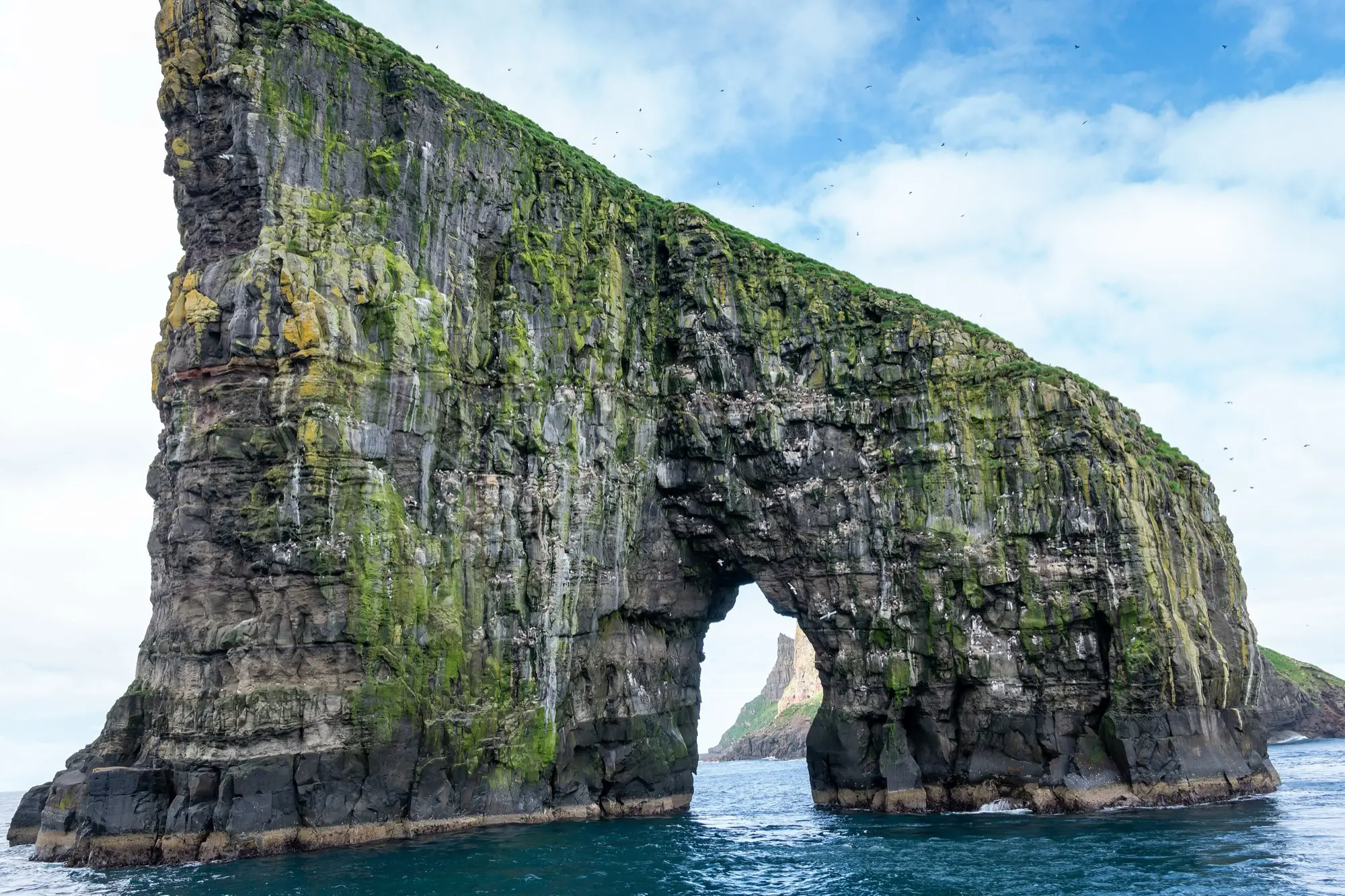

The best time to visit the Faroe Islands is between June and August. Visit Faroe Islands states that summer brings the most stable weather and forms the peak season for travellers. On DMI's Tórshavn normal, May and June are the driest months, while winter remains quiet, wetter and windier.
The best time to visit, in short
Visit Faroe Islands says summer (June to August) has the most stable weather and is the most popular season to visit. If you want to avoid rain, DMI's 1991-2020 normal for Tórshavn records June as the driest month with 63.1 mm of precipitation, preceded by May at 70.3 mm.
Your timing also dictates logistics on popular routes. Between 1 May and 31 August everyone taking the ferry to Mykines pays DKK 500, or DKK 400 online in advance, which includes a mandatory guide on the island. Visit Faroe Islands says most visitors spend 3 to 5 days to see the main sights.
Summer (June to August): the main season
Summer delivers the warmest temperatures of the year. Visit Faroe Islands gives summer as 10 to 13 °C, noting it offers the best hiking conditions, though it remains windy with occasional fog during this peak tourist period. Visit Faroe Islands also calls June ideal for outdoor activities and hiking.
According to DMI's climate normals for the Faroe Islands, the mean temperature in Tórshavn is 9.1 °C in June, 10.8 °C in July and 11.2 °C in August. Average daily highs reach 11.3 °C in June, 12.9 °C in July and 13.3 °C in August. You can compare these figures against historical records on the Faroe Islands weather by month page.
Cultural life peaks during the midsummer weeks:
- Village festivals take place across the archipelago throughout July.
- The music festival G! Festival takes place around mid-July.
- The last of the July village gatherings is Ólavsøka on 28 and 29 July. This national holiday includes parades, traditional national dress, concerts and sports competitions.
Spring (April and May): birds, lambs and fog
Spring is a period of transition across the cliffs and pastures. Visit Faroe Islands gives spring (April to May) as 5 to 9 °C, describing the conditions as unstable but improving as puffins return and the birdwatching season begins.
March marks the arrival of returning bird life, including puffins, with several operators running dedicated boat tours to the cliffs. On 12 March, the islands celebrate the return of the oystercatcher, the national bird, during Grækarismessa in Tórshavn, marked by community gatherings, music and food.
Lambing takes place throughout April, and Visit Faroe Islands asks all visitors to keep their distance from the ewes and newborn lambs. Weather conditions remain variable; every May the islands are wrapped in fog that rolls in and out depending on the wind and local fronts. Despite the mist, May ranks among the driest stretches on the calendar: DMI's Tórshavn normal records 70.3 mm of precipitation in May, surpassed only by June's 63.1 mm.
Autumn (September and October): rain and quiet roads
Visit Faroe Islands gives autumn (September to October) as 7 to 11 °C, characterised by dramatic skies and rising rainfall levels.
Data from DMI's 1991-2020 normal shows that rainfall steps up noticeably: September averages 118.1 mm of precipitation, while October climbs to 146.8 mm. The village festival Heystfagnaður takes place in Eiði on the island of Eysturoy, usually towards the end of October.
Winter (November to March): storms, rain and few visitors
Winter brings the harshest weather alongside the quietest trails. Visit Faroe Islands gives winter (November to March) as 3 to 7 °C, warning that Atlantic storms are possible and snow falls occasionally. Strong wind often leads to cancelled and delayed ferries and buses. Check how to get to the Faroe Islands to see how schedules shift during these months, or read our guide to the Faroe Islands in winter for what is open in winter and the daylight.
On DMI's normal for Tórshavn, January is the wettest month of the entire year at 167.3 mm, while February is the coldest month, averaging a mean temperature of 4.0 °C. Visit Faroe Islands notes that in January the weather rules your plans, but the islands remain far less crowded than typical winter destinations.
Specific seasonal features define the colder months:
- Heavy November rain feeds the streams, putting the waterfalls in full force during an off-peak travel period.
- In December, a small Christmas village opens in central Tórshavn, selling handmade crafts, waffles and mulled wine.
- For music events, Winter Jazz takes place across Tórshavn each January.
- If you hike in the mountains, be mindful of the hare-hunting season: the annual hare-hunting season runs from 2 November to 31 December in the mountains on any day except Sunday, taking place mostly on Saturdays.
Seasons that decide what you can do
Several key sights and activities operate on strict calendar schedules rather than general weather conditions. Consult our Faroe Islands travel guide and guide to Faroe Islands hikes when matching your plans to these fixed dates:
- Mykines ferry and hiking: Between 1 May and 31 August, all passengers taking the ferry to Mykines must pay DKK 500 (DKK 400 when booked online in advance). This payment includes the mandatory local guide on the island.
- Drangarnir: Guided hikes out to the Drangarnir sea stacks operate exclusively from 1 April to 1 October, running on Wednesdays, Saturdays and Sundays.
- Áir whaling station: The historic whaling station at Áir, dating from 1905, opens its doors for public visits from mid-June until mid-August.
- Mountain access: The hare-hunting season takes place every year from 2 November to 31 December. It is conducted in the upland terrain on any day except Sunday, mostly on Saturdays.
How many days to plan
Strong wind often leads to cancelled and delayed ferries and buses. For travel across the wider region, check our guides on the Denmark hub, or follow a structured Faroe Islands itinerary. Visit Faroe Islands states that most visitors spend 3 to 5 days to see the main sights across the territory.