
Two drives: the Marguerite Route on the West Zealand coast from Korsør to Skælskør and Bisserup, and the west coast of Jutland from Skagen to Ribe. Drive on the right with dipped headlights or daytime running lights at all times, limits are 50, 80 and 130 km/h unless signed, motorways are free except the Storebælt and Øresund bridges, and a foreign diesel car first registered before 1 January 2011 must be registered no later than the day it enters a low emission zone.
Route 1: the Marguerite Route from Korsør to Skælskør and Bisserup
The Marguerite Route (Margueritruten) is marked by brown signs with a white daisy, among Denmark's most recognisable road markers. The route is named after Queen Margrethe II, whose nickname is Daisy, and VisitDenmark calls it a route for those with time to enjoy scenic nature while driving. The stretch from Korsør to Skælskør suits both car and bicycle.
This section begins at the foot of the Great Belt Bridge. In Korsør the fortress, which has guarded the entrance to the Great Belt since the Middle Ages, houses the Korsør Town and Ferry Museum. South of Korsør the route follows the coast towards Skælskør past Halskov Odde, with views of the bridge, on a narrow, quiet road, and passes close to Kobæk Strand.
Skælskør has colourful houses along the harbour and a narrow lagoon cutting inland. From the town, you can continue south towards Bisserup and Karrebæksminde, while the Trelleborg Viking fortress near Slagelse is within easy reach. Between Bisserup and Skælskør the route reaches Holsteinborg Castle through what VisitDenmark calls Denmark's longest avenue of chestnut trees. This is the castle Hans Christian Andersen visited most often. The route then continues to Borreby, a Renaissance castle built in 1556.
Check our map of Denmark to see where these stops sit.
Route 2: the west coast of Jutland from Skagen to Ribe
Grenen, where the Skagerrak and the Kattegat meet, is about 3 km from Skagen town centre. The large car park at Grenen takes payment by card or mobile payment only; cash is not accepted. Read more in our guide to Skagen.
Råbjerg Mile, which VisitDenmark calls the largest migrating dunes in northern Europe, moving 15 metres a year, is less than 20 minutes from Skagen. In the north of Jutland the Marguerite Route takes in both the east and the west coast, through Børglum Abbey, Rubjerg Knude and the lighthouse by Lønstrup, Lilleheden plantation in Hirtshals, Tversted, Bangsbo in Frederikshavn and the coast museum in Sæby.
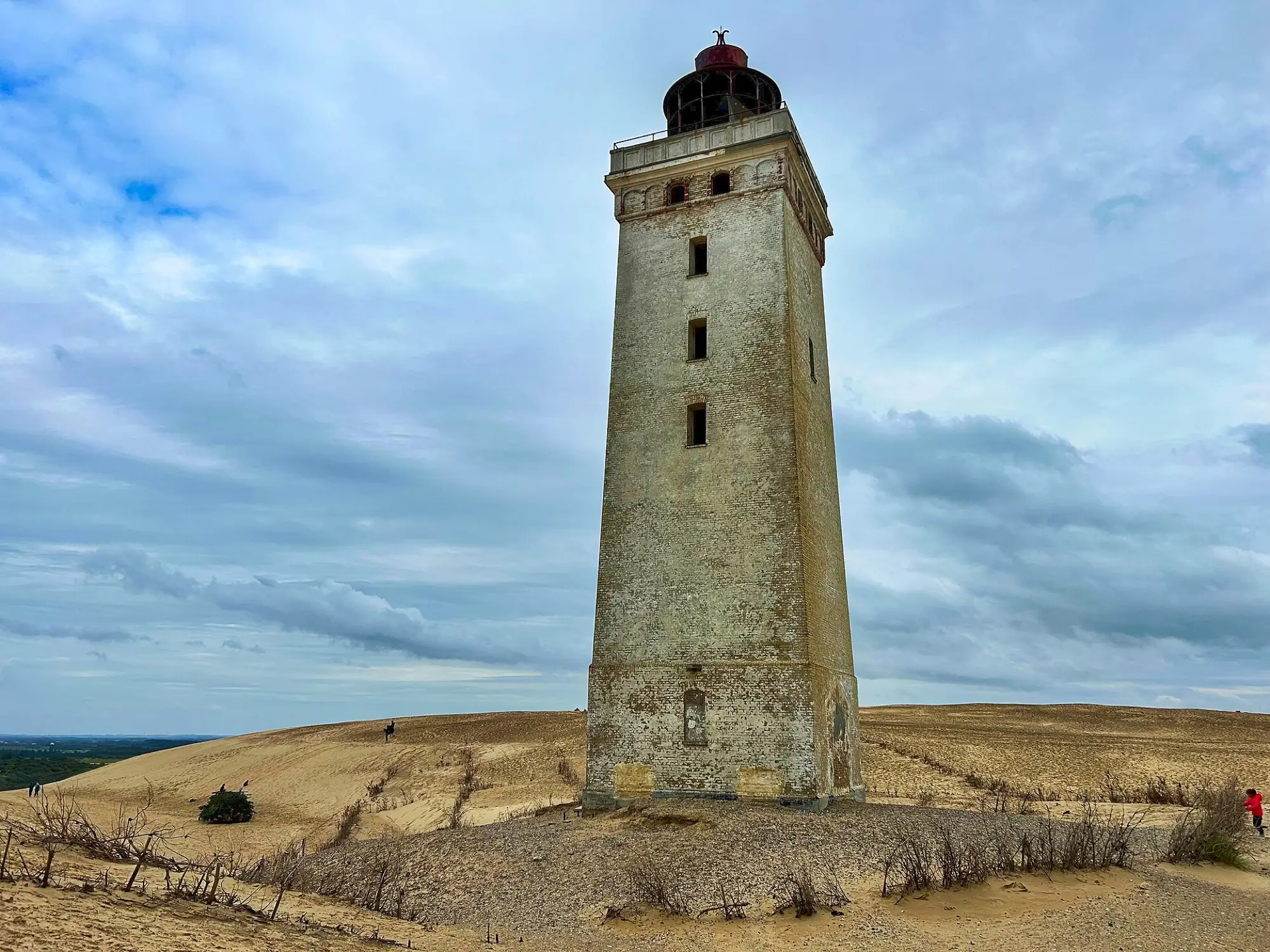
Rubjerg Knude lighthouse was first lit on 27 December 1900. A dune grew so tall that it blocked the beam, and the light was put out for the last time on 1 August 1968. In the autumn of 2019 the lighthouse was moved 70 metres further inland, and you can climb to the top for a view over the North Sea and the dunes.
The coast between Agger and Hanstholm in Thy is called Cold Hawaii because its wind conditions are like Hawaii's, and it has 31 surf spots. Klitmøller holds surf competitions every year. There is no entrance fee to Thy National Park, covered in our guide to Denmark national parks. In South Thy the Marguerite Route enters Thy from the south on the Agger to Thyborøn ferry, between the port of Thyborøn and the spit at Agger Tange, or from the east on the Neessund ferry from Mors.
The Wadden Sea tourist board calls Ribe Denmark's oldest town, with a history going back to around 710 AD and a medieval centre of cobbled narrow streets. Ribe Cathedral, whose first building period was about 1150 to 1225, will close from 18 May 2027 for one and a half years.
Speed limits and speeding penalties
The general speed limits in Denmark are:
- 50 km/h in built-up areas
- 80 km/h outside them
- 130 km/h on motorways
These limits apply to cars, vans and motorcycles unless signs show another limit. VisitDenmark says the motorway limit is 130 km/h in most places and 110 km/h in others. A car with a trailer is limited to 80 km/h on motorways and 70 km/h on ordinary roads.
Driving more than 60% over the limit or at 160 km/h or more brings a conditional disqualification from driving. Driving at 200 km/h or more means losing your licence outright. VisitDenmark says foreign visitors who break the speed limits get an on-the-spot police fine.
Headlights, phones, alcohol and cyclists
The Danish Road Safety Council (Rådet for Sikker Trafik) says you must drive with dipped headlights or daytime running lights at the front of the car around the clock. From sunset to sunrise, when visibility is reduced by rain, snow or fog, and in tunnels, the rear lights must be on too. On most newer cars one switch setting lights only the daytime running lights at the front, with no rear lights, and forgetting the rear lights in those hours brings a fine.
Traffic drives on the right. You overtake on the left and keep to the right-hand lane of multi-lane roads when not overtaking. You must indicate when changing lane on the motorway.
When you turn right you must give way to cyclists and motorcyclists going straight on. Using a mobile phone while driving is prohibited; hands-free is allowed only if the system is built into the car, and a headset does not count. The blood alcohol limit is 0.5 per thousand.
Driving a hire car on a foreign licence
Check the hire company's own conditions before you book.
On a temporary stay such as a holiday you may drive in Denmark on:
- A valid licence issued in the EU or EEA
- A Faroese or Greenlandic licence
- An international driving permit under the 1926, 1949 or 1968 conventions
- Another foreign licence written in Latin letters or accompanied by a translation into Danish, English or French made by an authority or an authorised organisation in the issuing country
If you hold none of those licences, the Danish Road Traffic Authority (Færdselsstyrelsen) can give you permission to drive during a temporary stay, a tourist driving licence (turistkørekort), and in some cases may require you to pass a supervised driving test first. Once you take up ordinary residence in Denmark, a licence issued outside the EU and EEA is valid for up to 180 days, after which it must be exchanged.
Bridge tolls and the Kattegat ferry
Apart from the Great Belt Bridge (Storebæltsbroen) between Zealand and Funen and the Øresund Bridge (Øresundsbron) between Copenhagen and Sweden, the whole Danish motorway network is free to use. Sund & Bælt says the Storebælt link, two bridges and a tunnel, is the 18 km fixed connection between eastern and western Denmark.
Storebælt's 2026 price list gives the prices for a single crossing from 1 January 2026. A single crossing in a car 3 to 6 m long costs DKK 205 at the express price or DKK 235 at the card and cash price. The express price applies only with an active Bizz or number plate payment agreement in a green express lane; paying by card or cash means the card and cash price. At the Storebælt toll station you pay by card in the blue lanes and in cash in the yellow lanes, where Danish kroner and euros are accepted, but not the 500 euro note.
For the Øresund Bridge, prices are per single trip, include 25% VAT and are valid from 14 September 2026. A single trip in a car up to 6 metres costs DKK 470 at the toll station, DKK 420 as an online ticket and DKK 182 with the ØresundGO agreement, which has an annual fee of DKK 370. Øresundsbron says a round trip costs the price of a one-way trip times two.
Molslinjen sails between Odden on Zealand and Aarhus or Ebeltoft in Jutland, up to 24 times a day, 365 days a year. Molslinjen says the Aarhus to Odden crossing saves around 200 km of driving. Compare this option with rail on Copenhagen to Aarhus.
| Crossing | Payment | Price for a car |
|---|---|---|
| Storebælt (car 3 to 6 m) | Express (active Bizz or number plate payment) | DKK 205 |
| Storebælt (car 3 to 6 m) | Card and cash | DKK 235 |
| Øresund Bridge (car up to 6 m) | Online ticket | DKK 420 |
| Øresund Bridge (car up to 6 m) | Toll station | DKK 470 |
| Molslinjen ferry (car up to 1.85 m high) | Lowprice (non-refundable) | From DKK 249 |
Low emission zones in five cities
Denmark has low emission zones (miljøzoner) in Copenhagen, Frederiksberg, Odense, Aarhus and Aalborg. The Copenhagen zone was extended to the municipal border towards Tårnby on 1 March 2025, without the Øresund motorway. No motorways lie inside the low emission zones, though some exits border a zone.
A diesel-powered passenger car must have a particulate filter or be at least Euro 5 to be used in the zones. The rules apply to Danish and non-Danish cars alike. Foreign-registered vehicles more than 30 years old do not have to be registered, and petrol cars and hybrids need no registration.
According to Miljøzoner rules, a non-Danish diesel passenger car first registered before 1 January 2011 must be registered no later than the day it enters a zone. It can drive in the zone right after registering, and the registration is valid for five years. The zones are enforced automatically by cameras that read number plates. The fixed penalty for a passenger car used illegally in a zone, or not registered, is DKK 1,500, reduced to DKK 1,000 if you later send documentation that the car meets the rules.
Parking and the parking disc
VisitDenmark says parking discs (parkeringsskive, or p-skive) are required where time-limited parking is allowed, and police may remove illegally parked cars or fine you on the spot.
Aarhus Municipality says the parking disc must be set to the time you start parking, moving the pointer forward to the next quarter hour. A car parked with a wrongly set disc gets a parking charge.
You may not park:
- On roads with an unbroken white centre line
- Within 5 metres of a pedestrian or bicycle crossing
- Within 10 metres of an intersection
- Within 12 metres of a bus stop