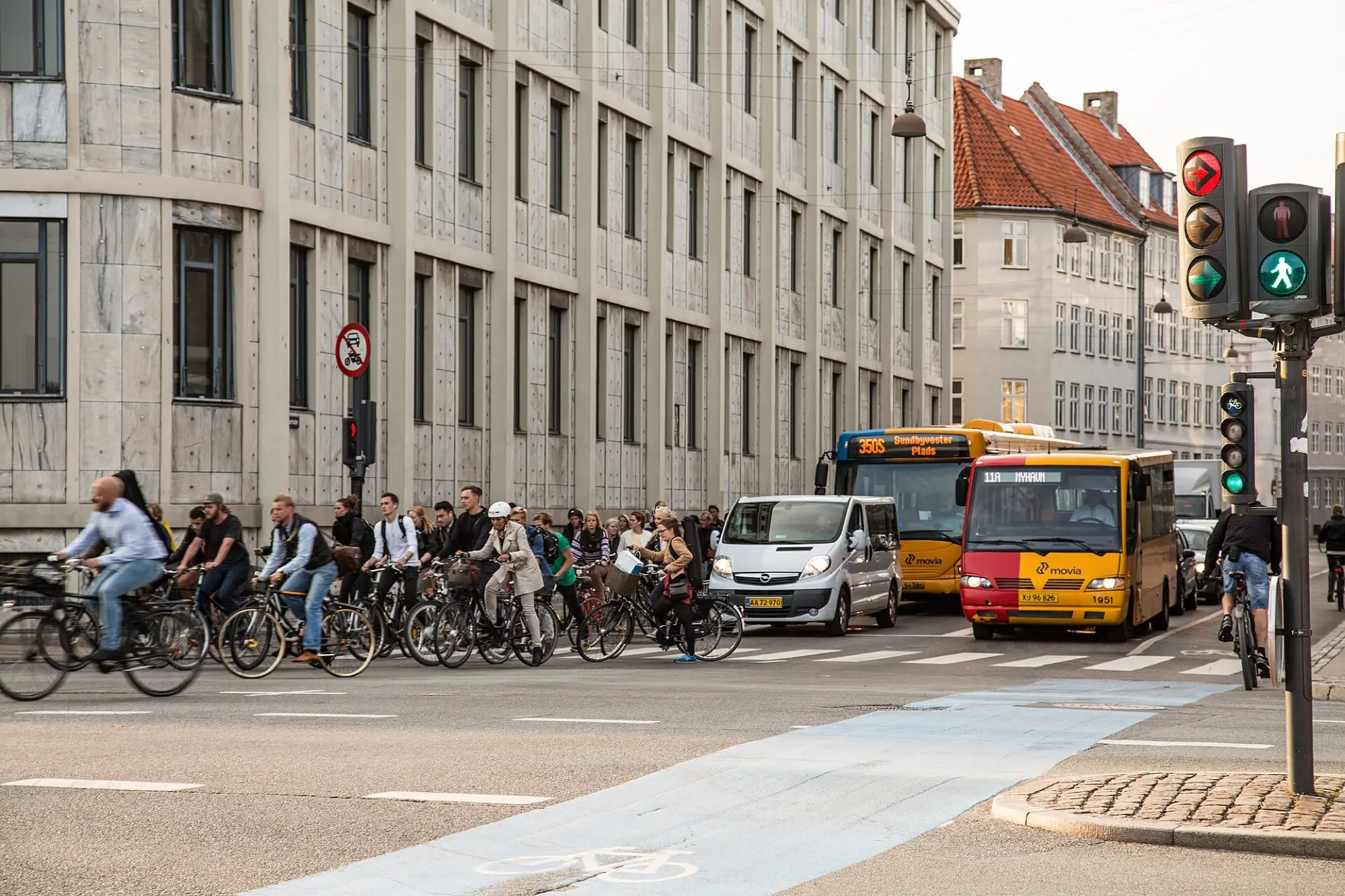

Before visiting Denmark, check the practical rules: entry rules and the EES, the krone, cards and cash, tipping, VAT refunds, cycling rules, public transport tickets, emergency numbers, tap water, plugs, shops on Sundays and holidays, smoking, alcohol ages, the weather and English.
| Item | Detail |
|---|---|
| Emergency (life-threatening) | 112 |
| Police (non-emergency) | 114 |
| Medical helpline (Capital Region) | 1813 |
| Standard VAT rate | 25% |
| Alcohol purchase age | 16 (in shops up to 6% ABV) / 18 (over 6% ABV and in bars) |
| Tobacco purchase age | 18 |
1. Entry rules and the EES: border checks and electronic registration
VisitDenmark says Denmark is in the Schengen area, so there is no passport control between Denmark and Germany or Sweden, but you must still carry your passport as identification. There is passport control when you arrive from outside Schengen, and some nationalities need a visa. UK citizens can visit Denmark without a visa for up to 90 days in any 180-day period, and visits to other Schengen countries in the previous 180 days count towards the 90 days. For Danish border checks, EU/EEA citizens, including children, need a passport or a national ID card approved as travel ID. Other nationals need a passport, with a Schengen visa or residence permit if required. Nordic citizens need no passport to enter Denmark, but must prove their nationality if checked; the Danish police recommend a passport, driving licence or national photo ID card.
The EU's Entry/Exit System (EES) registers non-EU nationals on a short stay each time they cross the external borders of 29 European countries, recording fingerprints and a facial image. It began its progressive start on 12 October 2025, became fully operational on 10 April 2026 and replaces passport stamping. According to guidance on GOV.UK entry requirements, EES registration costs nothing, children aged 11 or younger are not fingerprinted but may be photographed, the record is valid for 3 years, and you should allow extra time at the border.
2. The krone: local currency and declaration thresholds
The Danish krone (kroner in the plural, abbreviated DKK or written kr.) is the currency of Denmark, Greenland and the Faroe Islands. There are 100 øre in a krone, but the 50 øre coin is the only øre coin still in circulation. Notes come in 50, 100, 200 and 500 kroner, and coins come in 1, 2, 5, 10 and 20 kroner. Danmarks Nationalbank runs a fixed exchange rate policy that keeps the krone stable against the euro, and on 31 October 2022 it marked 40 years of the fixed exchange rate regime. There is no limit on the currency you may bring in or take out, but amounts over EUR 10,000 (about DKK 75,000) must be declared.
3. Cards and cash: the legal duty to accept payment in coins and notes
VisitDenmark says international credit cards work in restaurants, hotels, petrol stations and shops, but the business may add a fee, which you are told about before you pay. Many smaller shops and supermarkets do not take international credit cards. Under section 81 of the Payments Act, the Danish Consumer Ombudsman cash rule states that a business that takes cards or mobile payment must, as a rule, accept cash from 06:00 to 22:00. A business cannot get round this with a "no cash" sign or by having no change, and breaking the rule is punished with a fine.
This cash rule does not apply to online and telephone sales, unstaffed self-service points such as unstaffed petrol stations, or temporary events such as festivals of at most 14 days that say in advance they take no cash. Businesses in areas especially exposed to robbery may limit cash hours to 06:00 to 20:00 if they put up a sign saying so. Pharmacies and dentists must take cash for their whole opening hours. You can withdraw cash from bank ATMs with Visa, Cirrus, Maestro or Mastercard. You are told about charges before the withdrawal, and most ATMs work around the clock.
4. Tipping: included service charges and taxi fares
VisitDenmark says service charges are included in hotel, restaurant and taxi bills. You may tip for great service, how much is up to you, and there is no set etiquette. In taxis, the tip is always included in the fare. Large luggage on an outside rack costs extra. Drivers give a receipt, and you can pay by cash or card.
5. VAT refunds: claiming back sales tax on purchases
VAT in Denmark is 25%, and prices are always shown including VAT. A tourist who lives outside the EU can get a VAT refund on goods bought during the stay; people whose official address is in Denmark or another EU country cannot. The goods must be worth more than DKK 300 (DKK 1,200 for residents of Norway and the Åland Islands) and must leave the EU before the end of the third month after the month of purchase. Shops are not obliged to help, and without the shop's help there is no refund. When you leave the EU, customs must stamp your invoice, no earlier than four hours before you leave Denmark on the day of departure. VisitDenmark says a VAT refund through the scheme pays back between 10% and 19%, which is the VAT minus an administration fee, only on purchases over DKK 300 in shops that are part of the scheme.
6. Cycling rules: mandatory equipment and hand signals
A bike in Denmark must have a bell, a white reflector at the front, yellow reflectors on the pedals and wheels and a red reflector at the back. Danish bikes come with them, but a bike brought from abroad must be fitted with them. When cycling in the dark, you must have a working white light at the front and a red one at the back. According to the Danish Road Safety Council, bike lights are required from sunset to sunrise and whenever visibility is reduced by fog, rain or snow. Lights must be clearly visible from at least 300 metres and from the side. The fine for cycling without lights is DKK 700. You must always cycle on the right and use the bike path where there is one. To turn left you cross to the far side and wait with the traffic. You must signal with your arm when slowing down, turning or stopping. A helmet is not a legal requirement for cyclists.
7. Public transport tickets: apps, zones and off-peak travel
The Copenhagen Metro points you to two apps: the Rejsekort app, where you check in and out with a swipe, and the Rejsebillet app, which sells single tickets for buses, trains, the metro and the light rail and works throughout the country. The Metro says the Rejsebillet app was to replace the DOT Billetter app by the end of 2025. The Basiskort card is for those who will not use an app. An adult single on the Metro costs DKK 24 for 2 zones, valid 1 hour 15 minutes, and DKK 30 for 3 zones, valid 1 hour 30 minutes and enough for the Copenhagen Airport to city route. Those aged 12 to 15 pay half. The City Pass costs DKK 100 and gives 24 hours of unlimited travel in zones 1 to 4, which include the whole metro and the airport. On the metro, an adult may bring two children under 12 for free. With a Basiskort, a Rejsekort or the Rejsekort app, trips that begin outside rush hour are 20% cheaper, that is 11 am to 1 pm and 6 pm to 7 am on weekdays and all day at weekends and on public holidays.
8. Emergency numbers: who to call for urgent help
112 is Denmark's number for life-threatening emergencies (police, ambulance and fire). For the police when it is not an emergency, call 114. If you lose something during your stay, the police's non-emergency number 114 will help you reach the local lost property office. For injuries or sudden illness VisitDenmark lists a number for each region, where you can speak to a nurse or doctor or be sent to a hospital emergency department; it is 1813 in the Capital Region (Copenhagen) and 1818 in Region Zealand, and the other regions have their own numbers.
9. Tap water: refill fountains and drinking water
Visit Copenhagen says tap water is safe to drink, and there are more than 60 public drinking fountains in the city where you can refill a bottle for free.
10. Plugs and adaptors: electrical standards
VisitDenmark says Denmark uses two-pin continental plugs like most other European countries. Visitors from Ireland or the UK need adaptors, and visitors from North America need a transformer for 110/125 volt appliances.
11. Shops on Sundays and public holidays: trading laws and opening hours
VisitDenmark gives typical supermarket opening hours as 8 am to 10 pm, varying from store to store; chains include Netto, Føtex, SuperBrugsen and Fakta. Borger.dk says 1 May, 5 June (Constitution Day), 24 December and 31 December are not public holidays in Denmark. The Danish Business Authority says the shop-hours law closes larger shops on the public holidays and also on the later part of New Year's Eve. On those days grocery shops with a yearly turnover under DKK 20.1 million may open; those between DKK 20.1 and 46.5 million need an auditor's statement first; those over DKK 46.5 million must always stay closed. Pharmacies (apoteker) normally open 9 am to 6 pm Monday to Friday and 10 am to 4 pm on Saturday and are closed on Sunday, though there are some 24-hour pharmacies.
12. Smoking: public restrictions and age limits
Tobacco and cigarettes are sold only to people aged 18 or over. Smoking is against the law in indoor public places, including restaurants, cafés, bars, all public transport and taxis, except in special smoking booths. Bars or cafés with an alcohol licence that are smaller than 40 square metres may allow it, and most hotels are non-smoking.
13. Alcohol age limits: retail rules and licensed premises
VisitDenmark says that as of April 2025 the age limit for buying drinks of up to 6% ABV, such as standard beer, in shops is 16; for anything stronger than 6%, which includes most wine and all spirits, it is 18 everywhere; and in bars and restaurants it is 18 whatever the strength.
14. The Danish weather: seasonal temperatures and wind
DMI's preliminary 1991-2020 values for Denmark as a whole give a mean temperature of 1.6 °C in January and 16.9 °C in July. VisitDenmark says the prevailing wind is westerly, so the west coast gets more rain than the rest of the country. Full details are available in the Denmark weather by month guide.
15. English is widely spoken: communication and the Danish alphabet
VisitDenmark says Danes tend to speak very good English and it is easy to get around without Danish. Foreign films are shown in the original language with Danish subtitles, in cinemas and on television. Danish has three extra letters at the end of the alphabet, æ, ø and å, and å can also be written aa, as in Aalborg and Aarhus.