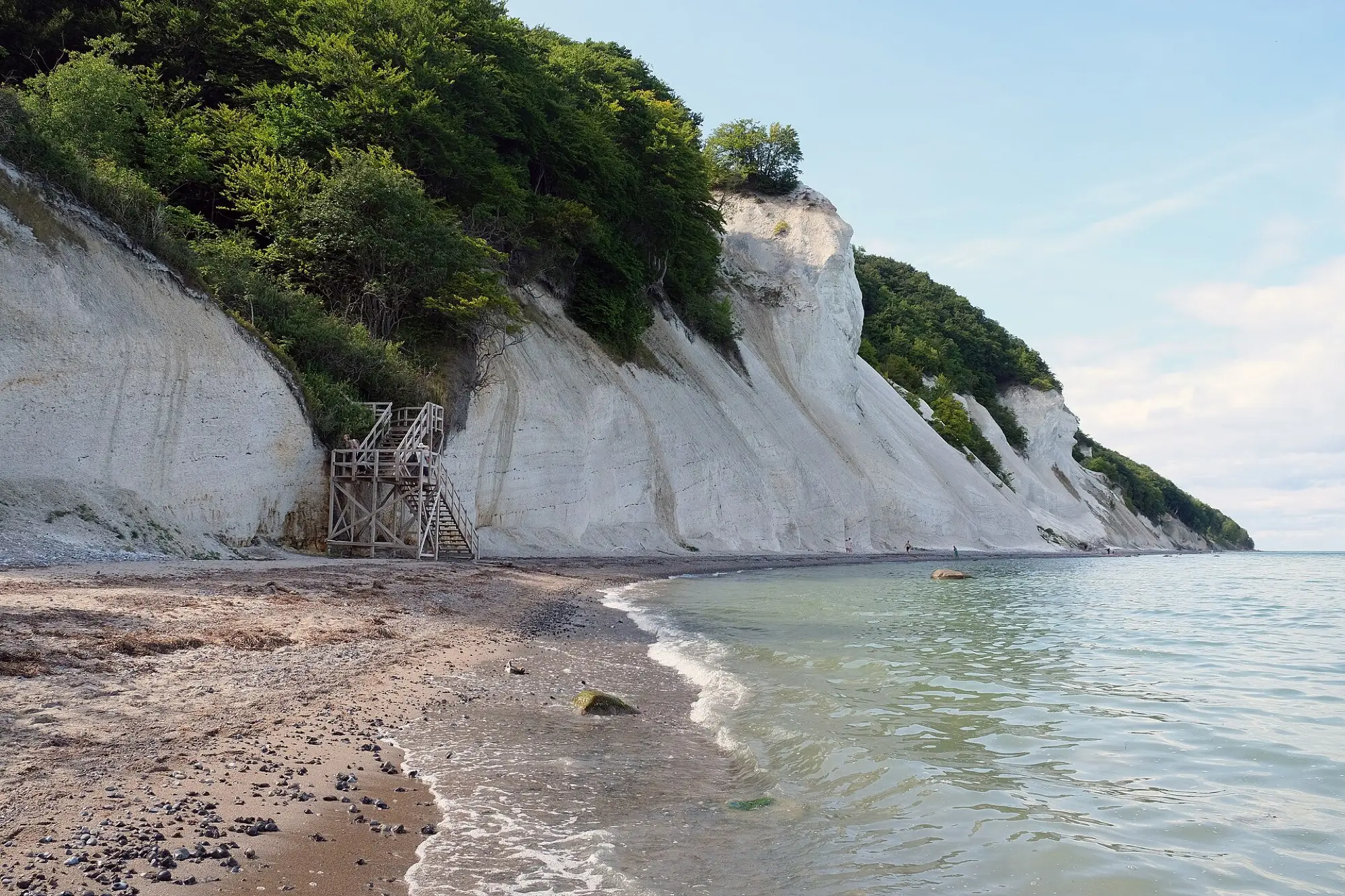

Møns Klint is a chalk cliff about 6 km long on the east coast of the island of Møn, 128 m high at Dronningestolen, on the UNESCO World Heritage List since 13 July 2025. The GeoCenter closes for the winter. By bus you change at Vordingborg station and Stege, and bus 678 reaches the GeoCenter only from 29 March to 31 October.
The cliffs, the chalk and the World Heritage listing
The Danish Nature Agency says the World Heritage listing covers the roughly 6 km long coastal cliff and parts of the hill landscape behind it. Møns Klint is the highest cliff in Denmark. Walking north from the GeoCenter car park you reach its highest point, Dronningestolen (the Queen's Chair), an almost vertical 128 m drop to the beach.
According to the Danish Nature Agency guide to attractions, the chalk is made of the remains of microscopic algae and other sea creatures that lived about 70 million years ago, when there was a tropical sea where Denmark lies. When the last ice age reached Denmark about 12,000 years ago, the ice peeled flakes of chalk up to 50 m thick off the old seabed and pushed them together, which made Høje Møn. The black stripes of flint in the cliff show how the layers were folded.
Møns Klint was inscribed on the UNESCO World Heritage List on 13 July 2025, at the 47th meeting of the UNESCO committee in Paris. The GeoCenter says the cliff shows how ice age glaciers shaped the landscape. In addition, Møn and the surrounding islands are Denmark's first UNESCO biosphere reserve, covering an area of 450 square kilometres. For Denmark's national parks, see Denmark national parks.
The stairs down to the beach
The Nature Agency's guide says steps connect the top of the cliff with the beach in five places; Grårygtrappen has 468 steps and Maglevandstrappen 497, the longest set of steps in Denmark.
In October 2023 a storm damaged all five stairs from the cliff to the beach. The Nature Agency said on 28 October 2026 that it has rebuilt most of the stairs since, but needs solutions that stand up better to wind and weather. A new stair design by MASU planning won an architecture competition for Møns Klint, and the Nature Agency plans for the stair at Sandskredsfaldet to be built during 2028.
On the beach you can find fossils of the marine animals in the chalk, especially sea urchins and thunderstones, which are part of the shell of a prehistoric squid.
Rockslides, closures and staying safe
Rockslides happen at Møns Klint every year, with the risk greatest in winter and spring. Climbing the cliff outside the stairs and trails is prohibited, barriers must be respected and all traffic in the area is at your own risk. Check the Nature Agency's notices and respect every barrier before walking on the beach.
In the first weekend of 2024 the point at Sommerspiret collapsed in a slide 380 m wide and 175 m out into the sea, the biggest since 2007. A smaller slide took Forchhammers Pynt, just north of the GeoCenter, with its path and railing, and the Nature Agency closed the whole beach. After that slide the Nature Agency suggested coming back in late spring, when the risk of slides is lower. In 2007 the Store Taler slide sent up to 500,000 cubic metres of chalk, clay and soil and about 100 beech trees 300 m into the Baltic Sea. On average about 2 to 4 cm of the cliff disappears each year.
GeoCenter Møns Klint
GeoCenter Møns Klint's interactive exhibition takes you about 70 million years back to the Cretaceous, starting at the bottom of the Cretaceous sea with a 14-metre-long killer lizard. Queen Margrethe opened the GeoCenter in 2007. It is owned by a private foundation and provides nature services on behalf of the Danish Nature Agency.
| Ticket type | Adult price | Child price (ages 3 to 11) |
|---|---|---|
| Day ticket | DKK 155 | DKK 100 |
| Weekly ticket | DKK 200 | DKK 145 |
| Season ticket | DKK 250 | DKK 195 |
Children aged 0 to 2 enter free of charge. A ticket bought online is DKK 10 cheaper. A weekly ticket allows as many visits as you like on seven consecutive days. The season ticket runs from 30 March 2026 to 30 October 2026.
In 2026 the GeoCenter was open 10:00 to 17:00 over Easter, 28 March to 6 April, 10:00 to 18:00 in high season from 27 June to 9 August, and 12:00 to 16:00 from 19 to 30 October. The GeoCenter is closed for the winter from 31 October 2026 to 20 March 2027. In high season and selected periods the GeoCenter runs open guided tours to the fossil beach, in the forest and on mountain bikes, for DKK 25 on top of the entrance ticket.
Walking trails and the Camøno
The Danish Nature Agency says Møns Klint has seven marked hiking trails from 2.2 km to 9 km long. A 267-metre-long walkway at the GeoCenter, opened in 2013, gives wheelchair users, people with walking frames and prams access to several viewpoints over the cliff.
Museum Southeast Denmark gives the Camøno as a 175 km hiking route across three islands: Møn, Nyord and Bogø. The Camøno is 12 stages; its Cliff stage runs 16.6 km from Pension Elmehøj to Villa Huno on hilly terrain rated moderate. For more trail routes across the country, see our overview of hiking in Denmark. VisitDenmark says that the Klintekongens Rige trail on Møn was named the best hiking trail in Europe by the Deutsches Wanderinstitut, and can be walked at any time of year.
Liselund, the romantic park and its manor house
Liselund park, part of the National Museum of Denmark, is open every day from 07:00 to 22:00 all year, and entry to the park is always free. The manor house can be visited only on guided tours, held from May to September. Antoine de la Calmette and his wife Lisa bought the estate in 1784, and its two-storey thatched main house was completed in 1793. The Nature Agency calls the park Denmark's best-preserved romantic garden.
In 2026 the Liselund house tours ran from 30 June to 29 September, last about 45 minutes and cost DKK 85 for adults, with children free. Bicycles are not allowed in Liselund park, and dogs must be on a lead.
The dark sky park
On 17 March 2017 the International Dark-Sky Association designated Møn and Nyord as Scandinavia's first International Dark Sky Park and Dark Sky Community. The park covers the eastern side of Møn and state-owned land on Nyord. In the designation announcement the mayor said about 100 stars can be seen from Copenhagen and more than 5,000 from Møn and Nyord.
VisitDenmark lists Dark Sky Møn and Nyord as open all year and free, and says the season is best from September to March, when the dark hours are longest. For other dark locations, consult our guide to viewing the northern lights in Denmark.
Getting there by bus
By public transport, the Nature Agency says to take Movia bus 664 from Vordingborg station to Stege and change to bus 678, which stops at the GeoCenter only in the tourist season. The GeoCenter says bus 678 runs directly from Stege to the GeoCenter only from 29 March to 31 October.
Bus 667 runs all year from Stege to Magleby, and from Magleby it is a 5.5 km walk or ride to Møns Klint; you may take a bicycle on the bus. Among the day trips from Copenhagen, the GeoCenter sells a day trip by minibus from Colbjørnsensgade 15 in Copenhagen. It goes first to the Camp Adventure forest tower and gives 2 hours 45 minutes at Møns Klint. The trip lasts about 8 hours 30 minutes and includes GeoCenter entry, but does not include the forest tower.
Driving and parking
VisitDenmark says Møn is 1.5 hours south of Copenhagen by car, with Møns Klint on the island's eastern shore. The GeoCenter is at Stengårdsvej 8, 4791 Borre. Coming from Zealand on the E47/55 you take exit 41 and follow the signs to Møns Klint.
According to the GeoCenter planning information, parking at the GeoCenter car park costs DKK 45. Your number plate is read at the entrance and you pay by QR code or at the meter before you drive to the exit barrier. The Nature Agency says parking is free at Camping Møns Klint, at Liselund and at several other places in the area. Motorhomes and caravans are welcome in the GeoCenter car park during the day, but you may not spend the night there.