
To see key Viking sites in Denmark, visit Jelling, the National Museum's Kongernes Jelling centre, Trelleborg, Fyrkat, Aggersborg, Lindholm Høje, Ribe and its Viking centre, the Viking Ship Museum in Roskilde, the Ladby ship and Moesgaard near Aarhus. You can locate each destination across the country using the Denmark map. UNESCO inscribed Jelling on the World Heritage List in 1994 and added the five Viking ring fortresses in 2023.
Jelling: the mounds, the runestones and the church
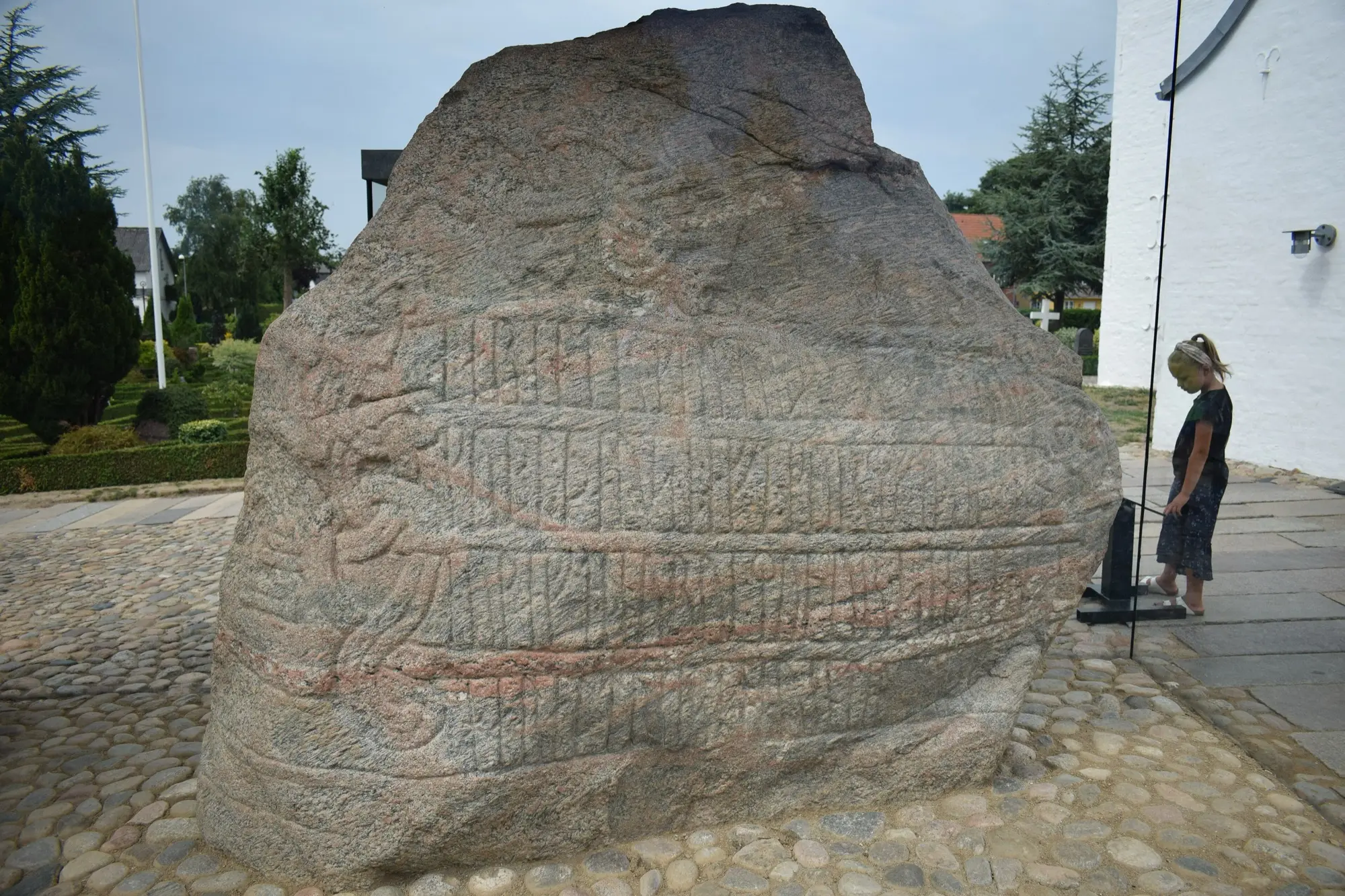
According to UNESCO, Jelling, in central Jutland, was a royal monument in the reigns of Gorm and his son Harald Bluetooth in the 10th century. UNESCO says the site has two flat-topped mounds, 70 metres across and up to 11 metres high, built of turf stacked in even layers with the grass side down. The large runic stone stands exactly midway between the mounds, and its inscription reads "king harald bade this monument be made in memory of gorm his father and thyra his mother, that harald who won for himself all denmark and norway and made the danes christians". Its south-west face carries the earliest depiction of Christ in Scandinavia. The smaller runic stone has stood where it is since about 1630, and reads "king gorm made this monument to his wife thyra, denmark's ornament". A small whitewashed stone church stands on the site of at least three earlier wooden churches, all destroyed by fire. UNESCO inscribed the Jelling mounds, runic stones and church on the World Heritage List in 1994.
Kongernes Jelling: the National Museum's centre
Kongernes Jelling (the kings' Jelling), the experience centre and museum at Jelling, is part of the National Museum of Denmark, which also operates key cultural venues in Copenhagen. You will find the exhibition centre at Gormsgade 23, Jelling. Kongernes Jelling admission is free for children and DKK 60 for adults.
Trelleborg: the best-preserved ring fortress
Lex says Trelleborg near Slagelse on Zealand is one of Denmark's five Viking Age ring fortresses, from the late 900s. It is the best preserved of the five and gave its name to the type. UNESCO inscribed the Viking-Age Ring Fortresses on the World Heritage List in 2023.
Fyrkat in Himmerland
Lex says Fyrkat lies in Himmerland in the valley south of Onsild Å (Onsild stream), and that a quarter of it has not been excavated but kept for the future. Harald Bluetooth had Fyrkat built by Onsild Å near the head of Mariager Fjord and important routes, and a full-size model of a longhouse was built there in the 1950s.
Aggersborg on the Limfjord
Lex says Aggersborg is the largest of the five ring fortresses, with no fewer than 48 buildings inside the rampart. It lies in North Jutland just north of the Limfjord, two kilometres from Aggersund. Aggersborg sat on the Limfjord, which gave access from the North Sea to the Kattegat.
The five ring fortresses as a set
UNESCO inscribed the Viking-Age Ring Fortresses on the World Heritage List in 2023. UNESCO says the ring fortresses of Aggersborg, Fyrkat, Nonnebakken, Trelleborg and Borgring were built between about 970 and 980 CE, in the reign of Harald Bluetooth. All five were built to one precise geometric design, with circular ramparts and four gateways near the cardinal points. UNESCO says the fortresses were used for only a short time, and that their function can only be inferred.
Lindholm Høje: graves in the shape of ships
Lex says Lindholm Høje is a burial ground from the late pagan period on the north side of the Limfjord near Nørresundby. There are about 600 graves, mostly cremation graves, from the 500s to the 900s. Lex says the graves lie very close together and the stone ship settings form almost a whole fleet. Finds include jewellery, glass beads and gaming pieces, used as grave goods.
Ribe and its Viking centre
Lex calls Ribe Denmark's oldest town still in existence, known for its cathedral. The town has a historical museum with exhibitions on the Viking Age and on the town's medieval history. There is an outdoor Viking centre outside the town where in summer you can see working craft workshops. Lex says the Viking centre's main street is divided into long narrow plots, one for each booth.
The Viking ship museum in Roskilde
Lex says the Viking Ship Museum in Roskilde has an exhibition hall, the Viking Ship Hall, and an open-air museum area, the Museum Island. The Viking Ship Hall holds the five Skuldelev ships and was designed by Erik Christian Sørensen. The hall opened to the public in 1969 and was listed in 1997.
The Ladby ship near Kerteminde
Lex says the Ladby find is a fine Viking Age grave by the village of Ladby on Funen, 3 km south-west of Kerteminde, which travellers can reach while exploring the region from Odense. A chieftain was buried there in the early 900s in a ship about 21.5 m long and 3 m wide, with rich grave goods including horses and dogs. Vikingemuseet Ladby (the Viking Museum Ladby) also holds other Viking Age finds from north-east Funen.
Moesgaard near Aarhus
Lex says Moesgaard, south of Aarhus, holds a Viking moot every year. Denmark's best-preserved bog body, the Grauballe Man, is one of Moesgaard Museum's biggest attractions.