
Aarhus is Denmark's second-largest city. Key highlights include ARoS and Your rainbow panorama, Den Gamle By, Moesgaard Museum, the Latin Quarter, Aarhus Cathedral, Dokk1, the Iceberg, the harbour bath, Marselisborg forests and Deer Park, Tivoli Friheden, Godsbanen, Aarhus Street Food, Salling Rooftop, the Infinite Bridge and the Botanical Garden.
1. ARoS and Your rainbow panorama: the city in every colour
ARoS admission is DKK 200 for adults and DKK 150 for visitors under 31 and students. Children under 18 go free. On top of the museum stands Olafur Eliasson's Your rainbow panorama, which opened in May 2011. You can read more about ARoS and the rainbow walkway before your visit. The installation is a circular glass walkway 150 metres long and 52 metres across, raised on columns 3.5 metres above the roof and showing the city through every colour of the spectrum.
From 1 October 2026 to 31 May 2027 ARoS is closed on Mondays, open 10:00 to 20:00 Tuesday to Friday and 09:00 to 17:00 on Saturday and Sunday. From 1 June to 30 September 2027 the museum also opens on Mondays, operating from 09:00 to 20:00.
2. Den Gamle By: four periods of a Danish market town
Den Gamle By charges adults DKK 145 from 1 January to 27 March and DKK 205 from 28 March to 31 December. Children aged 0 to 17 go free. Den Gamle By is open 365 days a year, running from 10 am to 5 pm from 1 August to 30 December and from 10 am to 9 pm in July.
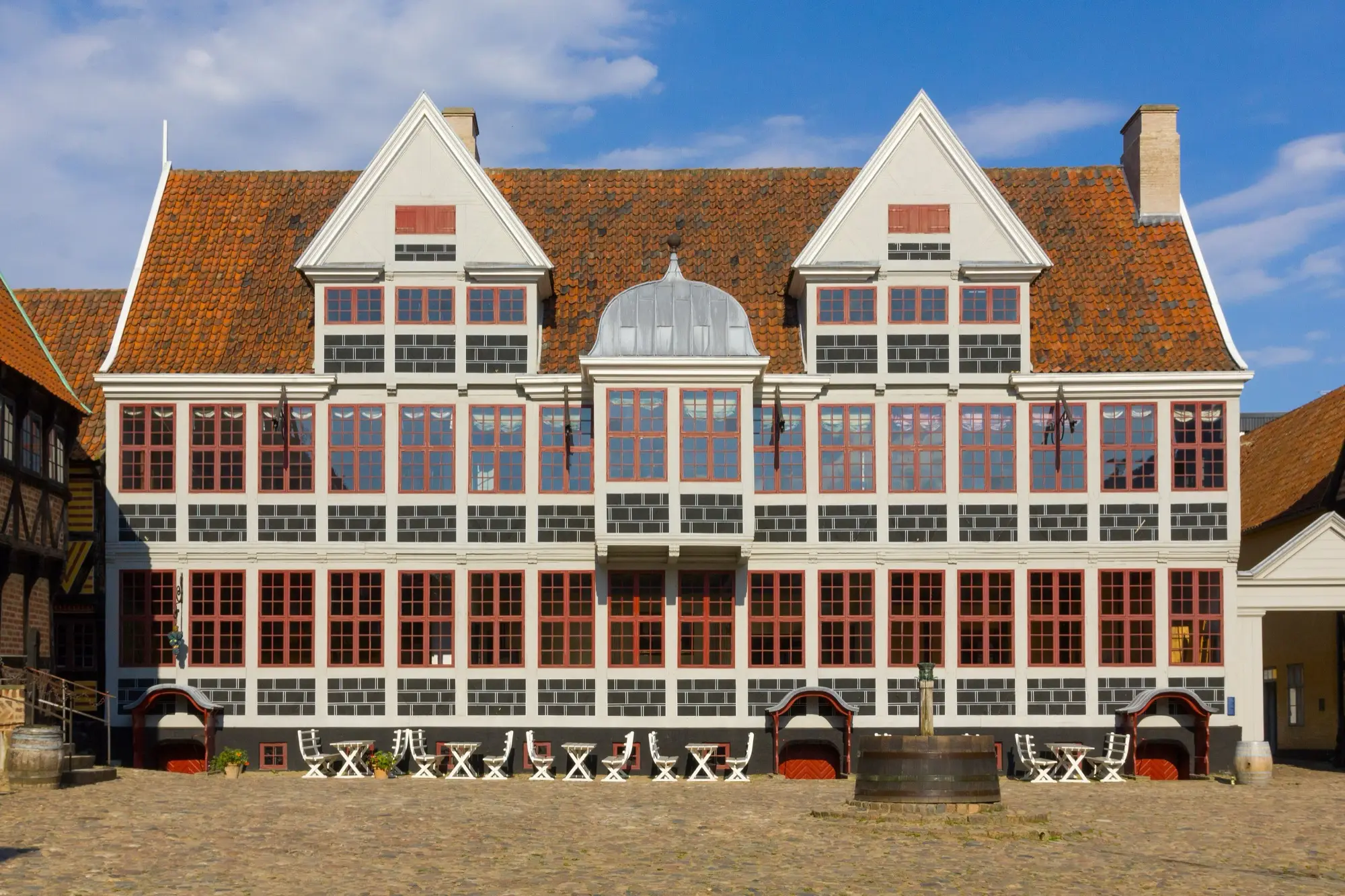
VisitAarhus says Den Gamle By was named European Museum of the Year 2026 and shows the history of Danish market towns in four periods: 1864, 1927, 1974 and 2014. Den Gamle By recommends planning 4 to 5 hours or more to see all of it. Den Gamle By opens for Christmas evenings from 6 pm to 9 pm on 27 and 28 November and on 4 and 5, 11 and 12, and 18 and 19 December.
3. Moesgaard Museum: the Grauballe Man and a roof you can walk on
Moesgaard Museum charges adults DKK 200 at the ticket desk or DKK 190 online; children and young people aged 0 to 17 go free. The exhibition building, designed by Henning Larsen Architects, opened in 2014. Moesgaard displays the Grauballe Man, which the museum calls the world's best-preserved bog body. He was found in Nebelgaard Bog in 1952 and lived around 390 BC.
The museum roof is open to everyone, with a view of Aarhus Bay. Moesgaard suggests it for picnics in summer and sledging in winter. By bike, Moesgaard is about 9 km from central Aarhus, along Oddervej or through the Marselisborg forests. Parking at Moesgaard is free and has no time limit. In the week this page was checked in November 2026, Moesgaard opened 10:00 to 17:00, was closed on Monday and stayed open until 21:00 on Wednesday.
4. The Latin Quarter: the oldest streets in Aarhus
VisitAarhus calls the Latin Quarter the oldest quarter in Aarhus. It grew up from the late 14th century, after the city was allowed to demolish its old Viking fortifications. The quarter lies by the cathedral, making it an interesting stop alongside other Viking sites in Denmark.
The Latin Quarter's narrow cobbled streets have historical names such as Klostergade, Volden and Borggade, with the small Pustervig Torv square at its centre.
5. Aarhus Cathedral: 93 metres from door to altar
Aarhus Cathedral says that with a length of 93 metres it is the longest church in Denmark. It seats about 1,200 people and is dedicated to St Clement, patron saint of sailors. Building started in the last decades of the 12th century and the Romanesque church was not finished until about 1350; it was rebuilt in the Gothic style from 1449 to about 1500.
Admission to the cathedral is free and it is open to visitors every day, but on Sundays and public holidays only to worshippers. The tower can be climbed in selected periods, typically in summer. The cathedral says it has the largest area of frescoes of any church in Denmark, including one of 220 square metres, painted between 1470 and 1520. VisitAarhus points to the altarpiece by Bernt Notke and the organ with over 6,000 pipes.
6. Dokk1: the library on the harbour, free to walk in
Dokk1, the culture house with the main library at the mouth of the canal, is free to visit during opening hours; some concerts and events need a ticket. The Dokk1 building is open 08:00 to 22:00 Monday to Friday and 10:00 to 16:00 on Saturday and Sunday, and closed on public holidays.
Dokk1's own site calls its gong the world's largest tubular bell.
7. The Iceberg on Aarhus Ø: 208 flats shaped like ice
The Iceberg (Isbjerget) on Aarhus Ø is a residential building of 208 rental apartments, all different, designed to maximise the sea views. You see the building from outside.
Its roofs rise and fall in peaks and valleys to mimic an iceberg. The building was designed by two Danish, one Dutch and one French studio on the harbour of Aarhus Ø.
8. The harbour bath: a 50-metre pool in the harbour
The harbour bath on Aarhus Ø, designed by Bjarke Ingels Group (BIG), is a floating complex with a 50-metre pool, a diving pool, children's pools and two saunas; VisitAarhus lists it as free.
In June, July and August the harbour bath is open every day from 10 am to 6 pm, with lifeguards during opening hours. The promenade deck is open 24 hours a day all year. From September to May you can swim in the diving pool on Saturdays and Sundays from 8 am to 12 noon, with changing rooms and toilets open. The saunas are not open in July and August.
9. Marselisborg forests and the Deer Park: deer south of the city
Marselisborg Deer Park covers 22 hectares in the Marselisborg forest south of the city, with sika and fallow deer you can get close to and wild boar in their own enclosure; it is free and open all year. Visitors must not feed the animals; on weekday mornings staff give them supplementary food at the troughs.
South of Aarhus a forest belt stretches 7 kilometres along the coast, with old beech stands and a 25 km mountain bike trail.
10. Tivoli Friheden: the city's amusement park since 1904
Tivoli Friheden, the amusement park in the middle of Aarhus with roller coasters and a Ferris wheel, has been there since 1904. Its Hjertekig free fall tower is 65 metres tall, which VisitAarhus says is the highest in Denmark.
VisitAarhus lists Tivoli Friheden's season as 1 April to 30 December every year. Christmas at Tivoli Friheden runs on selected days up to and including 30 December.
11. Godsbanen: the old freight yard turned culture centre
Godsbanen is a 10,500-square-metre cultural centre in the old freight yard in central Aarhus, with more than 700 events a year. Godsbanen is free to visit during opening hours. You can climb its sloping roof for a view over the city.
12. Aarhus Street Food: more than 30 kitchens in the old bus garages
Aarhus Street Food is a permanent street food market with more than 30 street kitchens and bars, in the old bus garages by the bus station. Dishes range from tacos and bánh mì to smørrebrød (open sandwiches). You can compare other dishes in our guide to traditional Danish food. For the dates listed when this page was checked, 19 November to 3 practical December, Aarhus Street Food opened every day from 11:30 am to 9 pm.
13. Salling Rooftop: a free view above Strøget
Salling Rooftop, on top of the Salling department store, has a 360-degree view of the city with restaurants, cafés and bars; VisitAarhus lists it as free. The Salling Skywalk is a glass platform 27 metres above Strøget.
In the week this page was checked in November 2026, Salling Rooftop opened 10 am to 8 pm on weekdays, 10 am to 7 pm on Saturday and 10 am to 6 pm on Sunday. Every Friday from mid-April to mid-September a DJ plays on the roof (Friday at the top).
14. The Infinite Bridge: a circle in the bay, summer only
The Infinite Bridge is a circular wooden pier 60 metres in diameter, 2.4 metres wide and 188 metres round, by Varna and Ballehage beach south of the centre. The bridge was first shown at the Sculpture by the Sea event in 2015 and was rebuilt as a permanent work with help from the municipality.
The Infinite Bridge is taken down for the winter; it is free to visit when it is up.
15. The Botanical Garden and its tropical houses
The Botanical Garden, just west of Den Gamle By, began in 1873 as an experimental garden for fruit trees; it is open all year and free. The tropical houses in the Botanical Garden have four climate zones under glass domes, from desert to tropical rainforest, with a café.
Getting to Aarhus from Copenhagen and the airports
Aarhus is Denmark's second-largest city, with transport connections to the rest of Denmark. VisitDenmark says you can take the train to Aarhus from Copenhagen, or drive, in just over 3 hours, and that a ferry runs to Aarhus from Zealand. DSB runs several trains every hour between Copenhagen and Aalborg that stop in Aarhus. VisitAarhus says a DSB Orange ticket from Copenhagen to Aarhus can cost from DKK 99, but other fares are around DKK 300 to 500, depending on when you travel and book and on the class.
The Molslinjen ferry sails several times a day between Zealand and Aarhus, and the Kombardo and Flix buses run directly between Copenhagen and Aarhus. Aarhus Airport is a 35-minute drive from Aarhus, with daily airport buses to and from the city timed to every flight. Billund Airport is about an hour's drive from central Aarhus, and a shuttle bus leaves every hour, serving an area that includes Legoland Billund.
Getting around, and the end of the AarhusCard
VisitAarhus confirms that the AarhusCard city card has been discontinued; it can no longer be bought or used, and no pass replaces the separate tickets. Visitors can buy a day ticket for Aarhus, or a day ticket for the whole Aarhus region to take day trips from Aarhus; Rejseplanen shows times for buses, trains and light rail.
The L2 light rail line runs between Odder and Lisbjergskolen, with stations at Aarhus Central Station and Dokk1; the L1 runs from Aarhus H to Grenaa. City bus 18 runs from central Aarhus (Park Allé and Banegårdspladsen) directly to Moesgaard in around 25 minutes, on a two-zone ticket.