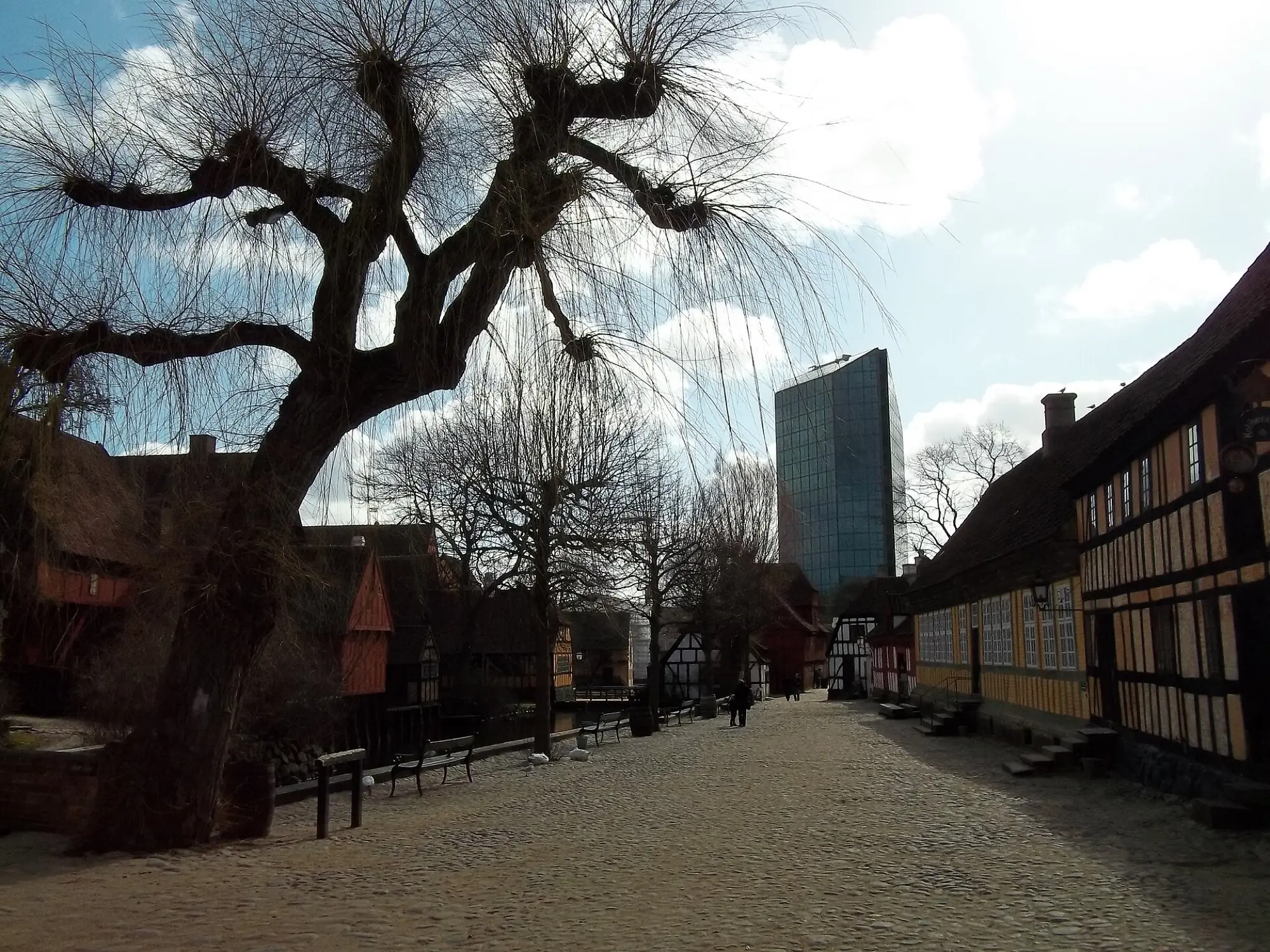

Den Gamle By is a museum town of 80 historic buildings moved from 25 Danish towns, with streets from four periods (1864, 1927, 1974 and 2014). It is open 365 days a year, adults pay DKK 145 or DKK 205 depending on the season, under-18s go free, and the Christmas season runs from 14 November to 31 December.
A museum town built from houses across the country
Den Gamle By calls itself Denmark's museum town. It explores Danish history with a focus on the period since 1500. VisitAarhus says the buildings come from towns throughout Denmark and have been reconstructed in the museum.
In total, Den Gamle By has 80 historic buildings from 25 towns and cities across Denmark, including a pharmacy, school, post office, customs house and theatre, along with seven historic gardens. Den Gamle By marked the centenary of its opening in 2014. The site won the European Museum of the Year award in 2026 and holds the maximum three stars in the Michelin Guide. In 2025, Den Gamle By had 560,260 visitors, and the museum says 30 per cent of its visitors come from abroad.
The four periods, from the old market town to the 2014 street
VisitAarhus notes that Den Gamle By shows the history of Danish market towns across four periods: 2014, 1974, 1927 and 1864. The museum describes time travel through 400 years of Danish history, in four parts:
- 1600–1900: the old market town
- 1900–1927: the modern era
- 1950–1974: welfare and broad-mindedness
- 2000–2014: our time
The oldest section portrays a Danish market town of Hans Christian Andersen's time and earlier. This area features half-timbered buildings gathered from all over Denmark, containing houses, gardens, shops and trade workshops.
In the 1927 quarter the town has cars, pavements, streetlights and telephone wires. Specific addresses here include a hardware store, a bookshop, Schou's soap house, a post office, and the car dealership Automobilforretning Carl Christensen with its workshop.
The 1970s quarter has streets, flats, shops, courtyards and workshops. Notable stops include Pouls Radio, a butcher, a kindergarten and a hairdresser. The domestic interiors reconstruct the homes of a nuclear family, a collective, a hippie couple and a single mother.
Queen Margrethe's street captures life in 2014. It features contemporary commercial premises: a tanning salon, a 7-Eleven, a bank branch, a pizzeria, the pub Bent J, and two residential flats.
From Easter to New Year, Den Gamle By operates as a living museum, with costumed interpreters.
The Danish Poster Museum and the other collections
Den Gamle By contains several specialist museum collections. The museum states that the Danish Poster Museum (Dansk Plakatmuseum) inside the grounds is Northern Europe's largest poster collection. Once you hold a general admission ticket to Den Gamle By, entry to the Poster Museum is free.
The Poster Museum building stands within the 1974 quarter. It opened on 31 October 2009, was designed by C.F. Møllers Tegnestue, and covers two floors comprising 360 m2 in all. The top floor displays 100 Danish classic posters from 1900 to 2008 as a permanent exhibition. The ground floor presents temporary changing exhibitions that usually run for 4 to 7 months.
Below ground in the 1974 neighbourhood, you will find Aarhus Fortæller (Aarhus Story). This underground display covers 800 square metres and details 1200 years of the city's history starting from the Viking Age. Further indoor exhibitions across the museum town house collections of toys, editorial cartoons at the museum of editorial cartoons, jewellery, clocks and watches, silverware, and porcelain and earthenware.
In addition, Museum 1927 operates as a traditional exhibition museum where the historical exhibits on display are up to 10,000 years old.
Tickets and prices by season
Ticket prices for Den Gamle By depend on the date of your visit:
- Adults: DKK 145 from 1 January to 27 March, and DKK 205 from 28 March to 31 December.
- Children aged 0 to 17: free entry throughout the year.
- Students: DKK 75 from 1 January to 27 March, and DKK 105 from 28 March to 31 December. Student rates apply when buying on arrival and presenting a valid student card.
- Schools: free entry, though school groups must register in advance.
Opening hours through the year
Den Gamle By is open 365 days a year. The museum's daily hours follow this schedule:
- 1 January to 6 February: open 10:00 to 16:00.
- 7 February to 15 February: open 10:00 to 17:00 every day during the winter holiday.
- 9 February to 27 March: open 10:00 to 16:00 on weekdays.
- 7 February to 22 March: open 10:00 to 17:00 at weekends.
- 28 March to 30 June: open 10:00 to 17:00.
- 1 July to 31 July: open 10:00 to 21:00.
- 1 August to 30 December: open 10:00 to 17:00.
- 24 December and 31 December: open 10:00 to 15:00.
Christmas at the old town museum
Christmas in Den Gamle By runs from 14 November to 31 December. The museum stays open every single day during this period, including 24 and 31 December. If you are comparing regional holiday displays, see our guide to Christmas markets in Denmark and our overview of cultural traditions during Christmas in Denmark.
The museum says its festive setup covers 400 years of Christmas traditions. The seasonal installations include decorated streets, historic shops and homes, a Christmas tree and food stalls in the town square, a dedicated Christmas shop, and children's areas known as the pixie attic and Cone Town. Outdoor stalls sell mulled wine, 1616-style æbleskiver, wild boar sausages, duck sandwiches, and Den Gamle By's own Christmas beer.
Christmas evenings (aftenjul) run from 6 to 9 pm on 27 and 28 November, 4 and 5 December, 11 and 12 December and 18 and 19 December, after regular opening hours; the Christmas evenings page says the museum is closed from 17.00 to 18.00.
A Christmas evening requires a separate ticket from daytime admission. An adult ticket costs DKK 190. Under-18s go free but must book a ticket. There is a limited number of tickets each evening. There is no student discount for Christmas evenings. Den Gamle By notes that weekends in December are popular and suggests choosing a weekday for a calmer visit.
Getting there and practical tips
Den Gamle By is a 15-minute walk from Aarhus central station, or a 20-minute walk (1.5 km) from Dokk1. If you are planning an itinerary in the wider city, consult our guide to things to do in Aarhus. Walking between Den Gamle By and Aarhus Cathedral covers 1.1 km, which takes between 15 to 20 minutes on foot.
If travelling by public transport, take a bus from Aarhus central station to the Viborgvej stop. Bus route 3A operates about every 15 minutes, while bus routes 14, 114 and 118 run about every half hour. The main entrance sits at the intersection of Silkeborgvej and Viborgvej, at Viborgvej 2.
Both Den Gamle By and the greenhouses stand inside the Botanical Garden (Botanisk Have), which is a public park open to all visitors. Entry to the greenhouses is free.
Practical considerations across the museum grounds:
- The historic cobblestones in the 1864 neighbourhood can prove challenging with a wheelchair or pushchair. The museum recommends wearing flat, practical shoes. The information desk lends mobility scooters free of charge.
- Free luggage lockers secured with your own personal PIN code are provided on-site for larger bags.
- Dogs are welcome in the streets but not in the buildings and exhibitions; service dogs and guide dogs are exempt.