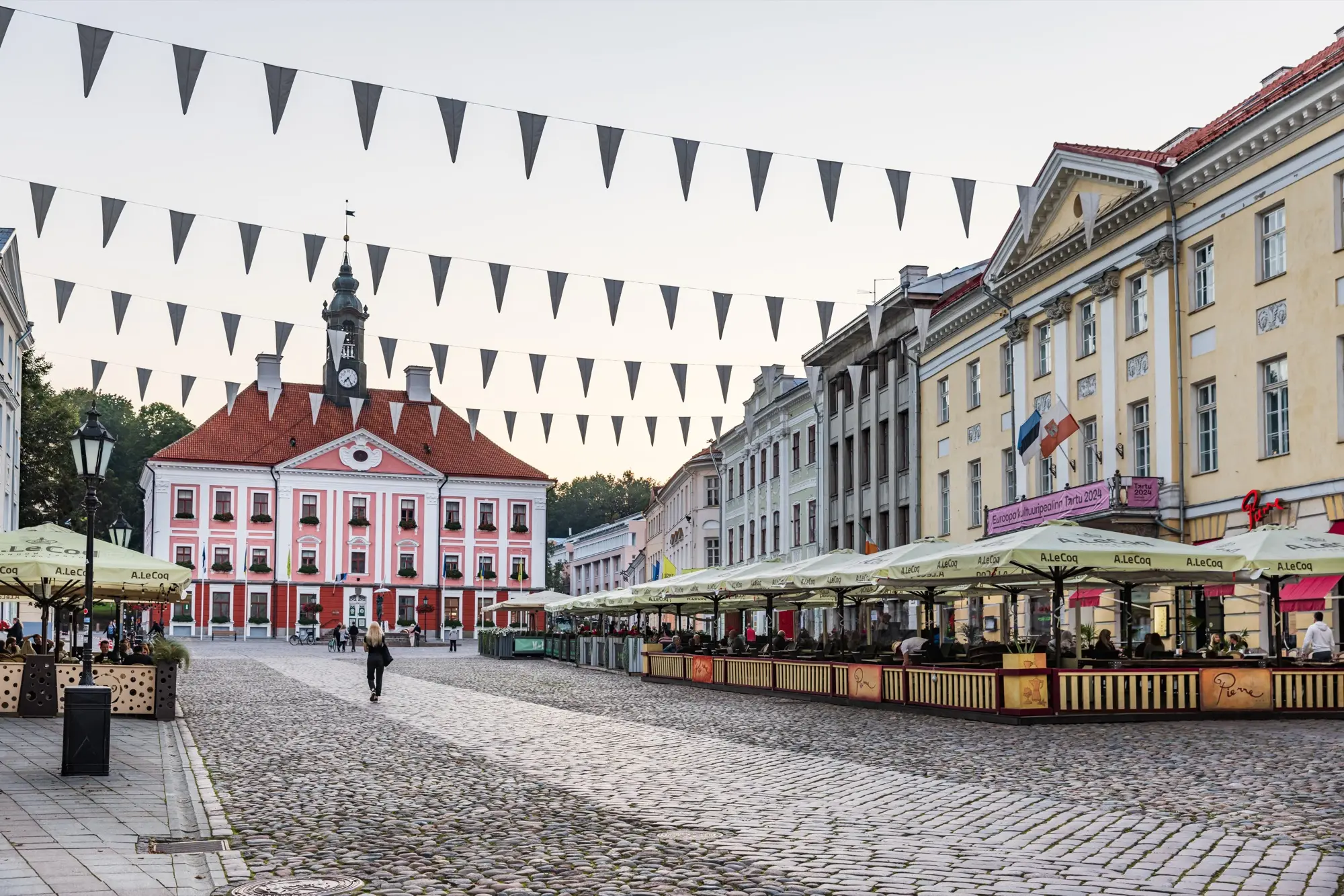

Tartu, Estonia's university city on the Emajõgi river, is reached from Tallinn on Elron trains. A visit takes in ten core sights: Town Hall Square, Toome Hill, the Estonian National Museum, AHHAA Science Centre, Tartu Art Museum, the KGB Cells Museum, Supilinn, the river, Aparaaditehas, and the market hall.
To see all the main indoor venues open, plan your visit from Wednesday to Saturday. The Estonian National Museum shuts on Mondays, the Art Museum shuts on Mondays and Tuesdays, the KGB Cells Museum opens Tuesday to Saturday only, and the University of Tartu Museum operates Wednesday to Sunday between October and April. AHHAA opens every day. If you have only one day, focus on Town Hall Square, Toome Hill, the Art Museum, Supilinn, and the riverside. If you have two days, add the Estonian National Museum and AHHAA Science Centre; holding a ticket for either gives you a 20% discount on entry to the other within one week.
Getting to Tartu from Tallinn, Helsinki and Riga
Trains operated by Elron run directly from Tallinn. Tickets on the Tallinn-Tartu line can be bought up to 14 days ahead from Elron's ticketing system, from the machines on board, or from on-board staff. If you are comparing day trips from Tallinn, Tartu is the longest rail option. The first train leaves Tartu at 6:52 and arrives in Tallinn at 9:35. Starting 31 August 2026, Elron's winter timetable makes Tallinn-Tartu trains approximately 20 minutes slower because of infrastructure works on the Tapa-Tartu section.
Tartu railway station is a 20-minute walk from Town Hall Square. Taking a bus or a taxi to the centre takes about 10 minutes.
For international arrivals, there are 12 flights a week between Helsinki and Tartu. The flight takes 45 minutes, landing at Tartu Airport, which is 10 km from the city. If you arrive by sea via the Helsinki-Tallinn ferry, you can transfer directly to the rail network in Tallinn. Southbound travellers can take a train to Riga that runs once a day with a change at Valga; the fare is €14.50 from Tartu (€25.90 from Tallinn).
1. Town Hall Square and the Kissing Students: start here, it costs nothing
Town Hall Square (Raekoja plats) is the centre of Tartu. Tartu Town Hall was completed in 1789 and houses the city government, an information point, and a pharmacy. The tower has a carillon of 34 bells that plays daily at 9:00, 12:00, 15:00, 18:00, and 21:00.
In front of the town hall stands the Kissing Students (Suudlevad tudengid) fountain, which is the focal point of the square. A fountain has stood on this spot since 1948, and the current sculpture by Mati Karmin was completed in 1998. Since 2006, the fountain has been ringed by paving tiles naming Tartu's sister cities, including Hämeenlinna, Tampere, and Turku, each pointing in that city's direction with the distance marked. The Leaning House and the paths up Toome Hill are a few steps away.
2. Toome Hill and the University of Tartu Museum: cathedral ruins with a view
King Gustav II Adolf of Sweden founded the University of Tartu in 1632, and today every fifth resident of the city is a student. Toome Hill (Toomemägi) rises directly behind the town hall as an English-style park in the city centre. It contains the old observatory, the old anatomical theatre, the Angel's Bridge (Inglisild), and the Devil's Bridge (Kuradisild).
Construction of Tartu Cathedral on Toome Hill began in the 13th century. The building was abandoned during the Reformation and became a ruin. The University of Tartu Museum is housed inside the restored choir of the cathedral.
From May to September, the museum opens Tuesday to Sunday from 10:00 to 18:00, with adult tickets costing €12. From October to April, it opens Wednesday to Sunday from 11:00 to 17:00, with adult tickets costing €10. Across the full year, a discount ticket is €8, a family ticket is €25, and children under eight enter free. The cathedral towers open only from May to the end of September; tower-only admission is €5 for an adult and €3 for concessions. A combined ticket covering the University of Tartu Museum, the Old Observatory, and the University of Tartu Art Museum costs €18 for an adult or €34 for a family, valid for one month.
3. Estonian National Museum (ERM): give it half a day
Founded in 1909, the Estonian National Museum (Eesti Rahva Muuseum) is the largest museum in the country, containing nearly 6,000 m² of exhibition space. Its permanent exhibitions are "Encounters", which traces cultural history across Estonia, and "Echo of the Urals", dedicated to Finno-Ugric peoples.
The museum opens Tuesday to Sunday from 10 am to 6 pm and is closed on Mondays. The box office stops selling tickets 1 hour before closing. A full ticket to all exhibitions costs €16, a discount ticket costs €12, and a whole-museum family ticket costs €32. Children up to 8 years old enter free. Every second Sunday of the month, tickets are 50% off. Keep your admission ticket: an ERM or AHHAA ticket gives 20% off entry at the other venue within one week.
4. AHHAA Science Centre: the rainy-day pick, open every day
AHHAA Science Centre is located at Sadama 1, just round the corner from Tartu bus station. It opens every day of the week: Monday to Thursday and Sunday from 10 to 19, and Friday and Saturday from 10 to 20.
An all-day adult ticket costs €20. A family ticket covering one or two adults and all their children aged 0 to 17 costs €45. Students, teachers, and seniors aged 65 and over pay €15. Pre-school children enter free (0 €) when accompanied by someone aged at least 14. Planetarium shows cost €7 at the ticket desk or €6 online; children must be at least 5 years old to attend regular planetarium sessions, though this rule does not apply to the family show.
5. Tartu Art Museum: the leaning house that tilts more than Pisa
Tartu Art Museum (Tartu Kunstimuuseum) occupies the three-storey Leaning House at Raekoja plats 18. Built in 1793, the house has tilted because the old town stands on the soggy bank of the Emajõgi. Its lean reaches 5.8 degrees, which is more than the Tower of Pisa. A pharmacy opened in the building in 1879.
The museum opens Wednesday, Friday, Saturday, and Sunday from 11 to 18, and Thursday from 11 to 20. It is closed on Mondays, Tuesdays, and public holidays. A full ticket for all floors costs €8, a reduced ticket is €6, and a family ticket for the whole building costs €9. On the last Friday of every month, every ticket costs €1. On the first weekend of every month, the family ticket is free. Entry is free for everyone on International Museum Day (18 May), the museum's anniversary (17 November), and Tartu City Day (29 June).
6. KGB Cells Museum: the most sobering hour in Tartu
The KGB Cells Museum sits at Riia 15b on Riia hill. From the city centre, walk up Riia street for 700 metres; the museum is in the grey five-storey building opposite the Ekraan cinema. This "grey house" was used in the 1940s and 1950s as an NKVD and KGB pre-trial prison. The corridor and basement cells have been restored to their original form.
The permanent exhibition includes texts in Estonian, English, Russian, and Finnish. The museum opens Tuesday to Saturday from 11:00 to 17:00, and ticket sales end half an hour before closing. Regular tickets cost €9, discounted tickets for children, students, and pensioners cost €6, and a family ticket costs €22.
7. Supilinn: Soup Town's wooden streets
Supilinn, which translates as Soup Town, is a bohemian district of historic 18th-century wooden houses with streets named after root vegetables. Set on the bank of the Emajõgi, the neighbourhood has green courtyards and can be walked round the clock throughout the year. It is best explored on foot or by bicycle. During the spring Supilinn Days festival, local courtyards and gardens open to the public.
Running alongside the neighbourhood is the Supilinna promenade. This 1.3 km path passes beneath an avenue of old poplars along the Emajõgi, fitted with bench-swings facing the water.
8. The Emajõgi river: bridges, boats in summer and the riverside walk
The Emajõgi flows between Lake Võrtsjärv and Lake Peipus and is the only river in Estonia navigable along its entire length. In summer, you can swim in the water, take riverboat rides, and go canoeing.
The pedestrian Arch Bridge (Kaarsild) crosses the river to connect the centre with the Ülejõe district. Built between 1957 and 1959 on the abutments of the historic Kivisild stone bridge, it was renovated in 2017. After dark, the bridge features a light show synchronised with the chimes of the town hall bells.
On the water, the barge Jõmmu is the only restored traditional wooden merchant sailing ship of its kind. It sails each year from 1 April to 30 November.
9. Aparaaditehas: Tartu's answer to Telliskivi
Aparaaditehas is a former factory complex turned creative quarter at Kastani 42, operating as Tartu's version of Tallinn's Telliskivi. The quarter is always open to walk through and contains restaurants, cafés, a bakery, small design and art shops, galleries, a concert hall, and a bookstore. It also houses the Typa printing and paper arts centre. The quarter's permanent residents include the house cat Johannes Gutenberg.
10. Tartu market hall: lunch and picnic food by the river
Tartu market hall (turuhoone), located at Vabaduse pst 1, was finished in December 1937 and was long the most impressive market hall in Estonia. It opens Monday to Saturday from 7:30 am to 4:00 pm and Sunday from 9:00 am to 3:00 pm.
Additional stalls operate nearby at Soola 10. The indoor market at Soola 10 opens Monday to Saturday from 8:00 am to 4:00 pm and Sunday from 9:00 am to 3:00 pm. The open-air market, also at Soola 10, sits right on the bank of the Emajõgi and opens Monday to Saturday from 8:00 am to 4:00 pm and Sunday from 8:00 am to 3:00 pm. This open market includes a fish stall on wheels selling fresh fish caught in the Emajõgi, Lake Peipus, and Võrtsjärv.
Tartu in winter and at Christmas
Tartu Christmas City fills Town Hall Square from 29 November 2026 to 10 January 2027 with pavilions, workshops, and live music. A central feature is the town-centre skating rink that surrounds the Kissing Students fountain, covering almost 1,000 square metres. Skating on the rink is free, and skates can be hired from the pavilion next to it. The rink is open daily from 10:00 to 22:00 from 29 November to 1 March.
Winter visits come with several seasonal closures. The cathedral towers on Toome Hill close for the winter, operating only from May to the end of September. The wooden barge Jõmmu also stays off the water, sailing only from 1 April to 30 November.
Indoor museum hours also shift over the festive period. Tartu Art Museum is closed for Christmas from 23 to 26 December 2026. AHHAA Science Centre is closed on 24 December and 1 January, opens from 10:00 to 20:00 on 25 and 26 December, and runs reduced hours from 10:00 to 17:00 on 31 December.
The 2024 European Capital of Culture, two years on
According to Visit Estonia, Tartu held the title of European Capital of Culture in 2024. Statistics Estonia data reported by Visit Tartu shows that foreign visitors staying in Tartu's registered accommodation in 2024 rose by 15 per cent compared with the year before. The number of Finnish visitors increased by 34 per cent, making Finland the single largest source of foreign tourists at 11.5 per cent. Marleen Otsus, Tartu's head of marketing, stated that the Capital of Culture title and marketing brought significantly more foreign visitors to the city.
The city retains an extensive cultural infrastructure, with more than 20 museums. Tartu has also been designated a UNESCO City of Literature since 2015.