Day trips from Tallinn range from quick nature excursions along the north coast to full-day regional travel to Tartu and the western seaside resorts. Several major destinations, including Paldiski, Tartu, Pärnu and Viru bog, can be reached using public transport, while wider circuits through rural coastal reserves require private transport. Checking departure points and travel times in advance ensures you match your itinerary to the available daylight.
Which day trips work by train or bus, and which need a car
Public transport options out of the capital fall into two separate systems: national passenger trains and regional buses. For rail travel, Elron train tickets are sold online, at ticket machines on board the trains, from on-board staff, and at the ticket office at Tallinn's main railway station, Balti jaam (Baltic Station), which is open daily from 8.00 to 21.30. Ticket machines on the train sell standard-class single tickets only, and payments can be made solely by bank card or Elron farecard.
Regional buses operate from Tallinn bus station (Tallinna bussijaam). Direct services run from this terminal to Pärnu at intervals of 30 minutes to 1 hour. You can reach the bus station from central Tallinn by city bus, taxi or tram.
When organising local connections, note how city ticketing interacts with long-distance transport. In Tallinn, a 1-hour ticket on municipal transport costs €2 and a 1-day ticket costs €5.50. Once your individual 1-hour tickets cost more than the day ticket on a single calendar day, the rest of the day's rides are free. However, Elron trains are not part of the municipal transit network, and the light-blue regional buses that travel into Harju County require a separate ticket. You can review city transport rules in our guide to staying in Tallinn or check card inclusions via our Tallinn Card price guide.
Viru bog, Lahemaa National park and Jägala waterfall
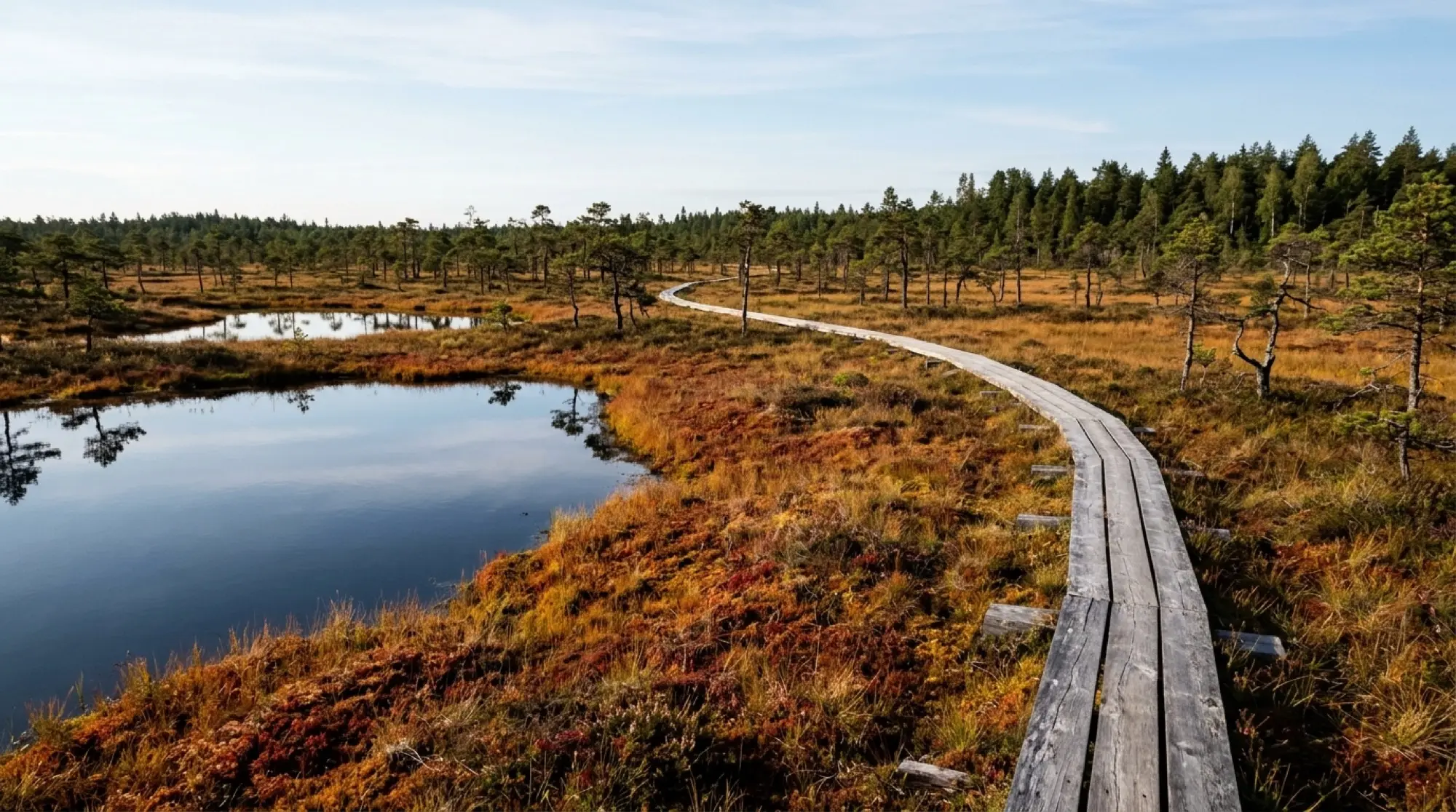
Nature trails east of the capital provide straightforward excursions into coastal forest and wetland. According to Visit Estonia's day trip guidance, the Viru bog nature trail is a 45-minute drive from Tallinn heading east along the road towards Narva. To reach the trail managed by the State Forest Management Centre (Riigimetsa Majandamise Keskus or RMK), drive 52 km from Tallinn on the Tallinn-Narva road (E20) and turn left towards Loksa. The 3.5 km trail through the bog can be walked as a 5.5 km circular route. Wheelchairs and prams can reach the observation tower by an access ramp, and the 1.3 km path leading to the tower is passable by wheelchair with an assistant. You can also travel there by regional bus, which drops passengers at a stop slightly under a kilometre from the trailhead.
Lahemaa National Park covers 725 square kilometres of forest, wetland and rocky and sandy coast, situated about an hour's drive from Tallinn. Beyond Viru bog, the park contains the coastal fishing villages of Käsmu, Altja and Viinistu, as well as the historic Baltic German manors of Palmse, Sagadi, Vihula and Kolga. Because these historic sites and fishing villages are dispersed throughout the national park, using a car or joining an organised tour is the practical way to connect them on a single itinerary.
Jägala Waterfall sits on the lower reaches of the Jägala River, about 4 km before it empties into the Gulf of Finland. The falls are about 8 metres high and more than 50 metres wide, making this the widest natural waterfall in Estonia. During prolonged cold weather, the flow freezes into a solid wall of ice with large icicles. The waterfall is a 30-minute drive east of Tallinn and combines easily with a trip to the Viru bog trail. If you are travelling without a car, the nearest public bus stop is located about 1.2 km from the site.
Tartu by Elron train from Balti jaam
Tartu, situated in the south of the country, is Estonia's second-largest city. King Gustav II Adolf of Sweden founded its university in 1632. Alongside its academic heritage, the city features Supilinn (Soup Town), a historic neighbourhood of traditional wooden houses where the streets are named after various root vegetables.
Direct passenger rail links run between Tallinn and Tartu from Balti jaam. Under Elron's winter timetable, which comes into force from 31 August 2026, Tallinn-Tartu trains will run approximately 20 minutes slower because of extensive infrastructure works along the Tapa-Tartu rail section. Under that schedule, the day's first train departs Tartu at 6:52 and reaches Tallinn at 9:35.
Tartu is also home to the Estonian National Museum (Eesti Rahva Muuseum or ERM). The museum is open from Tuesday to Sunday, between 10 am and 6 pm, and remains closed on Mondays. An admission ticket covering all museum exhibitions costs €16 at full price or €12 at the discounted rate.
Haapsalu on the west coast and Pärnu in summer
Haapsalu is located on the western coast, less than two hours from Tallinn, which makes it straightforward to visit as an out-and-back day trip. It is recognised as Estonia's oldest resort town, having originally received town rights in 1279. The central landmark is the 13th-century Haapsalu Castle; both the fortress and its museum underwent complete renovation in 2019. Visitors can enter the castle courtyard free of charge, while entering the museum of medieval history housed in the main castle building requires an admission ticket.
Further south along the coast lies Pärnu, the country's most popular summer holiday destination. The town is known for its long sandy beach, health spas and quiet residential streets lined with wooden villas. Driving or catching a regional direct bus from Tallinn bus station to Pärnu takes about two hours each way. For recommendations on when seaside resorts and coastal areas are at their best, consult our overview of the best time to visit Estonia.
Short western trips to Keila-Joa, Paldiski cliffs and Rummu quarry
Several coastal landscapes and heritage locations west of Tallinn are accessible for shorter morning or afternoon outings.
- Keila-Joa: Keila Waterfall at Keila-Joa measures 6 metres high and tens of metres wide, ranking as the third largest waterfall in the country. From the surrounding parkland, an access road leads across two suspension bridges directly to the falls. The paths and grounds can be navigated easily with strollers and wheelchairs, and a dedicated 3 km nature trail loops through Keila-Joa park. Keila Waterfall is roughly a 40-minute drive west of Tallinn; regional buses stop just 400 metres away.
- Paldiski: Closed to the general public during Soviet rule, the town of Paldiski is reached in only an hour by direct train from Tallinn. Pakri Lighthouse stands at the precipice of a high limestone cliff on the northwestern tip of the Pakri peninsula, and the nearby Leetse limestone cliff offers coastal walking routes.
- Rummu quarry: Formerly an active limestone and marble extraction site, Rummu now consists of abandoned industrial structures and mining equipment partly submerged in a clear blue lagoon. During the summer season, visitors use the site for stand-up paddleboarding, diving and snorkelling. Rummu is an hour's drive from Tallinn, or accessible by taking a train followed by a local bus connection; the nearest bus stop is roughly a kilometre away.
Winter visits require strict attention to daylight hours. On 1 December, Tallinn receives 6 hours and 36 minutes of daylight, with sunrise at 08:53 and sunset at 15:28. By the winter solstice on 21 December, daylight shrinks to 6 hours and 2 minutes, with the sun rising at 09:18 and setting at 15:20. You can track exact day lengths through our Tallinn daylight schedule. A winter excursion to walk open trails, waterfalls and exposed coastal cliffs demands an early departure to ensure all outdoor activities conclude before total darkness.