Can you see the northern lights in Tallinn tonight?
Clouded out — 100% cloud at best between 18:18 and 05:56.
Checked against NOAA SWPC and the MET Norway Locationforecast.
Tonight Tallinn is 27 of 27 on the ranked table of places.
Get an alert when Tallinn lights up
A heads-up in the hours before dark when tonight's forecast Kp reaches your choice and the cloud forecast leaves a gap, and an alert when the field is active over a clear enough sky at Tallinn. Two a night at most, nothing on the other nights.
Alerts come to this browser on this device. No email, no account; turn them off here or from any alert.
Aurora forecast for Tallinn: the next three nights
| Night | Dark, local time | Forecast Kp | Kp needed | Clearest hour |
|---|---|---|---|---|
| TonightWed 18 Nov | 18:18–05:56 | Kp 2.67 | Kp 6 | 100% at best |
| Clouded out — 100% cloud at best. | ||||
| Thursday nightThu 19 Nov | 18:18–05:58 | Kp 3.33 | Kp 6 | 74% at best |
| Clouded out — 74% cloud at best through the dark hours, with Kp up to 3.33 forecast. | ||||
| Friday nightFri 20 Nov | 18:16–06:00 | Kp 3.00 until 02:00 | Kp 6 | not forecast yet |
| Unlikely — Kp up to 3.00 is forecast until 02:00, and Tallinn needs about Kp 6. The cloud forecast does not reach this night yet. | ||||
Checked . Kp from the NOAA SWPC three-day forecast, issued ; cloud from MET Norway Locationforecast, issued . Tonight's row is the verdict above, which also reads the Kp now, OVATION and the magnetometers; the nights after rest on the forecasts alone.
Key facts
- Astronomically dark in Tallinn tonight from 18:18 to 05:56 local time, 11 hours and 38 minutes, as of .
- Aurora outlook for the next three nights: Wed 18 Nov, Clouded out; Thu 19 Nov, Clouded out; Fri 20 Nov, Unlikely, as of .
- In the 2026–27 season, astronomical darkness returns between 15 August and 1 September.
- Tallinn is at 59.44°N, 24.75°E.
Updated
Located across the Gulf of Finland at 59.4°N, Estonia's capital has no polar night and requires a strong geomagnetic storm of Kp 6 or higher before the northern lights reach the north-facing shoreline.
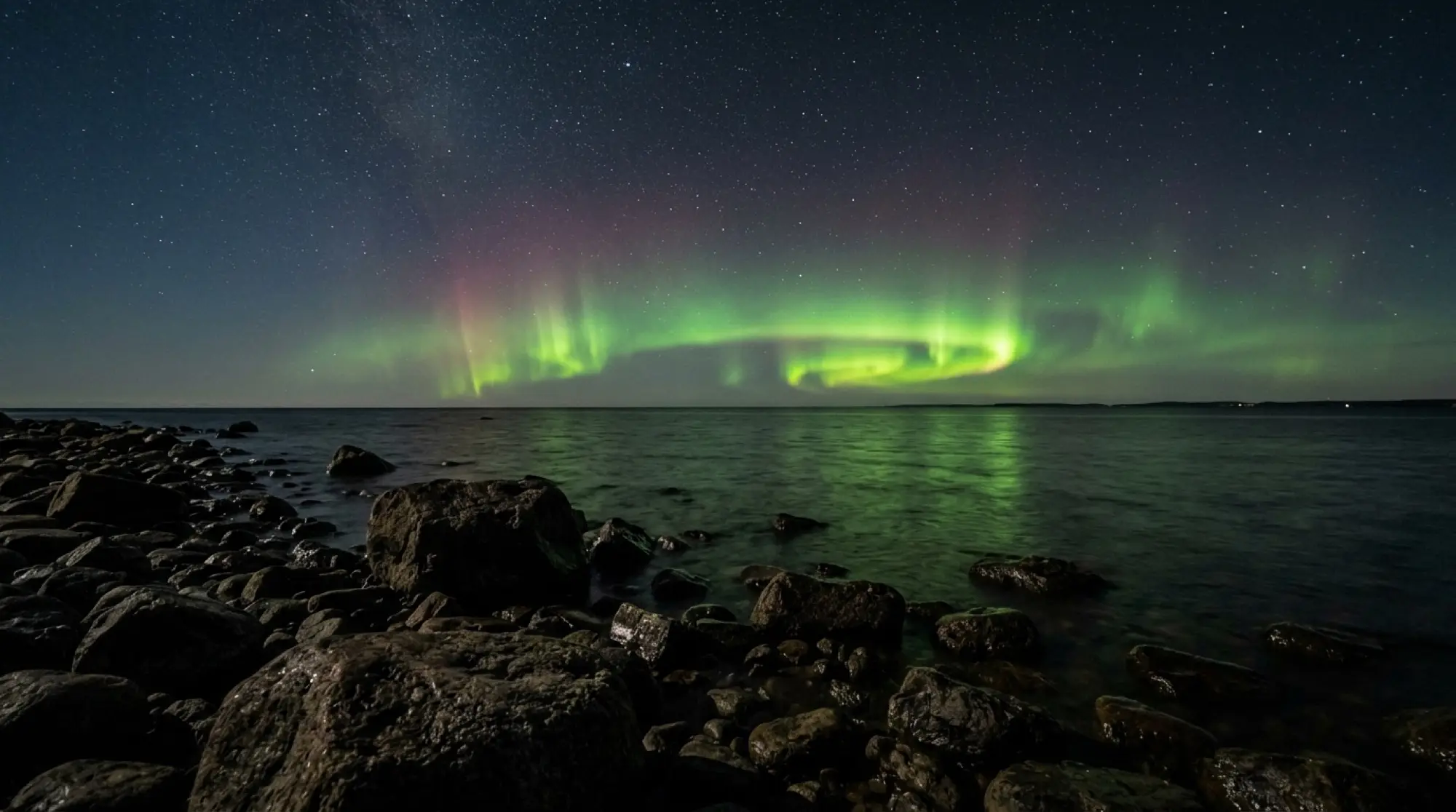
Illustrative image
The evidence
- Geomagnetic activity
- Kp 0.00 (quiet) NOAA SWPC, estimated Kp,Forecast peak Kp 2.67 during the dark hours NOAA SWPC 3-day forecast, issued 02:30 EET0% chance of aurora overhead NOAA SWPC OVATION,
- Cloud over the dark hours
- 100% cloud at best around 18:00, 100% at worst MET Norway Locationforecast, covering 18:18–05:56
- Darkness
- Astronomical dark 18:18–05:56 (11h 38m) computed here from the date and the coordinatesSunset 15:49, sunrise 08:24 computed here
- Moon
- First quarter, 62% lit, 22° above the horizon at the start of the dark hours computed here
Cloud forecast: MET Norway, under CC BY 4.0, reduced here to the clearest and cloudiest hour of the dark window. See where the data comes from.
How dark does it get in Tallinn tonight?
It is astronomically dark — dark enough to see the aurora — from 18:18 to 05:56 local time, 11 hours and 38 minutes.
Dark hours by date, 2026–27 season
| Date | Dark from | Dark until | Hours of darkness |
|---|---|---|---|
| 15 August | Not dark enough for the aurora | ||
| 1 September | 23:16 | 03:28 | 4h 12m |
| 15 September | 22:12 | 04:24 | 6h 12m |
| 1 October | 21:14 | 05:10 | 7h 56m |
| 15 October | 20:30 | 05:46 | 9h 16m |
| 1 November | 18:48 | 05:24 | 10h 36m |
| 15 November | 18:22 | 05:52 | 11h 30m |
| 1 December | 18:06 | 06:18 | 12h 12m |
| 15 December | 18:02 | 06:34 | 12h 32m |
| 1 January | 18:12 | 06:38 | 12h 26m |
| 15 January | 18:32 | 06:32 | 12h 00m |
| 1 February | 19:02 | 06:08 | 11h 06m |
| 15 February | 19:32 | 05:38 | 10h 06m |
| 1 March | 20:06 | 05:02 | 8h 56m |
| 15 March | 20:44 | 04:16 | 7h 32m |
| 1 April | 22:40 | 04:10 | 5h 30m |
| 15 April | 23:46 | 02:58 | 3h 12m |
Astronomical darkness (the sun more than 18° below the horizon), Tallinn local time, computed here from the date and the coordinates.
Tallinn is not an Arctic northern lights destination, and you should not book a trip to Estonia solely hoping to see the aurora. Sitting at 59.4°N on the southern shore of the Gulf of Finland, 87 km south of Helsinki, the Estonian capital lies well south of the quiet-night auroral oval and needs both a strong geomagnetic storm around Kp 6 and a cloudless northern sky before arcs rise above the water. When those two things align between the second half of August and late April, Estonia's north-facing Baltic coastline gives you a flat sea horizon in the exact direction low-latitude displays appear.
How often the northern lights reach Tallinn and Estonia
On the NOAA Space Weather Prediction Center storm scale, Kp 6 marks a G2 moderate geomagnetic storm, the threshold at which auroral arcs expand south to sub-auroral latitudes around 59°N to 60°N. On quiet nights when travellers in northern Lapland or Tromsø are watching green ribbons overhead, the sky over Tallinn Bay stays dark. According to the Finnish Meteorological Institute, aurora activity reaches the Gulf of Finland coast roughly once a month during the dark seasons, compared with three nights in four in northernmost Lapland. Compare those odds directly with Helsinki across the gulf before planning an evening outdoors.
Season and cloud cover cut those odds further, though not evenly across the year. From the start of May to mid-August, the sun never sinks 18 degrees below the horizon at Tallinn, leaving summer white nights with no astronomical darkness at all; you can check exact dark-sky hours by date on the Tallinn daylight table. Dark nights return in the second half of August and last until late April. Geomagnetic storms are statistically most common around the autumn and spring equinoxes in September to October and March to April. Early autumn works well in Estonia because dark nights arrive here weeks before twilight clears in the far north, and March brings noticeably clearer spring skies than late autumn. November and December are the hardest months on the Gulf of Finland, when cloud typically covers 65% to 85% of the sky.
Where to stand along the Tallinn coast and Harjumaa
When the live forecast above flags a G2 storm and breaks in the cloud, your biggest advantage in northern Estonia is geography. Estonia's northern shoreline faces due north across the open Gulf of Finland, so you are looking straight out over dark water rather than across lit suburbs or hills. Inside central Tallinn, street glare washes out faint arcs, though strong storms can be photographed from two easy shoreline spots facing Tallinn Bay: the concrete roof steps of Linnahall (the former Olympic concert hall beside the harbour) and Pirita beach northeast of Kadriorg, reached from the centre on city bus lines 1 and 8.
If you have access to a car or rideshare, getting 15 to 25 km clear of central Tallinn improves contrast sharply. Three local coastal viewpoints stand out around Harju County:
- Rohuneeme at the tip of the Viimsi peninsula, looking straight north into the open gulf past the harbour entrance.
- Tabasalu limestone cliff west of the city, giving an elevated view over Kakumäe Bay and the sea.
- Suurupi beach further west, where dark shoreline paths sit well away from Tallinn's port floodlights.
With your own car and a clear regional forecast, the darkest skies within an evening's drive sit 60 to 75 km east of the capital on the Käsmu and Juminda peninsulas in Lahemaa National Park, covered in more detail in our guide to day trips from Tallinn. Wherever you stand, switch off torches, stay off your phone screen, and give your eyes about 30 minutes to adapt to the dark. At 59.4°N a weak sub-auroral arc often looks like a pale grey band low over the water to the naked eye while a long-exposure camera sensor picks up distinct green and red pillars above it.
Getting to Tallinn, and heading north when you want reliable odds
Reaching the Tallinn shoreline is straightforward if you are already visiting central Tallinn. Lennart Meri Tallinn Airport sits 4 km from the city centre, connected in about 15 minutes on public bus line 2. Across the Gulf of Finland, fast ferries run by Tallink Silja, Eckerö Line and Viking Line cover the 87 km between Helsinki and Tallinn in 2 to 2.5 hours every day; our Helsinki to Tallinn ferry guide breaks down terminals and sailing times. On Tallinn's city buses and trams, tapping a contactless bank card at the front orange validator buys a €2 1-hour ticket and caps automatically at €5.50 per transport day.
If seeing the northern lights is a central reason for your trip rather than a welcome bonus during a Baltic storm, treat Tallinn as a starting point and head north under the main auroral oval. You can cross to Helsinki in 2 hours and board VR's overnight sleeper service on the Helsinki to Rovaniemi train or onward to Kolari in Finnish Lapland, or compare Arctic bases across Norway, Sweden, Finland and Iceland in our guide to the best places to see the northern lights.
What the numbers mean
Four things have to line up before you see anything, and three of them are on this page above. The fourth is your own eyes adjusting, which takes about twenty minutes in real darkness and does not survive a glance at a phone.
Darkness comes first because it cannot be argued with. The aurora is always there when the field is active; you can only see it once the sun is more than 18° below the horizon, which is what the dark band above marks. In Tallinn that is 11 hours and 38 minutes tonight.
Kp is a global index of how disturbed the Earth's magnetic field is, from 0 to 9, published every three hours. It is a blunt instrument: it says the whole planet was disturbed, not that the aurora is over Tallinn now. At 59°N you need Kp 6 or more — a real storm — before the auroral oval reaches this far south.
The local disturbance is the better number, and it is the one most aurora pages do not have. FMI runs magnetometers across Lapland; we take the rate of change of the horizontal field at the nearest one, in nanotesla per minute. Tallinn has none within 120 km, so its verdict rests on Kp and OVATION. A field moving fast overhead means current flowing overhead, which is the aurora itself. Above roughly 40 nT/min it is usually visible; above 100 a substorm is running and it will be moving.
Cloud ends most attempts. The figure above is the total cloud cover MET Norway's Locationforecast forecasts for the dark hours, at these exact coordinates. Anything over about 70% and you will not see through it; under 30% and it stops mattering.
The moon does not stop the aurora. A full moon high in the sky washes out the faint green arcs that make up most displays, so a strong night still shows and a marginal one does not.
Plan the trip
- Best places to see the northern lights
- Things to do in Tallinn and city guide
- The Helsinki–Tallinn ferry
- Daylight in Tallinn through the year
Nearby
Also on this site: how the daylight changes through the year, and the other 26 places.