Can you see the northern lights in Luleå tonight?
Clouded out — 98% cloud at best between 17:32 and 05:02.
Checked against NOAA SWPC and the MET Norway Locationforecast.
Tonight Luleå is 19 of 26 on the ranked table of places.
Get an alert when Luleå lights up
A heads-up in the hours before dark when tonight's forecast Kp reaches your choice and the cloud forecast leaves a gap, and an alert when the field is active over a clear enough sky at Luleå. Two a night at most, nothing on the other nights.
Alerts come to this browser on this device. No email, no account; turn them off here or from any alert.
Aurora forecast for Luleå: the next three nights
| Night | Dark, local time | Forecast Kp | Kp needed | Clearest hour |
|---|---|---|---|---|
| TonightFri 13 Nov | 17:32–05:02 | Kp 1.67 | Kp 3 | 98% at best |
| Clouded out — 98% cloud at best. | ||||
| Saturday nightSat 14 Nov | 17:30–05:04 | Kp 1.67 | Kp 3 | 0% at best |
| Unlikely — Kp up to 1.67 is forecast while it is dark, and Luleå needs about Kp 3. 0% cloud at best. | ||||
| Sunday nightSun 15 Nov | 17:28–05:08 | Kp 1.67 until 01:00 | Kp 3 | not forecast yet |
| Unlikely — Kp up to 1.67 is forecast until 01:00, and Luleå needs about Kp 3. The cloud forecast does not reach this night yet. | ||||
Checked . Kp from the NOAA SWPC three-day forecast, issued ; cloud from MET Norway Locationforecast, issued . Tonight's row is the verdict above, which also reads the Kp now, OVATION and the magnetometers; the nights after rest on the forecasts alone.
Key facts
- Astronomically dark in Luleå tonight from 17:32 to 05:02 local time, 11 hours and 30 minutes, as of .
- Aurora outlook for the next three nights: Fri 13 Nov, Clouded out; Sat 14 Nov, Unlikely; Sun 15 Nov, Unlikely, as of .
- In the 2026–27 season, astronomical darkness returns between 1 September and 15 September and ends between 1 April and 15 April.
- Luleå is at 65.58°N, 22.15°E.
Updated
Luleå is in Sweden at 65.6°N, where the sun rises every day of the year and spotting the northern lights south of the Arctic Circle needs about Kp 3.
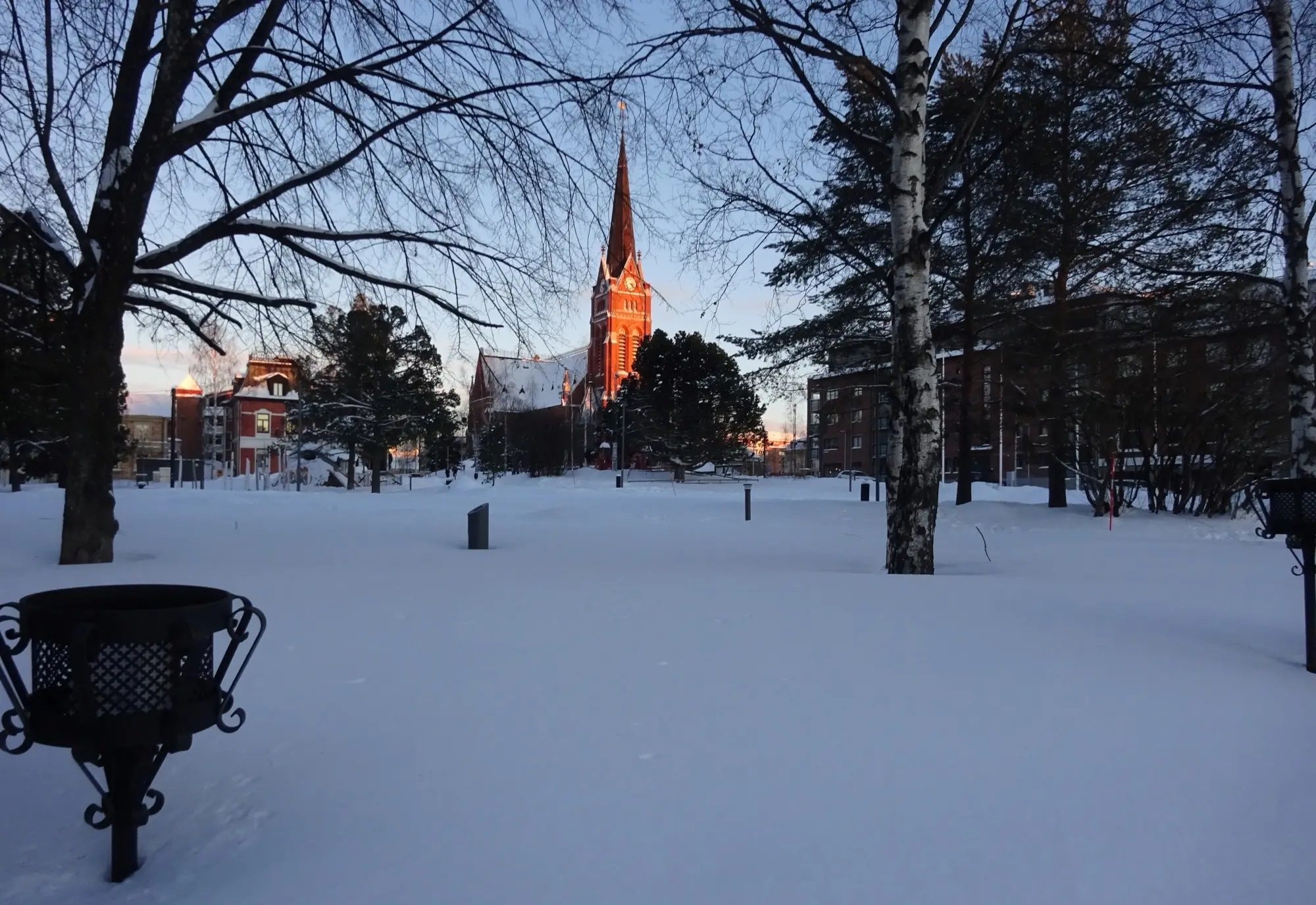
Photo: MikaPr65, CC BY-SA 4.0

The evidence
- Geomagnetic activity
- Kp 0.67 (quiet) NOAA SWPC, estimated Kp,Forecast peak Kp 1.67 during the dark hours NOAA SWPC 3-day forecast, issued 01:30 CET0% chance of aurora overhead NOAA SWPC OVATION,
- Cloud over the dark hours
- 98% cloud at best around 05:00, 100% at worst MET Norway Locationforecast, covering 17:32–05:02
- Darkness
- Astronomical dark 17:32–05:02 (11h 30m) computed here from the date and the coordinatesSunset 14:23, sunrise 08:10 computed here
- Moon
- Waxing crescent, 17% lit, below the horizon at the start of the dark hours computed here
Cloud forecast: MET Norway, under CC BY 4.0, reduced here to the clearest and cloudiest hour of the dark window. See where the data comes from.
How dark does it get in Luleå tonight?
It is astronomically dark — dark enough to see the aurora — from 17:32 to 05:02 local time, 11 hours and 30 minutes.
Dark hours by date, 2026–27 season
| Date | Dark from | Dark until | Hours of darkness |
|---|---|---|---|
| 1 September | Not dark enough for the aurora | ||
| 15 September | 22:22 | 02:34 | 4h 12m |
| 1 October | 20:54 | 03:50 | 6h 56m |
| 15 October | 19:58 | 04:40 | 8h 42m |
| 1 November | 18:02 | 04:32 | 10h 30m |
| 15 November | 17:28 | 05:08 | 11h 40m |
| 1 December | 17:04 | 05:40 | 12h 36m |
| 15 December | 16:56 | 05:58 | 13h 02m |
| 1 January | 17:08 | 06:04 | 12h 56m |
| 15 January | 17:30 | 05:52 | 12h 22m |
| 1 February | 18:10 | 05:20 | 11h 10m |
| 15 February | 18:50 | 04:42 | 9h 52m |
| 1 March | 19:36 | 03:52 | 8h 16m |
| 15 March | 20:30 | 02:52 | 6h 22m |
| 1 April | 23:10 | 02:00 | 2h 50m |
| 15 April | Not dark enough for the aurora | ||
Astronomical darkness (the sun more than 18° below the horizon), Luleå local time, computed here from the date and the coordinates.
Visit Luleå says the northern lights are visible in Luleå from late August until the first days of April, though over the city they will be shy and less prominent. Visit Luleå says the sea freezes every year, an ice track is ploughed between the north and south harbours, and ice roads reach some of the archipelago islands.
When to see the northern lights in Luleå
Visit Luleå states that the northern lights are visible from late August until the first days of April. During the rest of the year, the sky is too bright. To see them, you need clear skies or scattered clouds; the tourism board's rule of thumb is that if you can see stars, it is possible to see the aurora.
There is no fixed timetable. The lights may appear at any point during the hours of darkness and last for varying lengths of time. Visit Luleå says you can see the lights over the city, but there they will be shy and less prominent.
If you want to be sure of snow, ice, and cold weather, Visit Luleå recommends planning your trip between mid-December and the end of February, when dark, clear nights are occasionally lit up by displays. The Gulf of Bothnia is brackish—roughly four fifths fresh water—which allows the sea to freeze every year. The frozen sea ice becomes an activity area that is at its best from January well into March. Winter temperatures typically range from 0 to minus 35°C, with an extreme low of minus 41°C recorded in 1999. Read more about the northern lights in Sweden across the rest of the country.
How to get to Luleå
Direct flights from Stockholm Arlanda to Luleå Airport take 75 minutes. The Swedish Lapland Visitors Board identifies Luleå Airport and Kiruna Airport as the two main flight gateways to the region, served by SAS and Norwegian with connections through Stockholm, Copenhagen, and Oslo. Swedavia notes that the airport sits about seven kilometres from the city centre.
To travel between the airport and the centre, Luleå Lokaltrafik runs buses 4 and 104 from the stop outside the terminal. Bus 4 connects to Smedjegatan in the centre before continuing to the university. Bus 104 serves Smedjegatan, the central bus station, and the railway station. Cash is not accepted on local buses. You must pay using a bank card or bus card, or purchase and activate a ticket inside the Luleå Lokaltrafik mobile app prior to boarding.
If travelling overland, night trains depart Stockholm every evening for Luleå Central Station. According to Visit Sweden, the rail journey takes 12 to 14 hours. The station is located near the city centre, no more than a few minutes' walk away. Norrtåg operates regional services linking Luleå with Haparanda and Kiruna; the route connecting Luleå and Kiruna is the region's most popular rail link. If you drive, the E4 coastal highway from Stockholm passes just outside the city.
Where to stand to see the aurora
Visit Luleå advises heading to an open, suitably dark spot while avoiding artificial lighting as much as possible. Along the Bothnian Bay coast, the Swedish Lapland Visitors Board notes that getting away from artificial light is one of the most important things when photographing the northern lights, and finding good photographic conditions along the archipelago coast is often as straightforward as in the mountains.
Photographer Per Lundström highlights three specific spots on Visit Luleå's website:
- Gäddvik: Lundström recommends Gäddvik, preferably at the fishing museum and the small barn by a jetty, as a dark place where the water also makes for good photographs.
- Ormbergsbacken: Located on Ormberget, this elevated hill provides a quick view of any sky movement while the city lights sit below. Local bus line 2 reaches Ormberget from central Luleå in eight minutes.
- Sinksundet: He recommends standing down by the swimming area at Sinksundet, which is dark and by the water, so you can see the lights in both directions.
The Swedish Lapland Visitors Board lists Brändön Lodge in Luleå among its places to see the northern lights, with activities under the lights or in search of them, such as dog sledding, dinners and snowshoe treks. To assess other northern locations across the region, see our guide to the best places to see the northern lights.
The frozen sea in winter
Visit Luleå says an ice track of more than 10 km is ploughed between the north and south harbours as soon as the ice is thick enough. It generally opens in late December. You can step onto this track at the north harbour near Hälsans Hus or at the south harbour.
Visit Luleå says about 30 km of ice roads are ploughed to some of the archipelago's islands once the coastal ice is about half a metre thick, normally opening in January or early February. Visit Luleå states that driving across the ice is risk-free as long as you stay strictly on the ploughed roads. Speed is limited, and roadside signage indicates if a route is temporarily closed or when the season ends. The tourism board suggests day trips over the ice roads to islands including Hindersön, Sandön, and Junkön.
When photographing displays, Lundström suggests a tripod, with aperture f/2.8, ISO 1600 and a 15-second exposure as a good starting point. On a smartphone, activate night mode. Visit Luleå says to dress for the cold and wind, with layering the key.
Where to watch near Luleå
- Ormberget (Ormbergsbacken) 2.7 km north-east. Visit Luleå calls this a classic spot to watch and photograph the aurora. Reached in eight minutes on local bus line 2, the ski slope's top lets you quickly see if anything moves in the sky above the city lights.
- Gäddvik 5.2 km west. Visit Luleå's photographer recommends the spot, preferably by the fishing museum and small barn jetty, as the darkness and water make it good for photographs.
- Sinksundet 4.3 km north-east. Visit Luleå's photographer recommends standing down by the swimming area, where it is dark and by the water, allowing you to see the lights in both directions.
What the numbers mean
Four things have to line up before you see anything, and three of them are on this page above. The fourth is your own eyes adjusting, which takes about twenty minutes in real darkness and does not survive a glance at a phone.
Darkness comes first because it cannot be argued with. The aurora is always there when the field is active; you can only see it once the sun is more than 18° below the horizon, which is what the dark band above marks. In Luleå that is 11 hours and 30 minutes tonight.
Kp is a global index of how disturbed the Earth's magnetic field is, from 0 to 9, published every three hours. It is a blunt instrument: it says the whole planet was disturbed, not that the aurora is over Luleå now. At 66°N the auroral oval usually sits overhead already, so a quiet Kp is no reason to stay in.
The local disturbance is the better number, and it is the one most aurora pages do not have. FMI runs magnetometers across Lapland; we take the rate of change of the horizontal field at the nearest one, in nanotesla per minute. Luleå has none within 120 km, so its verdict rests on Kp and OVATION. A field moving fast overhead means current flowing overhead, which is the aurora itself. Above roughly 40 nT/min it is usually visible; above 100 a substorm is running and it will be moving.
Cloud ends most attempts. The figure above is the total cloud cover MET Norway's Locationforecast forecasts for the dark hours, at these exact coordinates. Anything over about 70% and you will not see through it; under 30% and it stops mattering.
The moon does not stop the aurora. A full moon high in the sky washes out the faint green arcs that make up most displays, so a strong night still shows and a marginal one does not.
Plan the trip
- Best places to see the northern lights
- Northern lights in Sweden
- Daylight in Kiruna through the year
- Stockholm in December
Nearby
Also on this site: how the daylight changes through the year, and the other 25 places.