Can you see the northern lights in Jokkmokk tonight?
Unlikely tonight — dark from 17:40 and there are breaks in the cloud, but the field is quiet (Kp 0.67).
Checked against NOAA SWPC and the MET Norway Locationforecast.
Tonight Jokkmokk is 14 of 26 on the ranked table of places.
Get an alert when Jokkmokk lights up
A heads-up in the hours before dark when tonight's forecast Kp reaches your choice and the cloud forecast leaves a gap, and an alert when the field is active over a clear enough sky at Jokkmokk. Two a night at most, nothing on the other nights.
Alerts come to this browser on this device. No email, no account; turn them off here or from any alert.
Aurora forecast for Jokkmokk: the next three nights
| Night | Dark, local time | Forecast Kp | Kp needed | Clearest hour |
|---|---|---|---|---|
| TonightFri 13 Nov | 17:40–05:12 | Kp 1.67 | Kp 2 | 50% at best |
| Unlikely — quiet field, Kp 0.67. | ||||
| Saturday nightSat 14 Nov | 17:38–05:16 | Kp 1.67 | Kp 2 | 0% at best |
| Unlikely — Kp up to 1.67 is forecast while it is dark, and Jokkmokk needs about Kp 2. 0% cloud at best. | ||||
| Sunday nightSun 15 Nov | 17:36–05:18 | Kp 1.67 until 01:00 | Kp 2 | not forecast yet |
| Unlikely — Kp up to 1.67 is forecast until 01:00, and Jokkmokk needs about Kp 2. The cloud forecast does not reach this night yet. | ||||
Checked . Kp from the NOAA SWPC three-day forecast, issued ; cloud from MET Norway Locationforecast, issued . Tonight's row is the verdict above, which also reads the Kp now, OVATION and the magnetometers; the nights after rest on the forecasts alone.
Key facts
- Astronomically dark in Jokkmokk tonight from 17:40 to 05:12 local time, 11 hours and 32 minutes, as of .
- Aurora outlook for the next three nights: Fri 13 Nov, Unlikely; Sat 14 Nov, Unlikely; Sun 15 Nov, Unlikely, as of .
- In the 2026–27 season, astronomical darkness returns between 1 September and 15 September and ends between 1 April and 15 April.
- Jokkmokk is at 66.61°N, 19.82°E.
Updated
Located in Sweden at 66.6°N, Jokkmokk has no polar night and sits just north of the Arctic Circle, where seeing the northern lights requires geomagnetic activity of about Kp 2.
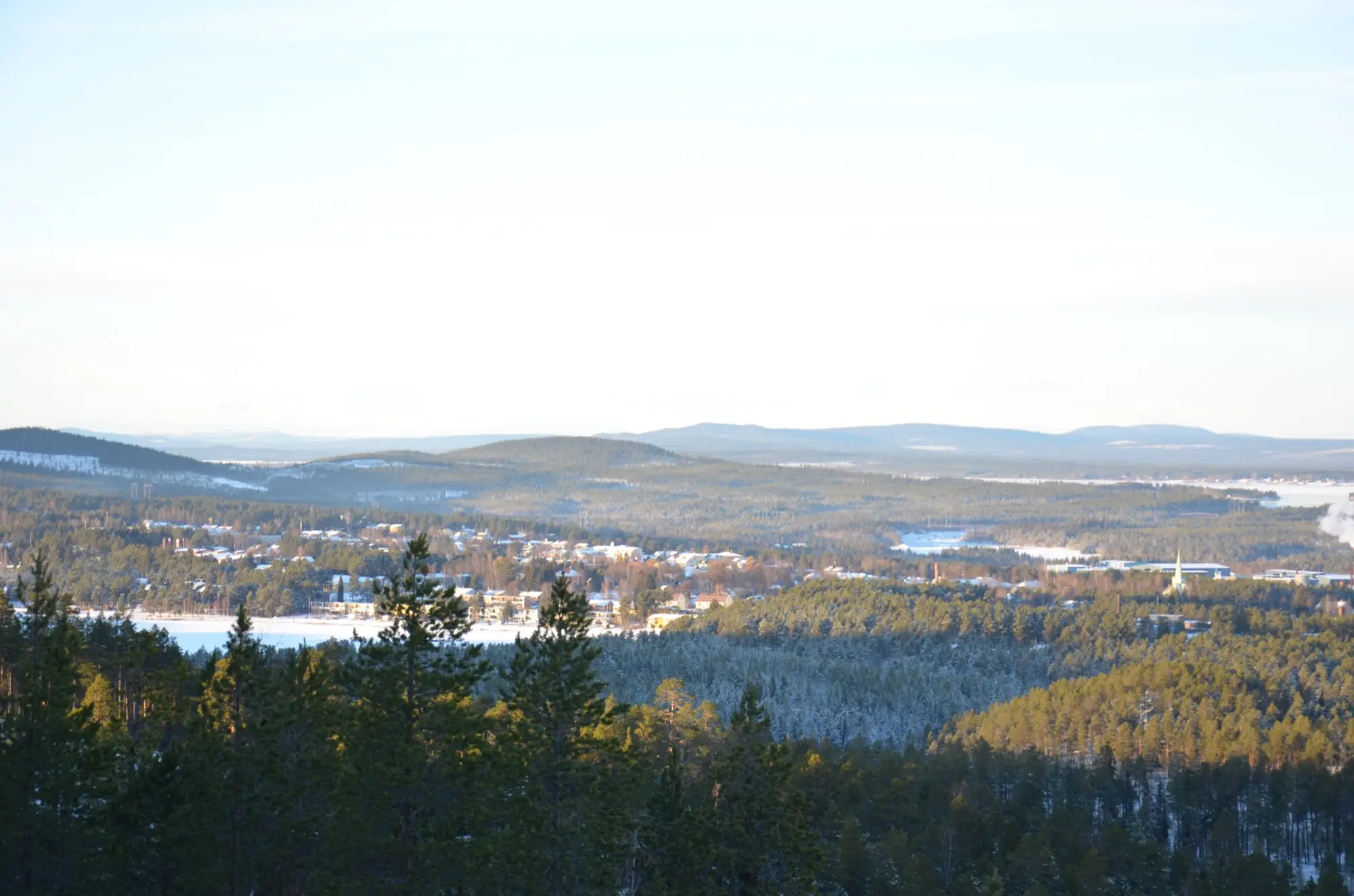
Photo: Bengt Oberger, CC BY-SA 3.0

The evidence
- Geomagnetic activity
- Kp 0.67 (quiet) NOAA SWPC, estimated Kp,Forecast peak Kp 1.67 during the dark hours NOAA SWPC 3-day forecast, issued 01:30 CET0% chance of aurora overhead NOAA SWPC OVATION,
- Cloud over the dark hours
- 50% cloud at best around 05:00, 100% at worst MET Norway Locationforecast, covering 17:40–05:12
- Darkness
- Astronomical dark 17:40–05:12 (11h 32m) computed here from the date and the coordinatesSunset 14:22, sunrise 08:30 computed here
- Moon
- Waxing crescent, 17% lit, below the horizon at the start of the dark hours computed here
Cloud forecast: MET Norway, under CC BY 4.0, reduced here to the clearest and cloudiest hour of the dark window. See where the data comes from.
How dark does it get in Jokkmokk tonight?
It is astronomically dark — dark enough to see the aurora — from 17:40 to 05:12 local time, 11 hours and 32 minutes.
Dark hours by date, 2026–27 season
| Date | Dark from | Dark until | Hours of darkness |
|---|---|---|---|
| 1 September | Not dark enough for the aurora | ||
| 15 September | 22:48 | 02:26 | 3h 38m |
| 1 October | 21:10 | 03:52 | 6h 42m |
| 15 October | 20:10 | 04:46 | 8h 36m |
| 1 November | 18:12 | 04:40 | 10h 28m |
| 15 November | 17:36 | 05:18 | 11h 42m |
| 1 December | 17:10 | 05:52 | 12h 42m |
| 15 December | 17:02 | 06:12 | 13h 10m |
| 1 January | 17:14 | 06:16 | 13h 02m |
| 15 January | 17:38 | 06:04 | 12h 26m |
| 1 February | 18:20 | 05:30 | 11h 10m |
| 15 February | 19:02 | 04:48 | 9h 46m |
| 1 March | 19:50 | 03:58 | 8h 08m |
| 15 March | 20:48 | 02:52 | 6h 04m |
| 1 April | 23:50 | 01:38 | 1h 48m |
| 15 April | Not dark enough for the aurora | ||
Astronomical darkness (the sun more than 18° below the horizon), Jokkmokk local time, computed here from the date and the coordinates.
Destination Jokkmokk says large parts of Jokkmokk, just north of the Arctic Circle, are national parks and nature reserves that are largely free from light pollution. The Swedish Lapland Visitors Board says the best time to see the northern lights is between September and late March.
When to see the northern lights in Jokkmokk
According to the Swedish Lapland Visitors Board, the best time to see the northern lights is between September and late March, although displays have been seen as early as late August. The board states that the lights can appear whenever it is dark, but the best times seem to be between 9 p.m. and 2 a.m. Light pollution of every kind—from streetlights to the full moon—is another factor, and weather conditions can also affect viewing.
Monthly conditions change substantially across this period:
- September, October and November: The board notes that these months offer increasing hours of darkness, remain snowless in many areas, and are not yet really cold. Destination Jokkmokk identifies September and October as the best time to see the Milky Way, noting that the Milky Way and the northern lights can sometimes be photographed in the same image.
- December and January: The board calls these great times to see the lights, with long nights. For how long the nights are at the Arctic Circle, see daylight in Rovaniemi.
- February and March: Days grow longer and the weather is warmer yet still very snowy, with evenings continuing to offer a chance to spot displays.
The board says there is no guarantee of seeing the northern lights, that the odds increase the longer you stay, and that at times clouds and snowfall keep the lights away. The board explains that the best chances occur north of the Arctic Circle, at high altitude, and preferably in open space without competing light sources.
Jokkmokk is described by the Swedish Lapland Visitors Board as a small town with a population of a little over 2,000. Destination Jokkmokk points out that large parts of the municipality are national parks and nature reserves that are largely free from light pollution, rating 1 on the Bortle scale (where 9 represents the sky above a major city). On clear nights without an aurora, there is an extensive starry sky to observe.
Winter planning often intersects with the historic Jokkmokk Market (Jokkmokks marknad). Held on the first weekend in February every year since 1605, the market usually meets visitors with proper, cold winter weather. The 422nd Jokkmokk Market will take place from Thursday the fourth to Saturday the sixth of February 2027. Market stalls run Thursday to Saturday from 10:00 to 18:00, accompanied by activities throughout the week and into the evenings, with the programme usually ready in December.
How to get to Jokkmokk
The Inland Railway (Inlandsbanan) summer service runs between 15 June and 12 August 2026.
To reach the town by public transport, Jokkmokk municipality states that the nearest station on the main line is Murjek, situated about an hour away by bus. The Swedish Lapland Visitors Board notes that you can usually combine a train ticket with a bus ticket to your final destination, taking the train to Murjek, Gällivare, Kiruna or Abisko and boarding a bus from there. Länstrafiken Norrbotten services serving Jokkmokk include:
- Line 43 connecting from Murjek station
- Trunk line 44 running between Gällivare, Jokkmokk and Luleå
- Trunk line 45 linking Gällivare, Jokkmokk and Östersund
If arriving by air, Luleå Airport sits 180 km south-east of Jokkmokk and is served by SAS and Norwegian. From the airport, take the airport bus to the central bus station in Luleå, then transfer to the Länstrafiken bus to Jokkmokk. Alternatively, a pre-booked airport car operates twice daily between Jokkmokk and Luleå Airport; this runs only on demand and must be booked by 17.00 on the day before the flight. Other regional landing points include Gällivare Airport (100 km north), Arvidsjaur Airport (155 km south), and Kiruna Airport (about 220 km north, served by SAS).
Drivers can reach Jokkmokk inland along the E45 highway. From the coast, drivers can turn off at Piteå onto road 374 to join the E45, or turn off at Luleå along road 97. In town, Jokkmokk's Infocenter serves as the municipality's combined reception desk, tourist information centre and switchboard, as well as the organising office for the market.
Where to stand to see the aurora
Within town, Jokkmokk municipality recommends Storknabben, the hill rising above the settlement. The summit provides open views over Jokkmokk and its surroundings, functioning as a viewing spot for the midnight sun in summer and the northern lights in winter. To reach the top, follow the trail named Jokkmokks Jokkes väg for 2 km one way, beginning at the Mountain Garden (Fjällträdgården). The path starts inside the Talvatis outdoor area (Talvatis friluftsområde) by Lake Talvatis in central Jokkmokk, where a walking route traces the water past an outdoor gym and the garden.
The Swedish Lapland Visitors Board advises visitors to be ready to move around, as walking through the local area can improve your chances. It also advises dressing so the cold does not force you back inside just as an aurora begins. As an alternative base, the board lists a hotel with glass igloos that serve as private observatories, with sites near Jokkmokk and Kiruna.
For day visits, Destination Jokkmokk notes Ájtte as the premier museum of Sámi culture and a specialised museum for the mountain region. Destination Jokkmokk says Sarek, Badjelánnda, Stora Sjöfallet/Stuor Muorke and Muddus/Muttos national parks are all part of the UNESCO World Heritage Site Laponia, and suggests admiring the northern lights in the dark winter sky. Read more about the northern lights in Sweden.
Where to watch near Jokkmokk
- Storknabben 2.6 km south-east. Jokkmokk municipality recommends this hill for northern lights in winter as it gives a wide view over Jokkmokk and its surroundings. You reach the top by following the 2 km Jokkmokks Jokkes väg trail from Fjällträdgården.
What the numbers mean
Four things have to line up before you see anything, and three of them are on this page above. The fourth is your own eyes adjusting, which takes about twenty minutes in real darkness and does not survive a glance at a phone.
Darkness comes first because it cannot be argued with. The aurora is always there when the field is active; you can only see it once the sun is more than 18° below the horizon, which is what the dark band above marks. In Jokkmokk that is 11 hours and 32 minutes tonight.
Kp is a global index of how disturbed the Earth's magnetic field is, from 0 to 9, published every three hours. It is a blunt instrument: it says the whole planet was disturbed, not that the aurora is over Jokkmokk now. At 67°N the auroral oval usually sits overhead already, so a quiet Kp is no reason to stay in.
The local disturbance is the better number, and it is the one most aurora pages do not have. FMI runs magnetometers across Lapland; we take the rate of change of the horizontal field at the nearest one, in nanotesla per minute. Jokkmokk has none within 120 km, so its verdict rests on Kp and OVATION. A field moving fast overhead means current flowing overhead, which is the aurora itself. Above roughly 40 nT/min it is usually visible; above 100 a substorm is running and it will be moving.
Cloud ends most attempts. The figure above is the total cloud cover MET Norway's Locationforecast forecasts for the dark hours, at these exact coordinates. Anything over about 70% and you will not see through it; under 30% and it stops mattering.
The moon does not stop the aurora. A full moon high in the sky washes out the faint green arcs that make up most displays, so a strong night still shows and a marginal one does not.
Plan the trip
- Best places to see the northern lights
- Northern lights in Sweden
- Daylight in Kiruna through the year
- Sweden vs Norway: which to visit
Nearby
Also on this site: how the daylight changes through the year, and the other 25 places.