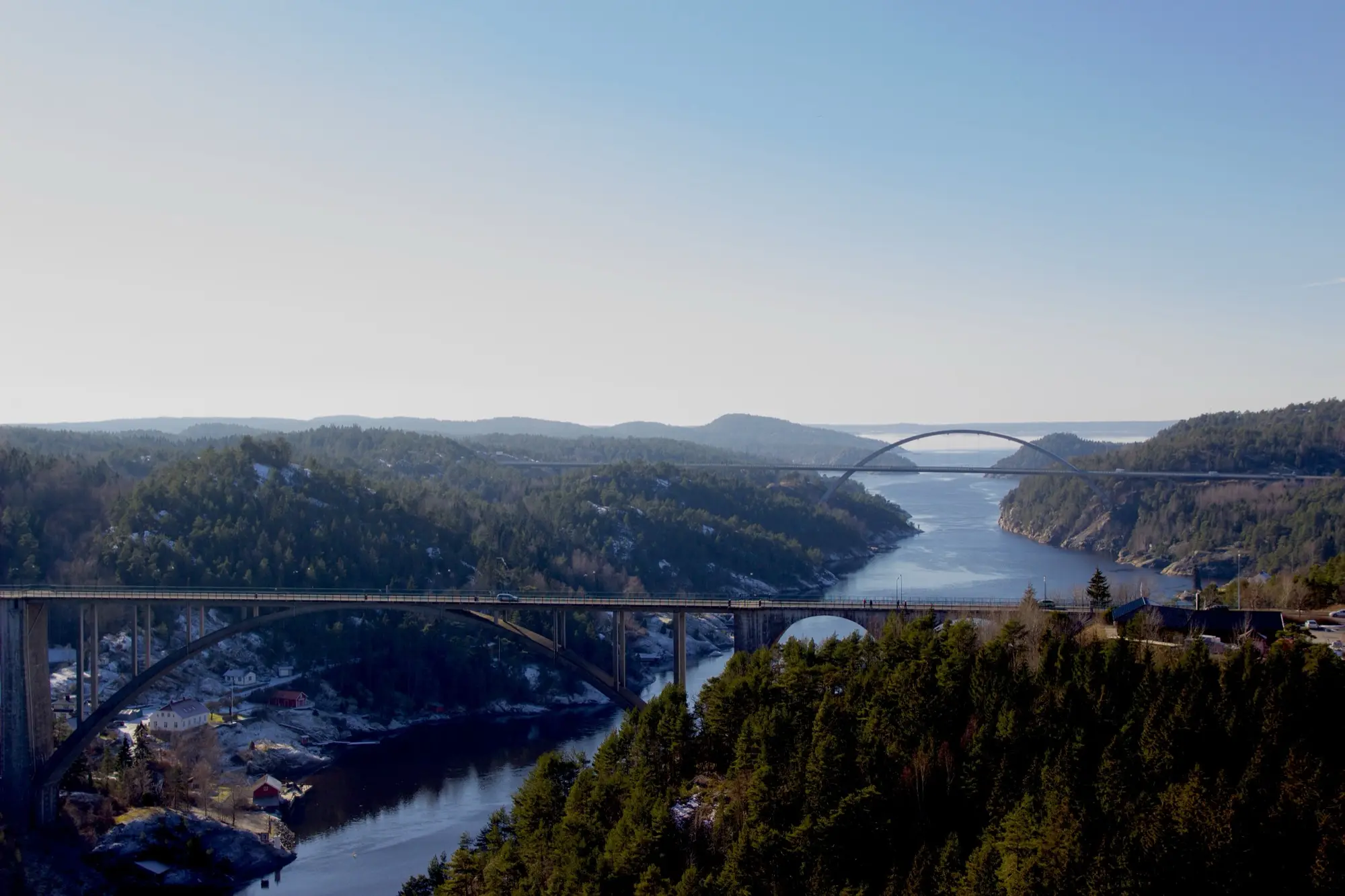

Norway is more expensive than Sweden on every standard category a visitor pays for, including food, transport, and lodging. Choosing between them comes down to whether your trip centres on the western fjords and coastal Arctic, or on Stockholm, forested lakes, and the lower costs found in Sweden. You can also connect both countries directly by road, ferry, or railway.
What each country is known for
According to the UNESCO World Heritage Centre, the West Norwegian Fjords include Geirangerfjord and Nærøyfjord, situated 120 km apart in south-western Norway, north-east of Bergen. They belong to a broader fjord area stretching 500 km from Stavanger to Åndalsnes. UNESCO notes these fjords rank among the longest and deepest on earth, featuring rock walls reaching up to 1,400 m above the water and extending 500 m below sea level. Along the coast, Hurtigruten and Havila operate passenger services throughout the year between Bergen and Kirkenes, calling at Tromsø twice each day. Visit Tromsø notes the voyage from Bergen to Tromsø takes about 64 hours.
Sweden's geography centres instead on islands, inland waters, and northern woodland. Visit Sweden states that Stockholm is constructed across 14 islands linked by 57 bridges, while the surrounding Stockholm archipelago contains more than 30,000 islands, making it the largest archipelago of its kind in Sweden. Visit Sweden speaks of Sweden's 100,000 lakes, and says you need a fishing licence or the rights holder's permission in most lakes and rivers, except the five largest lakes, where fishing with a rod and hand tools is free. Visit Sweden says Arctic Sweden, also known as Swedish Lapland, covers almost a quarter of the country; the northern lights are typically visible there from August to April, and from May the midnight sun brings 24 hours of daylight north of the Arctic Circle until mid-July.
Demographically, Statistics Sweden (SCB) reports Sweden's population as 10,605,529 in 2025. Statistics Norway (SSB) records Norway's population as 5,627,400 at the end of 2025, and 5,636,904 at the end of the second quarter of 2026.
Which is more expensive
Eurostat compiles price level indices comparing European countries against an EU average set at 100. For household final consumption expenditure in 2025, the index was 128.6 for Norway and 121.0 for Sweden.
| Expenditure Category (2025, EU = 100) | Norway | Sweden |
|---|---|---|
| Household final consumption expenditure | 128.6 | 121.0 |
| Food and non-alcoholic drinks | 133.1 | 109.9 |
| Restaurants and accommodation services | 139.7 | 123.4 |
| Alcoholic drinks | 226.4 | 149.8 |
| Passenger transport services | 167.4 | 144.8 |
For a more detailed breakdown of everyday travel costs, see our guide to the cost of living in Sweden.
Kronor and kroner, and paying in cash
Each country maintains its own currency.
Sweden uses the krona, issued by the central bank, Sveriges Riksbank. Sweden's circulating banknotes come in denominations of 20, 50, 100, 200, 500, and 1000 kronor. Active coins are 1, 2, 5, and 10 kronor.
Norway uses the krone, issued by Norges Bank. Active legal tender notes (series VIII) are 50, 100, 200, 500, and 1000 kroner. Norwegian coins are 1, 5, 10, and 20 kroner.
In Norway, notes and coins from Norges Bank are legal tender. Norwegian law says that since 1 October 2024, a consumer in a staffed shop must be offered the option to pay in cash. Exceptions to this mandate apply to unstaffed premises, vending machines, and amounts over 20,000 kroner. Since 1 May 2025, a business that refuses cash risks an infringement fine.
Buying a drink in each country
Both nations regulate off-licence retail sales through dedicated state monopolies.
In Sweden, the state-owned retail monopoly Systembolaget handles the sale of spirits, wine, and strong beer. Formed in 1955, Systembolaget is a retail monopoly not driven by profit, part of Sweden's restrictive alcohol policy. It has 452 stores plus an online shop, with about 450 stores in every Swedish municipality. It keeps limited opening hours, which are decided by the Riksdag (the Swedish parliament), and does not sell to anyone who is drunk or under 20. Under Sweden's Alcohol Act, beer of over 2.25 and not over 3.5 per cent (folköl) may be sold in shops that sell food. Alcohol may not be sold to anyone under 20 (under 18 for folköl), and may be served in bars and restaurants to anyone who has turned 18.
Under Norway's Alcohol Act only AS Vinmonopolet may sell drinks of over 4.7 per cent (groups 2 and 3); group 1 is over 2.5 and at most 4.7 per cent. Group 3 (22 to 60 per cent) may not be sold to anyone under 20, and weaker alcoholic drinks not to anyone under 18.
Norwegian law lets Vinmonopolet sell from 08.30 to 18.00, and from 10.00 to 16.00 on the day before a Sunday or public holiday, and forbids its sales on Sundays, public holidays, 1 and 17 May and Christmas Eve. Vinmonopolet's usual opening hours are Monday to Friday 10:00-18:00 and Saturday 10:00-16:00. Group 1 drinks (over 2.5 and at most 4.7 per cent) may not be sold after 20.00 on weekdays or after 18.00 on the day before a Sunday or public holiday, nor on Sundays, public holidays, 1 and 17 May.
Northern lights in Swedish Lapland or in Tromsø
Visitors seeking the aurora borealis look primarily to the Arctic portions of both countries. You can read our broader review of the best places to see the northern lights across the region.
For Sweden, the Swedish Lapland Visitors Board says more or less active northern lights can be caught around Abisko every night from October until the end of March, and that there the question is not the auroral activity but clear skies. SMHI names Abisko for the lowest normal annual precipitation in Sweden for 1991 to 2020, 347.2 mm, and says Abisko, in a precipitation shadow for most wind directions, has long been known as a very dry place. Kiruna Lappland says Kiruna's location within the northern polar aurora oval gives opportunities to see the northern lights from September to March. Detailed planning is covered in our guide to northern lights in Sweden and our page on aurora viewing in Abisko.
For northern Norway, Visit Tromsø says the northern lights may be visible in the Tromsø region from late August to early April whenever the sky is dark and clear enough, and that the weather in the north changes quickly, so a gap can open in the cloud. You can check conditions on our Tromsø aurora guide.
Daylight at midsummer and midwinter
Daylight alters dramatically between seasons. On this site's computed solar tables, the solstices yield the following times:
- Stockholm: On the summer solstice, the sun rises at 03:31 and sets at 22:08 (18 hours and 38 minutes of daylight), leaving no period dark enough for auroral observation. On the winter solstice, sunrise is at 08:43 and sunset at 14:48 (6 hours and 6 minutes of daylight), providing 12 hours and 34 minutes of dark sky. Our Stockholm daylight guide and winter breakdown for visiting Stockholm in December outline the city's seasonal shifts.
- Oslo: At the summer solstice, sunrise is at 03:53 and sunset at 22:43 (18 hours and 50 minutes of daylight), with no sky dark enough for the aurora. On the winter solstice, the sun rises at 09:18 and sets at 15:11 (5 hours and 52 minutes of daylight), yielding 12 hours and 36 minutes of dark sky.
- Kiruna: Located at 67.9°N (roughly 145 km north of the Arctic Circle), Kiruna sees continuous 24-hour daylight with no sunset on the summer solstice. On the winter solstice, the sun does not rise, creating 13 hours and 20 minutes of sky dark enough for the aurora.
- Tromsø: Situated at 69.6°N (about 340 km north of the Arctic Circle), Tromsø experiences midnight sun with no sunset on 1 June, the summer solstice, and 1 July. The sun does not rise at all on 1 December, the winter solstice, or 1 January. Solstice dark skies suitable for northern lights last 13 hours and 32 minutes, as detailed in our guide to daylight in Tromsø.
Camping and the right to roam
Both nations grant public access to open country, known as allemansrätten in Sweden and allemannsretten in Norway, though the legal rules are framed differently.
The Swedish Environmental Protection Agency explains that Swedish allemansrätten gives the public the right to wander freely through nature, forage for wild berries and mushrooms, and pitch a tent for a night or so across most uncultivated terrain, balanced by an obligation to respect landowners, wildlife, and other people. Two or three tents may be pitched well away from residential homes. The agency's standard rule of thumb is one or two nights in a single location. Larger groups pitching numerous tents must obtain the landowner's prior permission. In Swedish nature reserves and national parks, tent camping is generally restricted to designated, marked locations.
The Norwegian Environment Agency notes that Norway's allemannsretten allows people to walk and pitch tents on uncultivated land regardless of who owns it, but it applies specific legal boundaries. Your tent must be situated more than 150 metres away from any occupied house or cabin. Staying more than two nights in the same place requires permission from the landowner, except in the high mountains or areas situated far from human settlement. Hunting and freshwater fishing are explicitly excluded from the right. In addition, Norway imposes an annual outdoor fire ban: lighting fires in or near woodland and uncultivated ground is prohibited between 15 April and 15 September without municipal approval, unless you build the fire where it plainly cannot spread.
Seeing both on one trip
If you prefer not to choose between the two, several cross-border routes make combining them straightforward.
In the south, Visit Sweden notes that driving between Gothenburg and Oslo takes about three and a half hours, while driving from Stockholm to Oslo takes roughly six and a half hours. Visit Sweden says you can also reach Oslo by the ferry between Strömstad and Sandefjord, and that Color Line is among the ferry operators between Sweden and Norway. Further north, Visit Sweden says Trondheim is a two-and-a-half-hour drive from Åre, or a train journey of about the same length.
In the Arctic, road and rail links cross the border directly. Visit Sweden notes that the 173-km stretch between Kiruna and the Norwegian port of Narvik takes approximately two hours and fifteen minutes by car. The same route is served by the Iron Ore Line (Malmbanan), past Abisko National Park and Lake Torneträsk. Swedish railway operator SJ runs daily passenger trains between Kiruna and Narvik all year round. Kiruna Lappland says tickets should be bought online in advance, because they cannot be bought at the station or on board. Kiruna Lappland says SJ's night train runs between Stockholm and Narvik, with a choice of a seat, a sleeping car or, in first class, a private compartment with shower and toilet.
If you plan to visit Tromsø, bear in mind that there is no railway connection to the city. The nearest railway stations are Narvik, connecting to the Swedish rail network via Kiruna and Stockholm, and Fauske, connecting to the Norwegian network toward Trondheim and Oslo.