Can you see the northern lights in Abisko tonight?
Clouded out — 84% cloud at best between 20:04 and 04:58.
Checked against NOAA SWPC, FMI's Kilpisjärvi magnetometer and the MET Norway Locationforecast.
Tonight Abisko is 8 of 13 on the ranked table of places.
Get an alert when Abisko lights up
A notification on the nights it is dark, the sky is clear enough and the field is active enough for Abisko. One a night at most, nothing on the other nights.
Alerts come to this browser on this device. No email, no account; turn them off here or from any alert.
Located in Sweden at 68.3°N on Torneträsk, Abisko lies at a latitude where even a quiet geomagnetic night is often enough to see the northern lights.
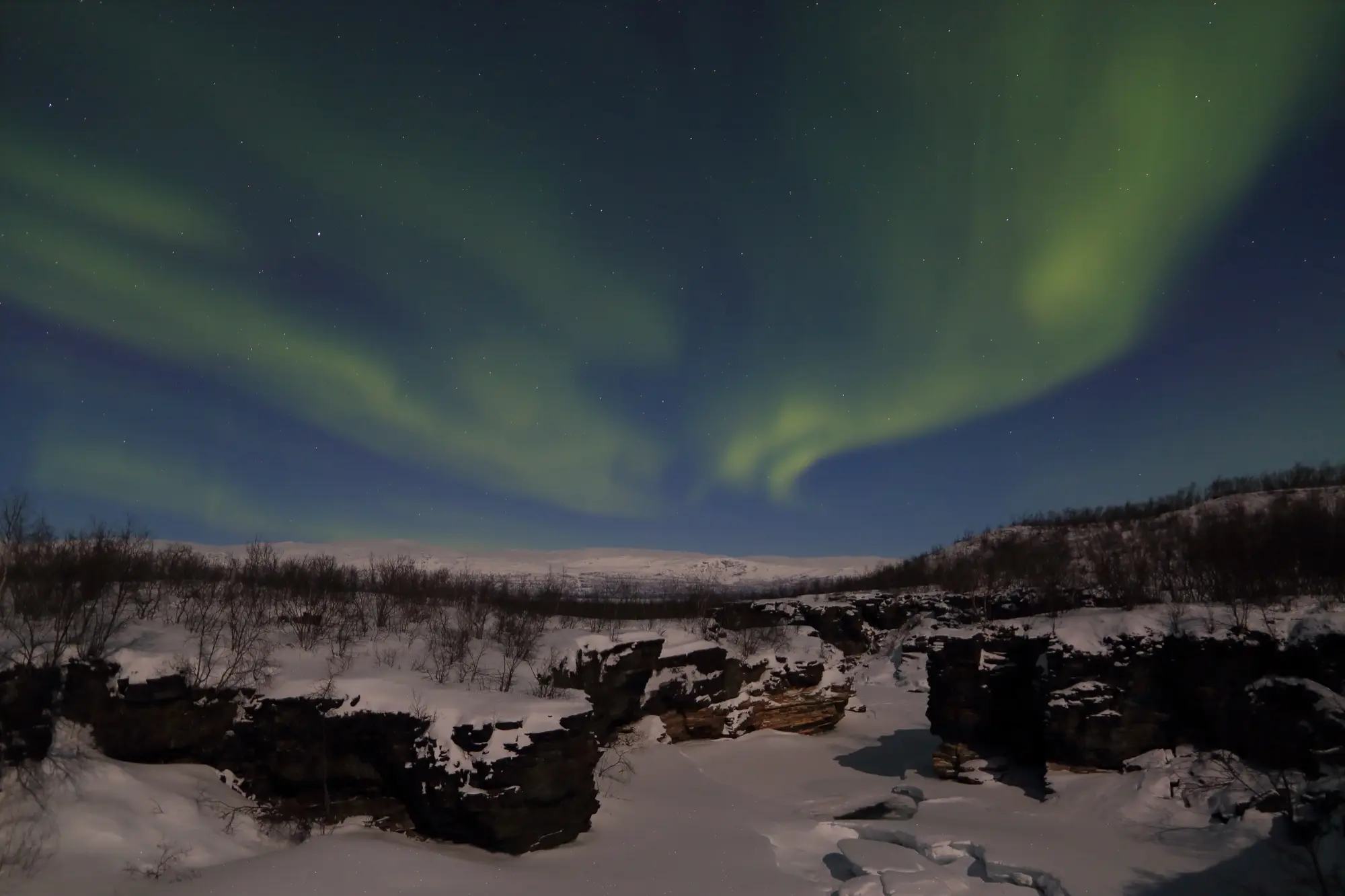
Photo: Pavel.shyshkouski, CC BY-SA 4.0

The evidence
- Geomagnetic activity
- Kp 0.00 (quiet) NOAA SWPC, estimated Kp, 4 minutes agoForecast peak Kp 4.33 during the dark hours NOAA SWPC 3-day forecast, issued 02:30 CEST2% chance of aurora overhead NOAA SWPC OVATION, 14 minutes agoLocal disturbance 1 nT/min at Kilpisjärvi, 111 km away FMI magnetometer network, 46 minutes ago
- Cloud over the dark hours
- 84% cloud at best around 21:00, 100% at worst MET Norway Locationforecast, covering 20:04–04:58
- Darkness
- Astronomical dark 20:04–04:58 (8h 54m) computed here from the date and the coordinatesSunset 16:52, sunrise 08:08 computed here
- Moon
- First quarter, 60% lit, 1° above the horizon at the start of the dark hours computed here
Cloud forecast: MET Norway, under CC BY 4.0, reduced here to the clearest and cloudiest hour of the dark window. See where the data comes from.
How dark does it get in Abisko tonight?
It is astronomically dark — dark enough to see the aurora — from 20:04 to 04:58 local time, 8 hours and 54 minutes.
Dark hours by date, 2026–27 season
| Date | Dark from | Dark until | Hours of darkness |
|---|---|---|---|
| 1 September | Not dark enough for the aurora | ||
| 15 September | 23:36 | 01:48 | 2h 12m |
| 1 October | 21:30 | 03:42 | 6h 12m |
| 15 October | 20:22 | 04:42 | 8h 20m |
| 1 November | 18:18 | 04:42 | 10h 24m |
| 15 November | 17:38 | 05:24 | 11h 46m |
| 1 December | 17:10 | 06:00 | 12h 50m |
| 15 December | 17:02 | 06:22 | 13h 20m |
| 1 January | 17:12 | 06:26 | 13h 14m |
| 15 January | 17:38 | 06:12 | 12h 34m |
| 1 February | 18:24 | 05:34 | 11h 10m |
| 15 February | 19:08 | 04:50 | 9h 42m |
| 1 March | 20:02 | 03:52 | 7h 50m |
| 15 March | 21:10 | 02:38 | 5h 28m |
| 1 April | Not dark enough for the aurora | ||
Astronomical darkness (the sun more than 18° below the horizon), Abisko local time, computed here from the date and the coordinates.
The Swedish Lapland Visitors Board says more or less active northern lights can be caught around Abisko every night from October until the end of March. According to the board, the question in Abisko is not auroral activity but clear skies. The board says Abisko usually has clear skies because the area gets less rainfall than the rest of Sweden.
When to see the northern lights in Abisko
The Swedish Lapland Visitors Board says more or less active northern lights can be caught around Abisko every night from October until the end of March. On the same page where it promotes its own STF Abisko Turiststation and STF Aurora Sky Station, the Swedish Tourist Association (STF) gives the best time to see the northern lights as mid-November to mid-March. You can check how night length changes across winter in the guide to Abisko daylight.
The Swedish Lapland Visitors Board says that in Abisko the question is not the auroral activity but clear skies. The board says Abisko usually has clear skies because the area gets less rainfall than the rest of Sweden, and that it often has a "blue hole" even when the rest of the sky is covered. STF also says the area is often called "the blue hole" because the sky there is frequently clear even when it is cloudy in surrounding areas.
A blog post by the Swedish Meteorological and Hydrological Institute (SMHI) on the 1991 to 2020 normals names Abisko for the lowest normal annual precipitation, 347.2 mm, and says Abisko, in a so-called precipitation shadow for most wind directions, has long been known as a very dry place. SMHI notes that Riksgränsen, a short way further west, gets three times as much precipitation as Abisko. For another perspective on northern conditions, see the guide to Tromsø northern lights.
STF says the Aurora Sky Station is open during two separate seasons, one in the dark part of winter when the northern lights are at their best and one during the summer's midnight sun, with a closed period in between, so check the current opening hours before you book.
How to get to Abisko
The village, where most homes, shops and the petrol station are, is usually called Abisko East; STF Abisko Turiststation is 3 km away in Abisko West. The village is 93 km from Kiruna along the E10 to the north-west, a drive of just over an hour. For connections in the regional hub, read the guide to Kiruna northern lights.
The nearest airports are Kiruna and Narvik (Evenes):
- From Kiruna Airport, a Länstrafiken Norrbotten airport bus goes directly to the tourist station, or you can take a taxi or a rental car.
- From Evenes, an airport bus goes to Narvik bus station, then the train or a Länstrafiken Norrbotten bus to Abisko.
SJ runs trains between Kiruna and Narvik daily all year round, along the railway between Torneträsk and Riksgränsen. SJ trains stop at a station called Abisko Turiststation, directly opposite the tourist station and about a 5-minute walk from its reception. Train tickets should be bought online in advance, because they cannot be bought at the station or on board.
To reach Kiruna from Stockholm by rail, Kiruna Lappland says you can sleep part of the journey on SJ's night train, which runs between Stockholm and Narvik, choosing a seat, a sleeping car or, in first class, your own sleeping compartment with shower and toilet. From Kiruna, you can take SJ's daily trains on to Abisko Turiststation. At the end of November 2026, Snälltåget runs what Kiruna Lappland calls a unique night train journey from Malmö via Stockholm to Narvik, stopping at Abisko and Björkliden among others; it leaves Malmö on Monday 23 November 2026 and returns from Narvik on Friday 27 November 2026.
Where to stand to see the aurora
The Swedish Lapland Visitors Board says Abisko National Park has some of the best conditions in the world for watching the northern lights, with mostly clear skies and almost no light pollution. You can compare how locations across the region stack up in the guide to the best places to see the northern lights.
STF says the chance of seeing the northern lights is just as high down at the tourist station as on Mount Njullá; from the top of Njullá you get panoramic views and even lower light pollution than around the tourist station.
The Aurora Sky Station stands on Mount Njullá, 900 metres above sea level, in a spot with very few distracting lights or sounds. The easiest way up to the Aurora Sky Station is the chairlift from its base station, a 10-minute walk from STF Abisko Turiststation. In the northern lights season, warm overalls and winter boots are included for guests who have booked the Sky Station's northern lights dinner or night visit, handed out at the base station.
The Swedish Lapland Visitors Board advises dressing warmly, because it could be a long wait outside for the lights. Kiruna Lappland says there are many guided activities for experiencing the northern lights in Abisko, and suggests a photo tour with professional northern lights photographers.
Where to watch near Abisko
- STF Aurora Sky Station (Njullá / Nuolja) 4.6 km west. A chairlift runs to the station from a base a 10-minute walk from STF Abisko Turiststation. It is an established northern lights viewing site, offering aurora talks during the evenings.
- STF Abisko Turiststation 2.2 km north-west. Located inside Abisko National Park with views of Lapporten, Njullá and Lake Torneträsk, it offers aurora chances as high as on the mountain. It has its own railway station.
- Abisko nationalpark 5.9 km south-west. The park offers mostly clear skies and almost no light pollution, with a local climate known as the blue hole that frequently keeps the sky clear when surrounding areas are cloudy.
What the numbers mean
Four things have to line up before you see anything, and three of them are on this page above. The fourth is your own eyes adjusting, which takes about twenty minutes in real darkness and does not survive a glance at a phone.
Darkness comes first because it cannot be argued with. The aurora is always there when the field is active; you can only see it once the sun is more than 18° below the horizon, which is what the dark band above marks. In Abisko that is 8 hours and 54 minutes tonight.
Kp is a global index of how disturbed the Earth's magnetic field is, from 0 to 9, published every three hours. It is a blunt instrument: it says the whole planet was disturbed, not that the aurora is over Abisko now. At 68°N the auroral oval usually sits overhead already, so a quiet Kp is no reason to stay in.
The local disturbance is the better number, and it is the one most aurora pages do not have. FMI runs magnetometers across Lapland; we take the rate of change of the horizontal field at the nearest one, in nanotesla per minute, which for Abisko is Kilpisjärvi, 111 km away. A field moving fast overhead means current flowing overhead, which is the aurora itself. Above roughly 40 nT/min it is usually visible; above 100 a substorm is running and it will be moving.
Cloud ends most attempts. The figure above is the total cloud cover MET Norway's Locationforecast forecasts for the dark hours, at these exact coordinates. Anything over about 70% and you will not see through it; under 30% and it stops mattering.
The moon does not stop the aurora. A full moon high in the sky washes out the faint green arcs that make up most displays, so a strong night still shows and a marginal one does not.
Plan the trip
- Best places to see the northern lights
- Daylight in Abisko through the year
- Daylight in Kiruna through the year
Nearby
Also on this site: how the daylight changes through the year, and the other 12 places.