Can you see the northern lights in Senja tonight?
Possible after 17:46 — the field is quiet (Kp 0.67), but at 69°N a quiet night is often enough.
Checked against NOAA SWPC, FMI's Kilpisjärvi magnetometer and the MET Norway Locationforecast.
Tonight Senja is 7 of 26 on the ranked table of places.
Get an alert when Senja lights up
A heads-up in the hours before dark when tonight's forecast Kp reaches your choice and the cloud forecast leaves a gap, and an alert when the field is active over a clear enough sky at Senja. Two a night at most, nothing on the other nights.
Alerts come to this browser on this device. No email, no account; turn them off here or from any alert.
Aurora forecast for Senja: the next three nights
| Night | Dark, local time | Forecast Kp | Kp needed | Clearest hour |
|---|---|---|---|---|
| TonightFri 13 Nov | 17:46–05:22 | Kp 1.67 | any Kp | 14% at best |
| Possible — Kp 0.67. | ||||
| Saturday nightSat 14 Nov | 17:44–05:24 | Kp 1.67 | any Kp | 0% at best |
| Possible — Kp up to 1.67 is forecast while it is dark, and at Senja a quiet field is enough. 0% cloud at best. | ||||
| Sunday nightSun 15 Nov | 17:40–05:28 | Kp 1.67 until 01:00 | any Kp | not forecast yet |
| Possible — Kp up to 1.67 is forecast until 01:00, and at Senja a quiet field is enough. The cloud forecast does not reach this night yet. | ||||
Checked . Kp from the NOAA SWPC three-day forecast, issued ; cloud from MET Norway Locationforecast, issued . Tonight's row is the verdict above, which also reads the Kp now, OVATION and the magnetometers; the nights after rest on the forecasts alone.
Key facts
- Astronomically dark in Senja tonight from 17:46 to 05:22 local time, 11 hours and 36 minutes, as of .
- Aurora outlook for the next three nights: Fri 13 Nov, Possible; Sat 14 Nov, Possible; Sun 15 Nov, Possible, as of .
- In the 2026–27 season, astronomical darkness returns between 1 September and 15 September and ends between 15 March and 1 April.
- Senja is at 69.23°N, 17.98°E.
Updated
Senja is an island in Norway at 69.2°N, where the sun does not rise for some weeks around the winter solstice and a quiet geomagnetic night is often enough to see the aurora.
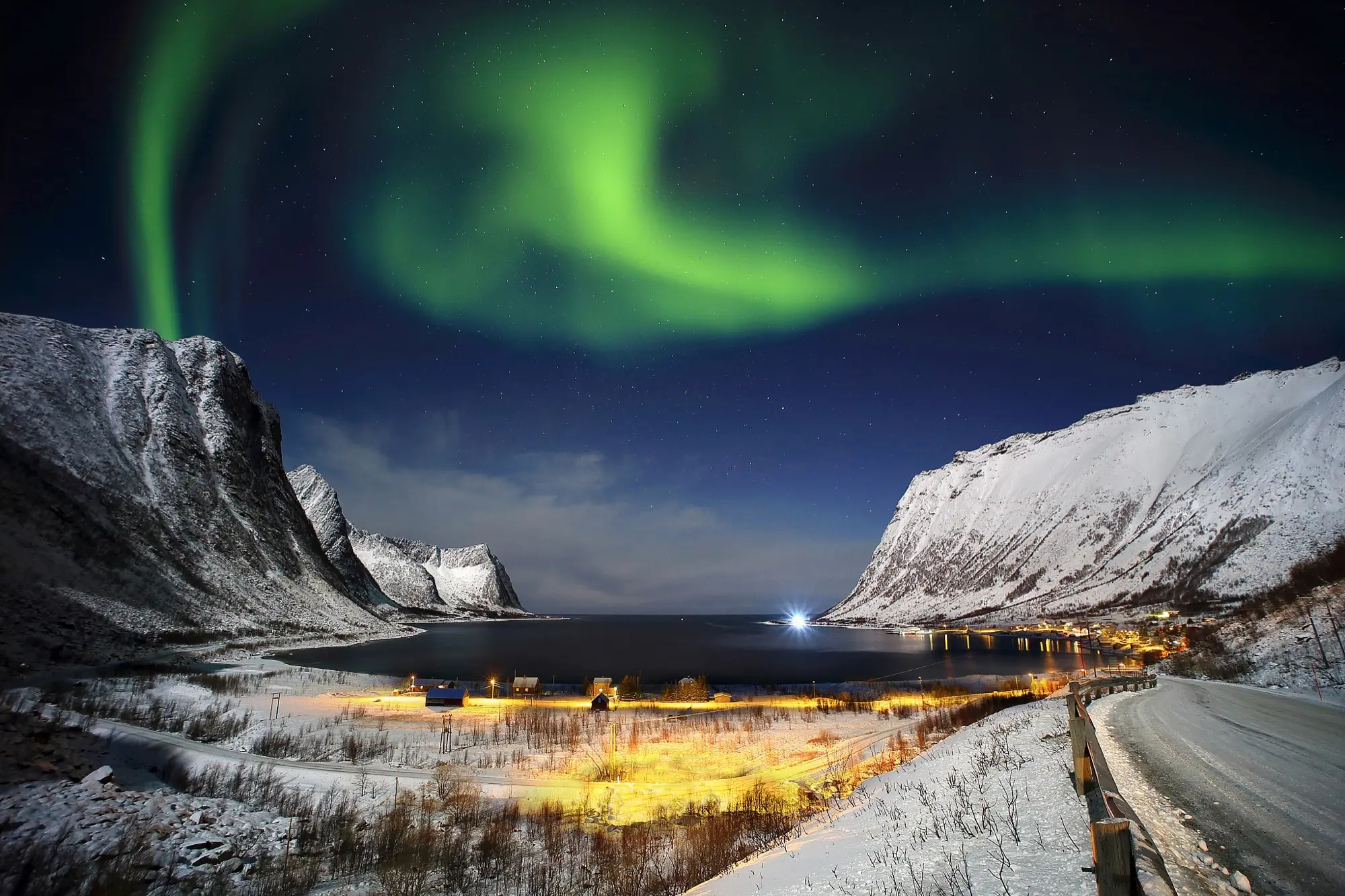
Photo: Russo Francesco, CC BY 3.0

The evidence
- Geomagnetic activity
- Kp 0.67 (quiet) NOAA SWPC, estimated Kp,Forecast peak Kp 1.67 during the dark hours NOAA SWPC 3-day forecast, issued 01:30 CET0% chance of aurora overhead NOAA SWPC OVATION,Local disturbance 3 nT/min at Kilpisjärvi, 112 km away FMI magnetometer network,
- Cloud over the dark hours
- 14% cloud at best around 02:00, 96% at worst MET Norway Locationforecast, covering 17:46–05:22
- Darkness
- Astronomical dark 17:46–05:22 (11h 36m) computed here from the date and the coordinatesSunset 13:53, sunrise 09:15 computed here
- Moon
- Waxing crescent, 17% lit, below the horizon at the start of the dark hours computed here
Cloud forecast: MET Norway, under CC BY 4.0, reduced here to the clearest and cloudiest hour of the dark window. See where the data comes from.
How dark does it get in Senja tonight?
It is astronomically dark — dark enough to see the aurora — from 17:46 to 05:22 local time, 11 hours and 36 minutes.
Dark hours by date, 2026–27 season
| Date | Dark from | Dark until | Hours of darkness |
|---|---|---|---|
| 1 September | Not dark enough for the aurora | ||
| 15 September | 00:32 | 00:58 | 0h 26m |
| 1 October | 21:42 | 03:38 | 5h 56m |
| 15 October | 20:28 | 04:42 | 8h 14m |
| 1 November | 18:22 | 04:44 | 10h 22m |
| 15 November | 17:40 | 05:28 | 11h 48m |
| 1 December | 17:10 | 06:06 | 12h 56m |
| 15 December | 17:02 | 06:28 | 13h 26m |
| 1 January | 17:14 | 06:32 | 13h 18m |
| 15 January | 17:40 | 06:16 | 12h 36m |
| 1 February | 18:26 | 05:38 | 11h 12m |
| 15 February | 19:14 | 04:50 | 9h 36m |
| 1 March | 20:10 | 03:50 | 7h 40m |
| 15 March | 21:24 | 02:32 | 5h 08m |
| 1 April | Not dark enough for the aurora | ||
Astronomical darkness (the sun more than 18° below the horizon), Senja local time, computed here from the date and the coordinates.
Most travel to Senja centres on Finnsnes, the mainland town linked to the island by bridge, which acts as the regional transport hub. Arctic Norway says that if it snows or rains you should head inland, where sometimes a 20-minute drive is enough to see the stars, and that when it snows heavily on the ocean side the clouds often open on the inland side.
When to see the northern lights in Senja
Northern Norway's tourism board states that Senja lies directly under the northern lights belt, the band surrounding the magnetic north pole where aurora displays occur most frequently. Auroral displays typically shine approximately 100 km above Senja, occasionally reaching heights up to 800 km, which allows them to be seen across broad regions of the north. According to a Finnsnes photographer speaking to Arctic Norway, the prime period for viewing northern lights in Senja spans from mid September to around the first of April. Arctic Norway says that during the final days of March, daylight starts eating into the best evening hours; viewing chances shift from excellent around the spring equinox to iffy in the first days of April, and by late April it is too late.
A Finnsnes photographer told Arctic Norway that Senja sees the same northern lights as the rest of northern Scandinavia, because the lights are so high up. He also explained that, as he understands it, the Kp index mainly shows how far south in Scandinavia and Europe the lights can be seen and matters less so far north. The tourism board reports its geophysics expert confirms this view; the photographer noted that he has been out when every app was red and seen nothing, and seen strong lights when the apps were pessimistic.
Arctic Norway says that despite lying around 300 km north of the Arctic Circle, Senja has a mild winter climate. Average temperatures in January and February range from -1 on the outermost coast to -5 inland. Arctic Norway says the sun is absent for six or seven weeks in winter, but it is not dark all the time, and the sun is visible again by mid-January. Arctic Norway says the best places vary from night to night, with the weather as the main question mark. For wider travel, see our guide to the northern lights in Norway.
How to get to Senja
Finnsnes sits on the mainland and connects to Senja across the 1147-metre Gisund Bridge. If you travel by air, Bardufoss Airport is 46 km away, which Visit Senja says is a 45-minute drive. Norwegian operates a daily service to Bardufoss from Oslo Gardermoen taking 1 hour and 50 minutes, and airport operator Avinor lists Norwegian as the sole carrier serving the airport. An airport bus connects Silsand, Finnsnes, Sørreisa, and Bardufoss Airport; Arctic Norway says the bus from Bardufoss to Finnsnes takes an hour. Alternative entry routes include flying to Tromsø Airport (165 km by road from Finnsnes) or Harstad/Narvik Airport Evenes (170 km from Finnsnes), both of which handle domestic and international flights. Finnsnes is also 144 km by road from Narvik. Rental vehicles are available at all the airports as well as within Finnsnes.
Express passenger catamarans run daily. Line 2 serves the route Tromsø – Finnsnes – Brøstadbotn – Engenes – Harstad, while line 4 operates between Lysnes in northern Senja and Tromsø on Mondays, Wednesdays, and Fridays only. All catamaran tickets must be purchased through the Svipper mobile app. The express catamaran from Tromsø city centre reaches Finnsnes in one hour. For motorists travelling between the Tromsø area and Senja, a year-round vehicle ferry operates daily between Brensholmen and Botnhamn. Deck space cannot be booked in advance, and fares are collected through the Autopass tag system. Drivers coming via the E6 from Harstad, Lofoten, Narvik, or Tromsø turn off toward Finnsnes and Senja at Buktamoen in Målselv, while travellers heading south-west afterward can consult our Lofoten northern lights guide.
Public transit options directly serving the island include the Senja Direct bus, which runs daily between Tromsø Bus Terminal Prostneset and Senja from 15 December until 31 March; tickets must be bought at least one day ahead. The Coastal Route vessels of Hurtigruten and Havila Voyages call at Finnsnes harbour daily. Northbound ships arrive at 11.00 and leave at 11.30, while southbound vessels dock at 04.20 and leave at 04.40; select ships accommodate vehicles. Local bus routes depart Finnsnes for outlying settlements, including Stonglandseidet, Gryllefjord, and Senjahopen, along with regional services to Harstad and Tromsø. However, Visit Senja says it is easy to reach Finnsnes by bus but harder to travel between places on Senja, since most routes go via Finnsnes and you may have to change.
Where to stand to see the aurora
The Norwegian Scenic Route Senja runs for 102 km between Botnhamn and Gryllefjord; since Senja is an island, you cross the bridge from the mainland. Arctic Norway says that with a car you can drive to well-known viewpoints on the Norwegian Scenic Route, among them the platform above the Bergsfjord, the Tungeneset viewpoint towards the Okshornan cliffs and the sea view from Ballesvika beach. A Finnsnes photographer told Arctic Norway how, one night in early November, he ended up at the Tungeneset viewpoint, the cloud thinned and he photographed the aurora reflected in the rock pools there.
Arctic Norway says that if it snows or rains you should head inland, where sometimes a 20-minute drive is enough to see the stars, and that when it snows heavily on the ocean side the clouds often open on the inland side. The Finnsnes photographer prefers the outer coast before the snow falls, for the cliffs and the shore pools that reflect the aurora; he also says the snow lightens up the landscape, perhaps just 20 minutes' drive from the coast.
Arctic Norway says Senja now has northern lights chasers; guides improve your chances because they are mobile and can drive to where the skies are clear, and because they understand aurora activity and changing weather. Arctic Norway says that on a cold, starry night you can go wherever you like to see the lights; dress warmly, wear reflectors if you walk along a road, and keep moving to stay warm. Arctic Norway also notes that many winter visitors rent a cabin for a quiet holiday and keep an eye out for the lights each night. If you plan to drive independently, car hire is available in Finnsnes and Tromsø. Arctic Norway says the roads are quiet but can be narrow and winding, and it only recommends hiring a car to people with some experience of snowy roads.
Where to watch near Senja
- Tungeneset 38 km north-west. Drive along the Scenic Route to this viewpoint, which Northern Norway's tourism board lists for northern lights viewing. A larch walkway leads over the rocks towards northern views of Oksen's peaks and pools reflecting the aurora.
- Bergsbotn viewpoint 29 km north-west. You can drive to this 44-metre platform above the Bergsfjord and surrounding peaks, which Northern Norway's tourism board names among the Scenic Route viewpoints for watching northern lights.
What the numbers mean
Four things have to line up before you see anything, and three of them are on this page above. The fourth is your own eyes adjusting, which takes about twenty minutes in real darkness and does not survive a glance at a phone.
Darkness comes first because it cannot be argued with. The aurora is always there when the field is active; you can only see it once the sun is more than 18° below the horizon, which is what the dark band above marks. In Senja that is 11 hours and 36 minutes tonight.
Kp is a global index of how disturbed the Earth's magnetic field is, from 0 to 9, published every three hours. It is a blunt instrument: it says the whole planet was disturbed, not that the aurora is over Senja now. At 69°N the auroral oval usually sits overhead already, so a quiet Kp is no reason to stay in.
The local disturbance is the better number, and it is the one most aurora pages do not have. FMI runs magnetometers across Lapland; we take the rate of change of the horizontal field at the nearest one, in nanotesla per minute, which for Senja is Kilpisjärvi, 112 km away. A field moving fast overhead means current flowing overhead, which is the aurora itself. Above roughly 40 nT/min it is usually visible; above 100 a substorm is running and it will be moving.
Cloud ends most attempts. The figure above is the total cloud cover MET Norway's Locationforecast forecasts for the dark hours, at these exact coordinates. Anything over about 70% and you will not see through it; under 30% and it stops mattering.
The moon does not stop the aurora. A full moon high in the sky washes out the faint green arcs that make up most displays, so a strong night still shows and a marginal one does not.
Plan the trip
- Best places to see the northern lights
- Northern lights in Norway: when and where to go
- Tromsø in winter
- Daylight in Tromsø through the year
Nearby
Also on this site: how the daylight changes through the year, and the other 25 places.