Can you see the northern lights in Lofoten tonight?
Clouded out — 100% cloud at best between 20:22 and 05:16.
Checked against NOAA SWPC and the MET Norway Locationforecast.
Tonight Lofoten is 13 of 13 on the ranked table of places.
Get an alert when Lofoten lights up
A notification on the nights it is dark, the sky is clear enough and the field is active enough for Lofoten. One a night at most, nothing on the other nights.
Alerts come to this browser on this device. No email, no account; turn them off here or from any alert.
Lofoten is an island chain in Norway at 68.2°N, where polar night keeps the sun below the horizon for weeks around the winter solstice and quiet geomagnetic nights are often enough to see the aurora.
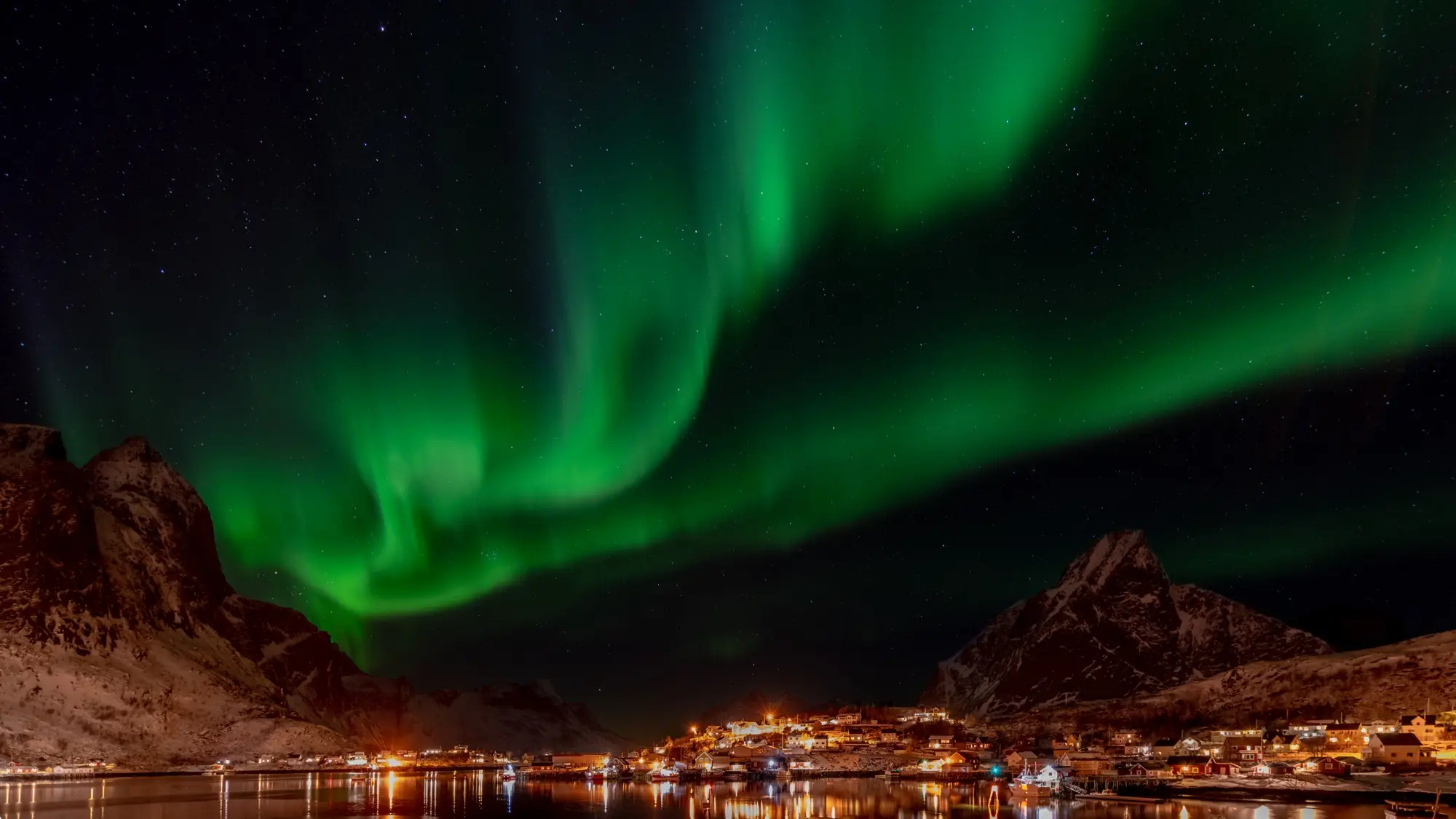
Photo: Christoph Strässler, CC BY-SA 2.0

The evidence
- Geomagnetic activity
- Kp 0.00 (quiet) NOAA SWPC, estimated Kp, 4 minutes agoForecast peak Kp 4.33 during the dark hours NOAA SWPC 3-day forecast, issued 02:30 CEST2% chance of aurora overhead NOAA SWPC OVATION, 14 minutes ago
- Cloud over the dark hours
- 100% cloud at best around 20:00, 100% at worst MET Norway Locationforecast, covering 20:22–05:16
- Darkness
- Astronomical dark 20:22–05:16 (8h 54m) computed here from the date and the coordinatesSunset 17:10, sunrise 08:25 computed here
- Moon
- First quarter, 60% lit, 1° above the horizon at the start of the dark hours computed here
Cloud forecast: MET Norway, under CC BY 4.0, reduced here to the clearest and cloudiest hour of the dark window. See where the data comes from.
How dark does it get in Lofoten tonight?
It is astronomically dark — dark enough to see the aurora — from 20:22 to 05:16 local time, 8 hours and 54 minutes.
Dark hours by date, 2026–27 season
| Date | Dark from | Dark until | Hours of darkness |
|---|---|---|---|
| 1 September | Not dark enough for the aurora | ||
| 15 September | 23:48 | 02:08 | 2h 20m |
| 1 October | 21:46 | 04:00 | 6h 14m |
| 15 October | 20:38 | 05:00 | 8h 22m |
| 1 November | 18:34 | 05:00 | 10h 26m |
| 15 November | 17:56 | 05:40 | 11h 44m |
| 1 December | 17:28 | 06:18 | 12h 50m |
| 15 December | 17:18 | 06:38 | 13h 20m |
| 1 January | 17:30 | 06:42 | 13h 12m |
| 15 January | 17:56 | 06:28 | 12h 32m |
| 1 February | 18:40 | 05:50 | 11h 10m |
| 15 February | 19:26 | 05:06 | 9h 40m |
| 1 March | 20:18 | 04:10 | 7h 52m |
| 15 March | 21:26 | 02:56 | 5h 30m |
| 1 April | Not dark enough for the aurora | ||
Astronomical darkness (the sun more than 18° below the horizon), Lofoten local time, computed here from the date and the coordinates.
Visit Lofoten says the islands lie within the aurora oval, with northern lights visible from late August to mid April. Lofoten has sometimes a lot of weather, but mountains help break up cloud and northern-facing beaches provide open viewing points. Getting to the archipelago requires flights to regional or island airports, ferries across the Vestfjord, or driving along the E10.
When to see the northern lights in Lofoten
Visit Lofoten says the Lofoten Islands lie in the Arctic Circle at 67 and 68 degrees north, within what is known as the aurora oval. According to Visit Lofoten, the northern lights are first visible in late August and fade in the spring sky in mid April, so they can be seen for about eight months of the year.
Visit Lofoten says there is no best time to see the northern lights. For hiking and camping September is a better month than November, for skiing or a winter look to your pictures January through March is maybe the best time to visit, and the long nights of November and December do not necessarily bring more hours of aurora. Visit Lofoten says that more commonly, under average conditions, the northern lights first appear around 20:00 to 21:00 and fade a little after midnight; during ongoing solar storms they can be visible as soon as it is sufficiently dark, though this is somewhat rare.
Visit Lofoten says you cannot see the northern lights every night, either because of low solar activity or because the sky is covered in cloud. Visit Lofoten says Lofoten has a lot of mountains and sometimes a lot of weather, and that the mountains help break up the cloud, opening gaps where the aurora can be seen even on cloudy nights. Visit Lofoten says that even in midwinter, with the islands under snow, Lofoten's coastal climate keeps temperatures quite mild compared with inland destinations.
How to get to Lofoten
Lofoten has three airports and Norway's only commercial helicopter route. Widerøe flies several times a day from Bodø to Svolvær and to Leknes. SAS flies from Oslo Gardermoen to Bodø and Tromsø, with Widerøe onward from Bodø to Svolvær and Leknes, and there are also flights from Tromsø to Leknes; one connecting ticket can cover the whole journey.
Harstad/Narvik Airport Evenes is 170 km from Svolvær. There are several daily direct flights to it from Oslo Gardermoen, and several carriers fly to it direct from European airports. The drive from Evenes to Svolvær takes around two and a half hours depending on conditions, and longer in winter. The Lofotekspressen, route 300, is the only public bus from Evenes Airport, running between Å, Leknes, Svolvær, Evenes and Narvik; Visit Lofoten advises checking the Reis app beforehand that it fits your flight's arrival.
The E10 runs from Luleå in Sweden west to Å in Lofoten. Lofast connects Lofoten to the mainland by road, and the E10 from Fiskebøl to Å is 163 km, with routes continuing inland past Kiruna.
Sea crossings connect the islands to the mainland:
- The quickest ferry from Bodø to Lofoten is the direct crossing to Moskenes, about three and a half hours, with or without a vehicle.
- An express boat, NEX 2, crosses the Vestfjord from Bodø to Svolvær, with stops on the way.
- Hurtigruten calls at Stamsund and Svolvær, northbound and southbound, in the evening.
Where to stand to see the aurora
Visit Lofoten calls the dozens of sandy beaches along Lofoten's sparsely populated northern coast the best places to begin the search as the sky darkens. Most are easily reached from the E10, and many are only a few minutes apart, so you can move quickly from one to the next. Visit Lofoten says most of Lofoten's inhabitants live in small towns and villages across the central and southern side of the islands, which leaves the northern side, and most of the best aurora-watching places, free of surrounding light pollution.
Visit Lofoten says the northern lights in general appear as an arch across the northern sky, so at a low activity level you want an open northern horizon and sky. As the intensity increases the arch moves higher, eventually overhead, and its points of origin on the horizon shift towards east and west, so when the aurora is very active you look west or east rather than north. Visit Lofoten says that on nights of high activity it can often be necessary to move between places. Uttakleiv beach suits low to mid-level auroras with its view of the northern horizon, but it is surrounded by mountains from west to east, so as activity increases the aurora moves behind them, and Haukland or Vik beach round the corner offer visibility west and south-west.
Many hotels, rorbu cabins and rentals in Lofoten are in places where you only have to step outside to see the aurora; long trips late at night are not required. Lofoten's aurora guides know where to go when most of the islands are under cloud; they call this the aurora hunt. For regional comparisons across destinations, see the guide to the best places to see the northern lights.
Where to watch near Lofoten
- Hov, Gimsøy 22 km north-west. Located on the island's north side with white sandy beaches and a golf course, Visit Lofoten describes it as a popular place to view the northern lights in winter.
- Uttakleiv beach 44 km west. A clear view of the northern horizon makes this a fine place for low and moderate auroras, though strong displays can move behind the surrounding mountains. Paid parking and services are available in the farmer-owned village.
- Haukland beach 43 km west. Located a 10-minute drive from Leknes on the north side of Vestvågøy, it has parking right by the beach and provides a view to the west and south-west when the aurora moves behind Uttakleiv's mountains.
- Skagsanden beach 54 km west. Visit Lofoten names it among Lofoten's best aurora viewing places, situated right by the E10.
What the numbers mean
Four things have to line up before you see anything, and three of them are on this page above. The fourth is your own eyes adjusting, which takes about twenty minutes in real darkness and does not survive a glance at a phone.
Darkness comes first because it cannot be argued with. The aurora is always there when the field is active; you can only see it once the sun is more than 18° below the horizon, which is what the dark band above marks. In Lofoten that is 8 hours and 54 minutes tonight.
Kp is a global index of how disturbed the Earth's magnetic field is, from 0 to 9, published every three hours. It is a blunt instrument: it says the whole planet was disturbed, not that the aurora is over Lofoten now. At 68°N the auroral oval usually sits overhead already, so a quiet Kp is no reason to stay in.
The local disturbance is the better number, and it is the one most aurora pages do not have. FMI runs magnetometers across Lapland; we take the rate of change of the horizontal field at the nearest one, in nanotesla per minute. Lofoten has none within 120 km, so its verdict rests on Kp and OVATION. A field moving fast overhead means current flowing overhead, which is the aurora itself. Above roughly 40 nT/min it is usually visible; above 100 a substorm is running and it will be moving.
Cloud ends most attempts. The figure above is the total cloud cover MET Norway's Locationforecast forecasts for the dark hours, at these exact coordinates. Anything over about 70% and you will not see through it; under 30% and it stops mattering.
The moon does not stop the aurora. A full moon high in the sky washes out the faint green arcs that make up most displays, so a strong night still shows and a marginal one does not.
Plan the trip
Nearby
Also on this site: how the daylight changes through the year, and the other 12 places.