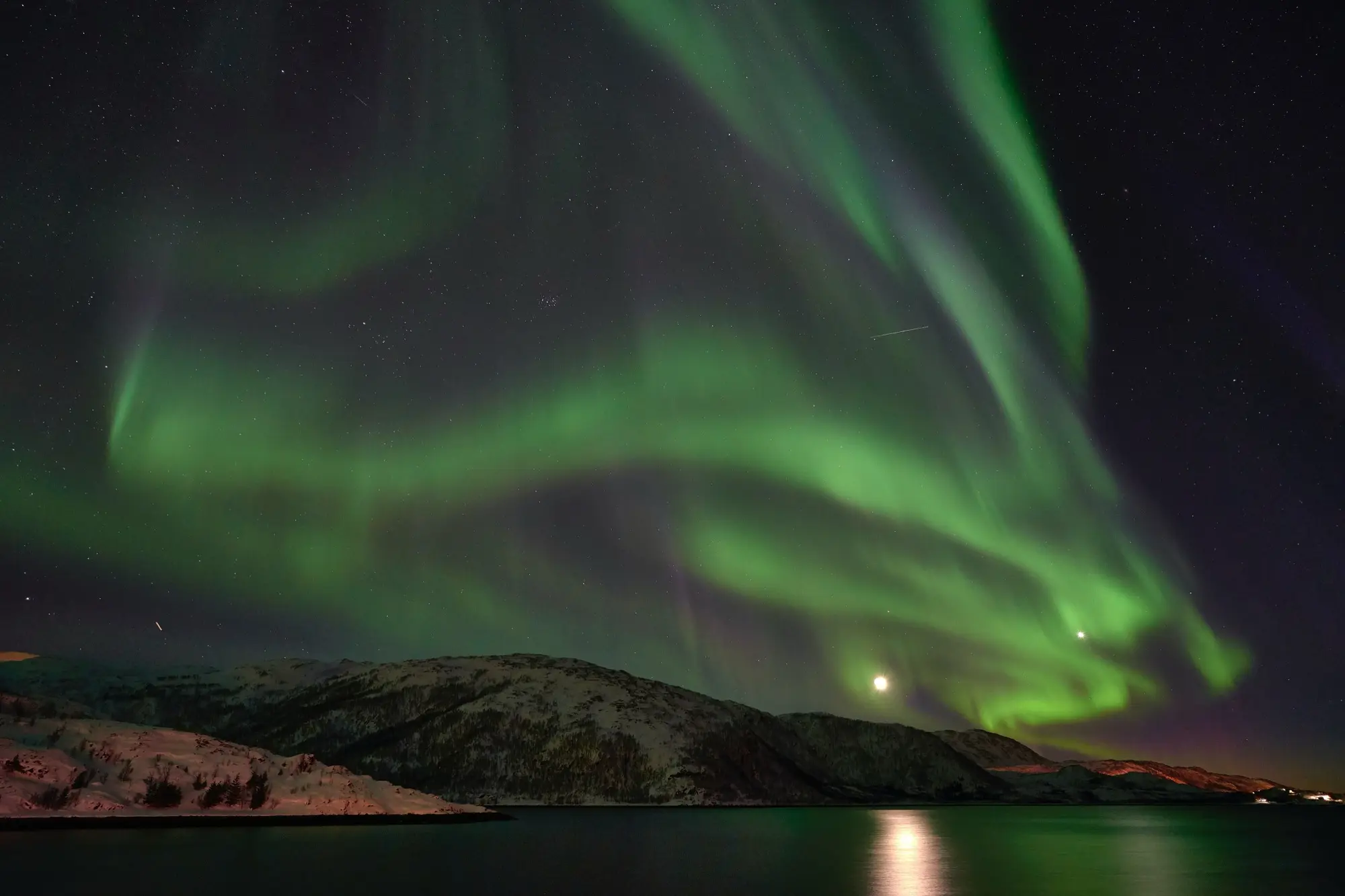

To see the northern lights in Norway, you need darkness, clear skies and a location under the auroral oval. For tonight's real-time visibility conditions and short-range predictions, check our dedicated hubs for the Tromsø northern lights, the Alta northern lights and the Lofoten northern lights. You can also compare live status across the region via our all live aurora verdicts page.
When the northern lights season runs in Norway
Visit Northern Norway states that from mid-September to the first days of April, it gets dark by about 6–7pm or earlier, which means the whole likely aurora window is dark. First-time visitors should plan their trips during this core period. The first northern lights can appear as early as mid-August and the last around May Day, but chances are slimmer because daylight cuts into the best viewing hours.
Local tourist boards specify slightly different viewing windows across regions:
- Visit Tromsø notes that the northern lights may be visible in the Tromsø region from late August to early April, whenever the sky is dark and clear enough. You can inspect exact daylight changes for your dates on our daylight in Tromsø page.
- Visit Lofoten gives the Lofoten season as the end of August to the middle of April.
- Visit Alta says there are chances to see the aurora in Alta from September to the end of March when conditions are right.
Around the equinoxes – late September/early October and late March – the aurora can be particularly strong, although equally strong displays happen all season.
Why Northern Norway sits under the aurora oval
Visit Northern Norway says Arctic Norway lies under the northern lights oval and so has the most northern lights. The northern lights belt stretches along the coast of Arctic Norway from Lofoten to the North Cape.
According to the NOAA Space Weather Prediction Center, the best place to observe the aurora is under an oval between latitudes of about 60 and 75 degrees. At these latitudes, the SWPC says, the aurora can be observed on more than half of the nights in a year.
Visit Lofoten says that because Lofoten is inside the oval, even low activity of about Kp 1 can produce visible northern lights, so clear skies matter more than a high Kp. Yr's aurora index uses a Kp threshold of 0 for geomagnetic latitudes of 66–74 degrees and 1 for 75 degrees and above.
The best hours of the night
The northern lights can appear at any time when it is dark, but they usually show between 6pm and 1am. After about 1am, the chance diminishes. Statistically, the best hour is 10pm–11pm, or 11pm–midnight when daylight saving time is in force. Visit Tromsø notes that the aurora is often most active between about 20:00 and 02:00.
Clouds, coast and inland
Clear skies are essential. Solid cloud cover, perhaps accompanied by snow or rain, means you cannot see the northern lights. A high cloud layer can often be thin enough to see the aurora through, while low cloud is usually dense and more of a hindrance.
Weather patterns differ across the region:
- Inland regions, sheltered from the ocean by high mountains, generally have a more stable climate with more cloudless nights, according to Visit Northern Norway.
- When cold easterly winds blow in winter, conditions are clearest along the coast.
- Visit Northern Norway notes that the first scientific aurora observations were made in Alta and that its dry climate makes it one of the best places to see them.
Everywhere in Arctic Norway, the weather can vary within a few kilometres, so being mobile helps. If you are near a town, find a location north of the built-up area, as faint northern lights typically appear on the north-western horizon.
Where to go - Tromsø, Alta, Lofoten, Senja, Narvik, North Cape and Svalbard
Different bases offer different geographic features:
- Tromsø: On clear nights, the aurora may be visible from Tromsø itself, including darker places such as Prestvannet.
- Alta: Visit Northern Norway says Alta can rightly call itself the City of Northern Lights. The world's first permanent northern lights observatory was built on Mount Halde in Alta by Kristian Birkeland in 1899. The Northern Lights Cathedral, also known as Alta Church, was consecrated in 2013, with lines inspired by the northern lights.
- Senja: Visit Northern Norway describes Senja as an island with a mild winter climate that lies right under the northern lights oval.
- Narvik: Guides in Narvik read the wind direction to find clear skies. In mild south-westerly weather, taking a trip into Sweden may be the answer.
- North Cape: At the North Cape, nothing is guaranteed in winter, as snow clouds and strong northerlies can blow in at any moment.
- Svalbard: Located an hour and a half by plane north of the mainland, Svalbard experiences daytime northern lights in late November, December and January, when there is no daylight at all. Because of polar bears, Visit Svalbard strongly recommends going with an organised northern lights group.
Getting there - flights and the coastal ships
You can fly, or take the coastal ships:
- Flights: There are several daily flights from Oslo to Tromsø, taking about 1 hour 50 minutes. Lofoten has three airports and Norway's only commercial helicopter route. Daily flights also operate to Svalbard from both Tromsø and Oslo.
- Coastal ships: Hurtigruten and Havila sail all year between Bergen and Kirkenes, and call at Tromsø twice a day.
If you book a voyage with Hurtigruten, review the specific terms of their policy:
- Hurtigruten's Northern Lights Promise covers voyages of 11 days or more along the Norwegian coast in the auroral season between 20 September and 31 March. It applies to The Coastal Express, The North Cape Line and Hurtigruten from Hamburg, for new bookings.
- If the northern lights are not officially sighted, Hurtigruten offers a free Coastal Express Classic Voyage in an unspecified inside twin cabin, full board; its terms set which voyage, and it changes by season.
- A sighting counts only if the ship's deck officers record it and announce it to passengers, and the ship's decision is final.
- The promise is valid until 31 March 2028, and the company states it may withdraw or amend the offer at any time.
Where the forecasts come from
- Yr: A joint service of the Norwegian Meteorological Institute (MET Norway) and the Norwegian Broadcasting Corporation, Yr is the app Visit Svalbard recommends for local cloud conditions. Yr's aurora forecast shows northern lights activity where you are up to 3 days ahead, while its aurora nowcast runs from 0–100% and predicts 30–90 minutes ahead. Yr states that its aurora forecast is a good indication of when to go out and look up, not a guarantee.
- Geomagnetic indices: Geomagnetic disturbance is given as the Kp index on a scale of 0 to 9; the higher the number, the greater the chance of aurora.
- Tromsø Geophysical Observatory: UiT's Tromsø Geophysical Observatory publishes geomagnetic data and an all-sky camera, and links directly to the Norwegian Center for Space Weather.
Tours, road safety and photo basics
Visit Northern Norway says a guided tour with an experienced northern lights guide gives the best chance, because a mobile guide can move away from the clouds. Organised northern lights tours from Tromsø usually run from September to early April. Visit Tromsø's aurora tourism guidelines say to always use a registered guide company and to listen to your guide.
Under Visit Tromsø's aurora tourism guidelines, you must never walk in the middle of the road, and drivers should not stop on blind bends and should watch for reindeer and elk.
For photography, Visit Northern Norway's photo guide identifies a tripod as the first piece of vital equipment. The guide suggests setting your camera to start at ISO 1600 with an exposure of 5–10 seconds, adjusting your settings from there.