Can you see the northern lights in Tromsø tonight?
Clouded out — 100% cloud at best between 20:10 and 04:52.
Checked against NOAA SWPC, FMI's Kilpisjärvi magnetometer and the MET Norway Locationforecast.
Tonight Tromsø is 10 of 13 on the ranked table of places.
Get an alert when Tromsø lights up
A notification on the nights it is dark, the sky is clear enough and the field is active enough for Tromsø. One a night at most, nothing on the other nights.
Alerts come to this browser on this device. No email, no account; turn them off here or from any alert.
Located in Norway at 69.6°N, Tromsø sits far enough north that even a quiet geomagnetic night is often enough to see the aurora.
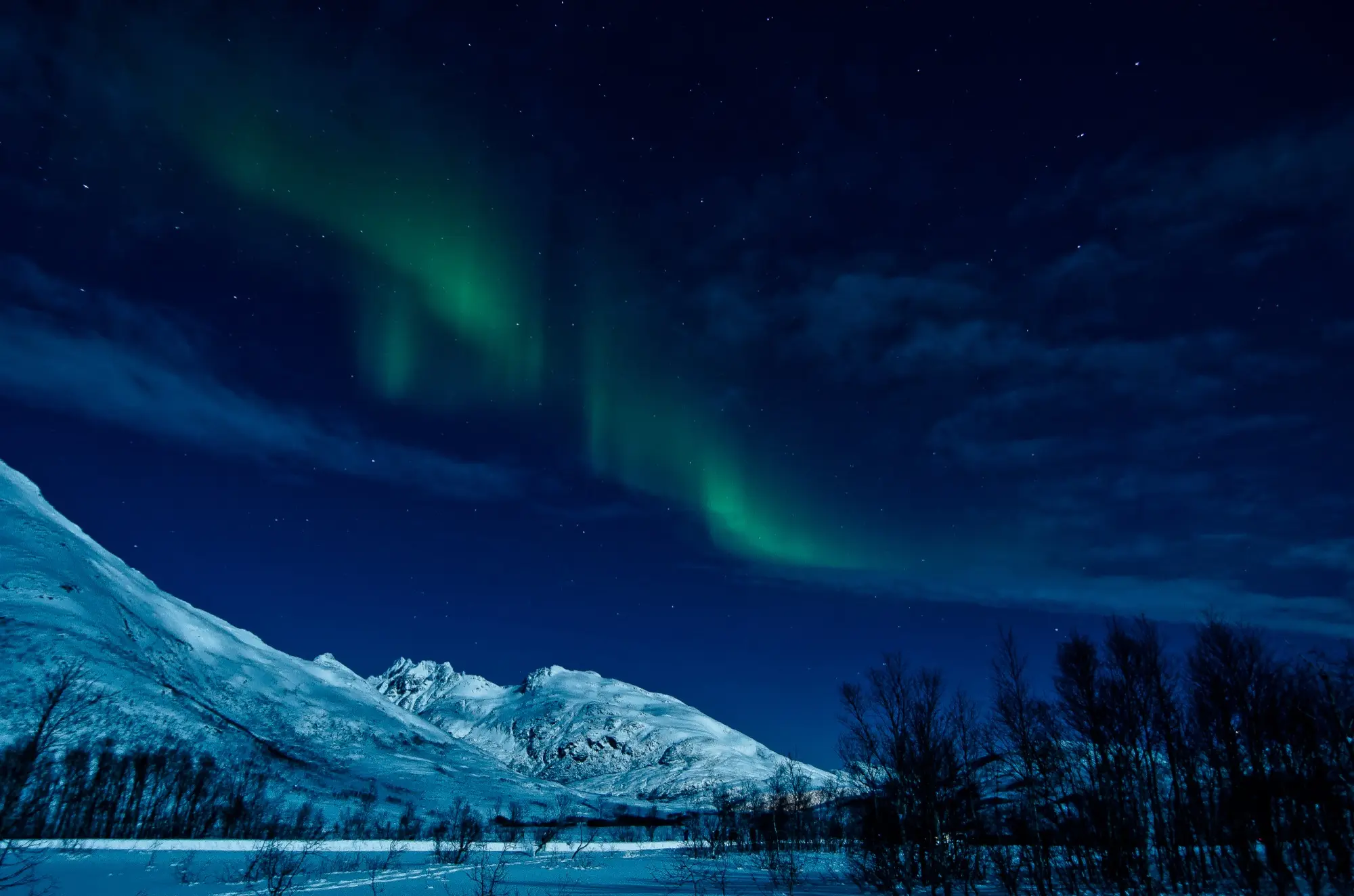
Photo: Andi Gentsch, CC BY-SA 2.0

The evidence
- Geomagnetic activity
- Kp 0.00 (quiet) NOAA SWPC, estimated Kp, 4 minutes agoForecast peak Kp 4.33 during the dark hours NOAA SWPC 3-day forecast, issued 02:30 CEST3% chance of aurora overhead NOAA SWPC OVATION, 14 minutes agoLocal disturbance 1 nT/min at Kilpisjärvi, 97 km away FMI magnetometer network, 46 minutes ago
- Cloud over the dark hours
- 100% cloud at best around 20:00, 100% at worst MET Norway Locationforecast, covering 20:10–04:52
- Darkness
- Astronomical dark 20:10–04:52 (8h 42m) computed here from the date and the coordinatesSunset 16:44, sunrise 08:16 computed here
- Moon
- First quarter, 60% lit, below the horizon at the start of the dark hours computed here
Cloud forecast: MET Norway, under CC BY 4.0, reduced here to the clearest and cloudiest hour of the dark window. See where the data comes from.
How dark does it get in Tromsø tonight?
It is astronomically dark — dark enough to see the aurora — from 20:10 to 04:52 local time, 8 hours and 42 minutes.
Dark hours by date, 2026–27 season
| Date | Dark from | Dark until | Hours of darkness |
|---|---|---|---|
| 15 September | Not dark enough for the aurora | ||
| 1 October | 21:42 | 03:30 | 5h 48m |
| 15 October | 20:26 | 04:36 | 8h 10m |
| 1 November | 18:18 | 04:40 | 10h 22m |
| 15 November | 17:36 | 05:24 | 11h 48m |
| 1 December | 17:06 | 06:04 | 12h 58m |
| 15 December | 16:56 | 06:26 | 13h 30m |
| 1 January | 17:08 | 06:30 | 13h 22m |
| 15 January | 17:34 | 06:14 | 12h 40m |
| 1 February | 18:22 | 05:34 | 11h 12m |
| 15 February | 19:12 | 04:46 | 9h 34m |
| 1 March | 20:10 | 03:44 | 7h 34m |
| 15 March | 21:26 | 02:22 | 4h 56m |
| 1 April | Not dark enough for the aurora | ||
Astronomical darkness (the sun more than 18° below the horizon), Tromsø local time, computed here from the date and the coordinates.
Visit Tromsø says the northern lights may be visible in Tromsø from late August to early April whenever the sky is dark and clear enough. Northern weather changes quickly, so spending more nights in the region gives a greater chance that aurora activity and clear skies coincide. Coastal ships, long-distance buses and flights provide transport options to the area.
When to see the northern lights in Tromsø
Visit Tromsø states that the northern lights may be visible in the region from late August to early April, whenever the sky is dark and clear enough. On its northern lights FAQ, Visit Tromsø notes that organised northern lights tours usually run from September to early April. Visit Tromsø puts the region's aurora down to its position directly below the northern lights oval.
Visit Tromsø says the aurora can appear at any time of the night, though it is often most active between about 20:00 and 02:00. The chances are best under a cloudless sky, but the weather in the north changes quickly and a gap can suddenly open in the cloud. The more nights a visitor spends in Tromsø, the better the chance that aurora activity and the weather coincide; there is never a guarantee.
According to Visit Tromsø, the polar night lasts from late November to late January. The sun stays below the horizon, but it never gets completely dark during the day; you can read more about local light patterns under daylight and dark hours. Visit Tromsø gives an average winter temperature of -4 °C, and says anyone going out for the northern lights should be prepared for anything from -25 °C to 5 °C.
How to get to Tromsø
Tromsø Airport Langnes is about 5 km from the city centre. According to Visit Tromsø, there are several daily flights from Oslo to Tromsø, taking about 1 hour 50 minutes. Visit Tromsø notes that SAS, Widerøe and Norwegian fly direct from several Norwegian airports, and there are direct flights from several European destinations. Avinor lists 17 airlines at Tromsø Airport, among them British Airways, easyJet, SAS, Norwegian and Wizz Air.
The airport is linked to the city centre by the Airport Express Bus, by city bus routes 24, 26, 40 and 42, and by taxi, which usually takes around ten minutes. Cash is not accepted on the buses.
Visit Tromsø states that there is no train to Tromsø. The nearest stations are Narvik, on the Swedish line from Abisko, Kiruna and Stockholm, and Fauske, on the Norwegian line from Trondheim and Oslo. You can check viewing conditions across the border in the Abisko northern lights guide. Long-distance buses link Tromsø with Alta, Narvik and Fauske all year, and with Rovaniemi in Finland in summer and from December to March.
Hurtigruten and Havila sail between Bergen and Kirkenes all year and call at Tromsø twice a day. According to Visit Tromsø, the voyage takes about 24 hours from Bodø and 17 hours from Svolvær.
Where to stand to see the aurora
Visit Tromsø states that the best place is one with a clear view of the sky and as little artificial light as possible. On clear nights the aurora may be seen from Tromsø itself, including darker places such as Prestvannet. The northern lights can often be seen downtown, even from a hotel window, but Visit Tromsø recommends leaving the city lights for places with little or no artificial light. You can compare local conditions with other destinations in the guide to the best places to see the northern lights.
Guided tours leave the city and can look for clearer skies when local conditions are poor. Visit Tromsø distinguishes northern lights hunts, by car, minibus or bus with the aurora as the aim, from experiences that combine the hunt with dog sledding, snowmobiling or a night in a lavvu, where the aurora is a bonus. Visit Tromsø recommends booking a tour before arriving, particularly in the busiest winter months, because popular departures and small tours sell out.
Visit Tromsø advises visitors to dress warmly, because a night out for the aurora is mostly sitting still and waiting; activity providers often lend thermal suits and winter boots. Under Visit Tromsø guidelines, visitors must wear reflective clothing and never walk in the road, which is dark and twisting. Drivers should not stop on blind bends and should watch for reindeer and elk.
Where to watch near Tromsø
- Prestvannet 1.4 km north-west. This lake is a 20-minute walk from the centre of town and offers a darker setting to see the aurora on clear nights, although surrounding lights create some light pollution.
- Telegrafbukta 2.7 km south-west. This beach faces east, south and west, working best when aurora activity is good on a clear evening. It can be reached by local bus from the city centre.
- Storsteinen (Fjellheisen) 2.1 km south-east. Bus 26 runs from Torgsenteret to the Fjellheisen cable car, which ascends from Tromsdalen to 421 metres above sea level in four minutes, offering a classic northern lights view.
- Tromsdalen 4.4 km south-east. This dark valley is reached on bus 26 to the Gaudalsvegen stop. In winter, the path becomes a ski trail requiring snowshoes or skis.
What the numbers mean
Four things have to line up before you see anything, and three of them are on this page above. The fourth is your own eyes adjusting, which takes about twenty minutes in real darkness and does not survive a glance at a phone.
Darkness comes first because it cannot be argued with. The aurora is always there when the field is active; you can only see it once the sun is more than 18° below the horizon, which is what the dark band above marks. In Tromsø that is 8 hours and 42 minutes tonight.
Kp is a global index of how disturbed the Earth's magnetic field is, from 0 to 9, published every three hours. It is a blunt instrument: it says the whole planet was disturbed, not that the aurora is over Tromsø now. At 70°N the auroral oval usually sits overhead already, so a quiet Kp is no reason to stay in.
The local disturbance is the better number, and it is the one most aurora pages do not have. FMI runs magnetometers across Lapland; we take the rate of change of the horizontal field at the nearest one, in nanotesla per minute, which for Tromsø is Kilpisjärvi, 97 km away. A field moving fast overhead means current flowing overhead, which is the aurora itself. Above roughly 40 nT/min it is usually visible; above 100 a substorm is running and it will be moving.
Cloud ends most attempts. The figure above is the total cloud cover MET Norway's Locationforecast forecasts for the dark hours, at these exact coordinates. Anything over about 70% and you will not see through it; under 30% and it stops mattering.
The moon does not stop the aurora. A full moon high in the sky washes out the faint green arcs that make up most displays, so a strong night still shows and a marginal one does not.
Plan the trip
- Best places to see the northern lights
- Daylight in Tromsø through the year
- Daylight in Kilpisjärvi through the year
Nearby
Also on this site: how the daylight changes through the year, and the other 12 places.