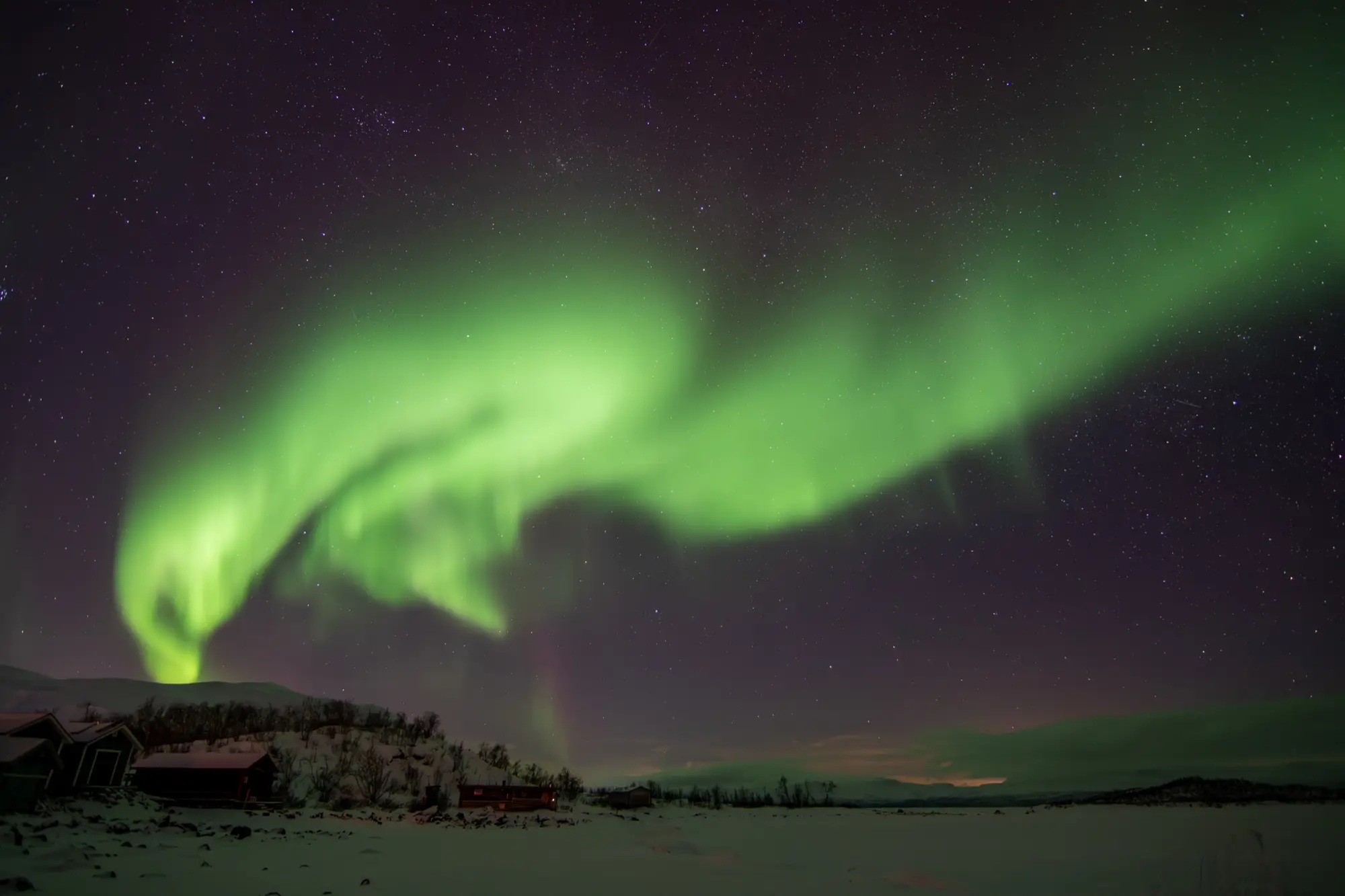

To see the northern lights in Sweden, you need to head north into the auroral zone during the dark season. Although solar storms occasionally bring displays further south, SMHI states that the best chances are in Norrland during the winter half of the year. Clear skies and darkness dictate what you can see, making the sheltered, dry climate of Abisko the most frequently recommended location.
Where in Sweden you can see the northern lights, and how often
According to the national weather agency SMHI, the auroral zone—where displays are most frequent on average—passes directly through northernmost Scandinavia before continuing across Iceland, the southern tip of Greenland, northern Canada, Alaska, and the Siberian coast. The northern lights (norrsken) can occasionally appear in southern Sweden, but SMHI notes that the best chances are in Norrland during the winter half of the year. When solar activity increases and triggers magnetic storms, the auroral oval widens, shifts to lower latitudes, and becomes more intense. On these occasions, the lights can be seen in southern Sweden and sometimes further south.
For regular sightings, position yourself under the main oval. The Swedish Lapland Visitors Board states that the best chances are north of the Arctic Circle at high altitude, ideally in open country without artificial light. Kiruna Lappland notes that active displays can be seen almost every evening during the dark season. Because Kiruna is far enough north for even minimal solar activity to produce a visible display, the local tourism board considers the weather to be the most unreliable factor. Around Abisko, the Swedish Lapland Visitors Board reports that more or less active northern lights can be observed every night from October until the end of March; the determining factor is not auroral activity, but clear skies.
Faint displays can easily fool newcomers. The Swedish Institute of Space Physics (IRF) points out that distinguishing a faint aurora from ordinary clouds can be difficult. If you are looking at an aurora, you can see stars through it. Auroras are also frequently greenish and shift shape differently from passing clouds.
When the season runs, and why darkness decides it
SMHI explains that the aurora is faint, meaning it cannot be seen during the daytime or in summer when the nights remain light, and the sky must be fairly free of clouds. The frequency of displays follows the sunspot cycle of roughly 11 years, with a lower chance of sightings at the solar minimum.
Locally, the season is strictly governed by darkness:
- September to November: The Swedish Lapland Visitors Board describes these months as bringing increasing darkness, often without snow cover and before the severe cold sets in. Kiruna Lappland points to September and October as producing some of the strongest displays.
- December and January: These months provide the longest nights alongside snowy landscapes. Kiruna Lappland notes that the polar night in Kiruna lasts about 28 days until the sun returns in early January, providing more hours to see the northern lights.
- February and March: The days grow longer and warmer while retaining snow cover. Kiruna Lappland highlights March for intense displays, and the Swedish Tourist Association (STF) considers mid-November to mid-March the period with the highest chances of a sighting.
Computed on this site for the 2026–2027 season, Abisko has no astronomical darkness on 1 September. By 15 September it receives 2 hours 12 minutes, expanding to 12 hours 50 minutes on 1 December and 13 hours 20 minutes on 15 December. By 15 March, darkness drops to 5 hours 28 minutes, and by 1 April, astronomical darkness ceases entirely. On the winter solstice on 21 December, the sun does not rise in Abisko, and darkness suitable for viewing lasts 13 hours 24 minutes. Conversely, on 1 June and 1 July the sun never sets, offering no aurora-dark sky at all. Kiruna follows an almost identical pattern: computed on this site for 2026–2027, it has no darkness on 1 September or 1 April, 2 hours 42 minutes on 15 September, 12 hours 48 minutes on 1 December, 13 hours 16 minutes on 15 December, and 5 hours 40 minutes on 15 March.
When a display starts, patience is required. The IRF notes that the most active auroras in Scandinavia typically appear before midnight, with the most intense stage often lasting only 10 to 30 minutes, making frequent checks outside essential.
Abisko, the clear-sky village
Abisko sits at 68.3°N on the shore of Lake Torneträsk. An SMHI climate analysis based on 1991–2020 normals recorded Abisko as having Sweden's lowest normal annual precipitation at 347.2 mm. SMHI notes that Abisko sits in a precipitation shadow for most wind directions, giving it a longstanding reputation as an exceptionally dry place. STF reports that the Abisko area is often called "the blue hole" because the sky is frequently clear there, even when it is cloudy in surrounding areas. You can review seasonal hours in the daylight in Abisko guide.
The village has long attracted atmospheric observers. The Swedish Polar Research Secretariat maintains the Abisko Scientific Research Station, roughly 200 km north of the Arctic Circle. The station has taken some measurements since 1913, and in 2021, the World Meteorological Organization designated it a Centennial Observation Station.
STF gives the winter 2026–2027 evening season for the chairlift and Aurora Sky Station as 19 October 2026 to 27 March 2027, running from 21:00 to 01:00, with advance booking required. Daytime opening runs from 13 February to 26 April 2027 between 09:30 and 16:00. STF lists chairlift tickets from 260 SEK, guided night visits from 1,295 SEK, and northern lights dinners from 2,395 SEK.
Kiruna, Jukkasjärvi and the rest of Swedish Lapland
Kiruna is Sweden's northernmost town, situated at 67.9°N and roughly 145 km north of the Arctic Circle; you can track its specific daylight hours on the daylight in Kiruna page. Kiruna Lappland states that the town is being transformed because the land is required for industrial purposes. The new centre is three kilometres east of old Kiruna, and roads and railways have already been redirected.
Kiruna Lappland states that Jukkasjärvi is about 18 km outside Kiruna, accessible via the E10 south or by Länstrafiken Norrbotten bus 501. It notes that the Icehotel, first built in 1989, is rebuilt there every winter from mid-December until mid-April. The Icehotel notes that Jukkasjärvi sits within the auroral oval and recommends viewing spots at Jukkasjärvi, Abisko, Puoltsa, and Kaalasjärvi, with peak viewing often occurring between 9 pm and 11 pm.
Beyond the Kiruna area, the Swedish Lapland Visitors Board highlights alternative wilderness locations across the region. These include Brändön Lodge on the Bothnian Bay coast near Luleå—where it suggests the coast is often as good for photography as the mountains—along with Treehotel in Harads and the Peace and Quiet Hotel, which operates sites near Jokkmokk and Kiruna.
Checking tonight before you go out
Before spending hours outdoors, check short-range monitoring equipment. The site's Abisko northern lights forecast explains the four factors that must align before you see anything, gives a verdict for tonight, and offers an alert on nights when conditions are dark, clear, and active enough in Abisko. Similarly, the Kiruna northern lights guide provides its own nightly verdict.
For real-time visual tracking, the IRF operates a publicly accessible all-sky camera at its Kiruna headquarters on the space campus. It photographs the sky from horizon to horizon once every minute. You can also use the IRF Aurora Alert mobile app for iPhone and Android, which sends notifications when an aurora develops over Kiruna.
Getting to the far north
Reaching the viewing areas involves choosing between flight routes and the Arctic railway line:
- By air: Kiruna Lappland notes that both SAS and Norwegian operate year-round direct flights connecting Stockholm Arlanda to Kiruna Airport, with flight times of approximately 90 minutes.
- By road: From Kiruna, the E10 highway heads west towards the Norwegian border. Kiruna Lappland lists the driving distances as 93 km to Abisko, 104 km to Björkliden, 132 km to Riksgränsen, and 178 km to Narvik.
- By night train: The national transit authority, Trafikverket, procures the long-distance sleeper route to upper Norrland. SJ AB has operated the service under contract since 15 December 2024. Under the previous operator, Vy, the route carried 368,652 passengers in 2024. For travel on the current timetable, SJ confirmed in June 2026 that passengers bound for Kiruna, Abisko, and Narvik must change trains in Boden.
SJ announced on 25 June 2026 that Trafikverket had awarded it the night trains to upper Norrland from December 2026 to December 2028. Change-free couchette and sleeper travel to Narvik will be reintroduced, with one daily return train between Stockholm and Narvik running Stockholm–Umeå–Luleå–Kiruna–Narvik. On 19 October 2026, SJ released night-train tickets for travel from 13 December 2026 to 10 January 2027 on two lines: Stockholm–Umeå and Stockholm–Boden–Kiruna–Narvik. STF states that SJ runs night trains on the Stockholm–Abisko–Narvik route, passing through Gällivare, Kiruna, Abisko, Björkliden, and Riksgränsen on the way to Narvik, and notes that Abisko Turiststation has its own railway station.