Can you see the northern lights in Helsinki tonight?
Unlikely tonight — dark from 18:24 and there are breaks in the cloud, but the field is quiet (Kp 0.67).
Checked against NOAA SWPC and the FMI HARMONIE forecast.
Tonight Helsinki is 15 of 26 on the ranked table of places.
Get an alert when Helsinki lights up
A heads-up in the hours before dark when tonight's forecast Kp reaches your choice and the cloud forecast leaves a gap, and an alert when the field is active over a clear enough sky at Helsinki. Two a night at most, nothing on the other nights.
Alerts come to this browser on this device. No email, no account; turn them off here or from any alert.
Aurora forecast for Helsinki: the next three nights
| Night | Dark, local time | Forecast Kp | Kp needed | Clearest hour |
|---|---|---|---|---|
| TonightFri 13 Nov | 18:24–05:48 | Kp 1.67 | Kp 6 | 69% at best |
| Unlikely — quiet field, Kp 0.67. | ||||
| Saturday nightSat 14 Nov | 18:24–05:50 | Kp 1.67 | Kp 6 | 0% at best |
| Unlikely — Kp up to 1.67 is forecast while it is dark, and Helsinki needs about Kp 6. 0% cloud at best. | ||||
| Sunday nightSun 15 Nov | 18:22–05:52 | Kp 1.67 until 02:00 | Kp 6 | not forecast yet |
| Unlikely — Kp up to 1.67 is forecast until 02:00, and Helsinki needs about Kp 6. The cloud forecast does not reach this night yet. | ||||
Checked . Kp from the NOAA SWPC three-day forecast, issued ; cloud from FMI HARMONIE forecast, issued . Tonight's row is the verdict above, which also reads the Kp now, OVATION and the magnetometers; the nights after rest on the forecasts alone.
Northern lights this week
This far south you need Kp 6 or more. NOAA's outlook has no day that high this week; the highest is Kp 5 on Tue Nov 17.
Kp needed here: 6
This is NOAA's 27-day outlook, a planning guide issued Nov 9. It gives the largest Kp of each day, not tonight's sky; tonight's verdict uses the live readings and the cloud forecast.
Key facts
- Astronomically dark in Helsinki tonight from 18:24 to 05:48 local time, 11 hours and 24 minutes, as of .
- Aurora outlook for the next three nights: Fri 13 Nov, Unlikely; Sat 14 Nov, Unlikely; Sun 15 Nov, Unlikely, as of .
- In the 2026–27 season, astronomical darkness returns between 15 August and 1 September.
- Helsinki is at 60.17°N, 24.94°E.
Updated
At 60°N, Helsinki needs a real storm — Kp 6 or above — and a dark spot with a clear northern horizon.
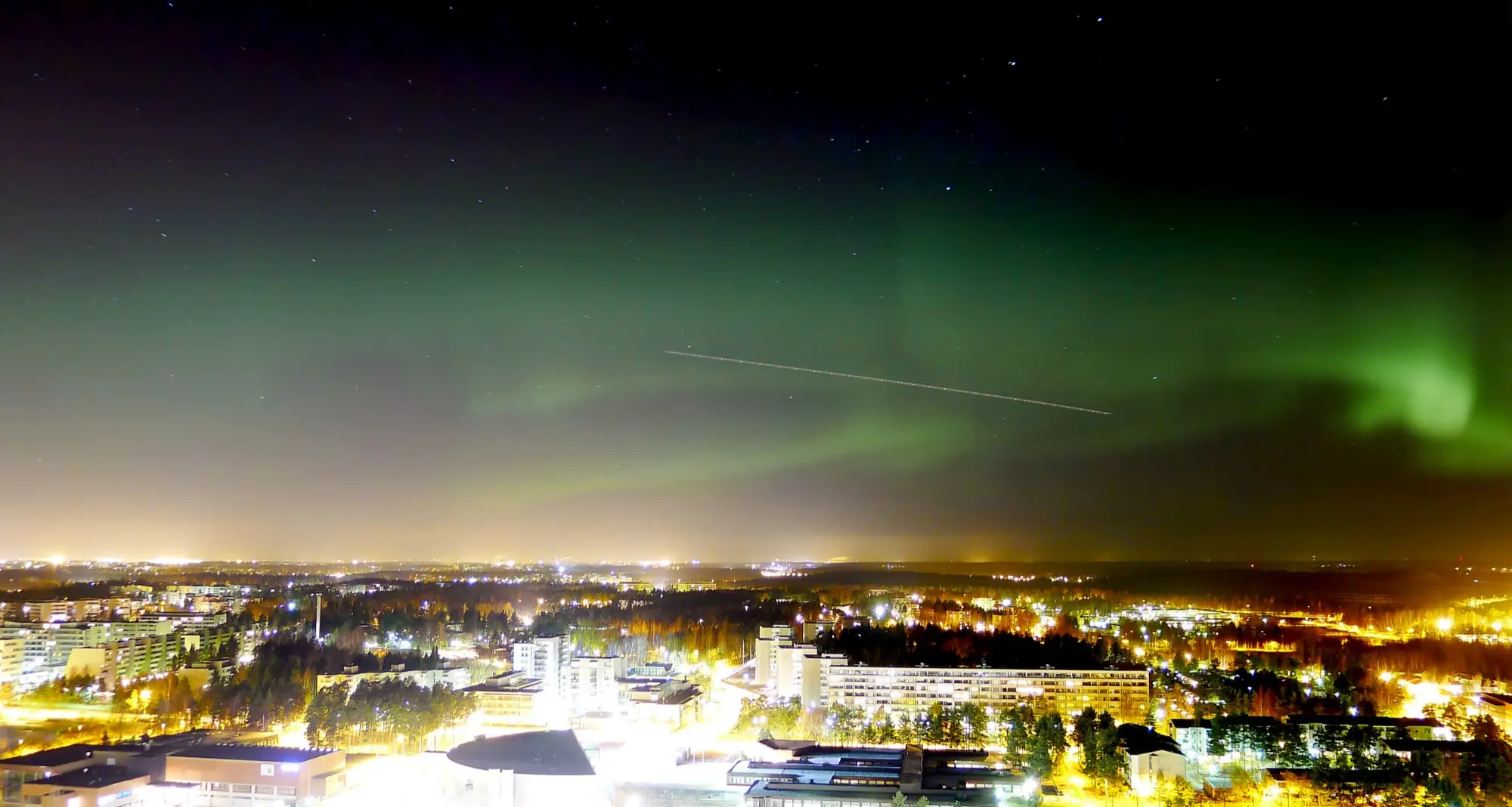
Photo: Timo Newton-Syms from Helsinki, Finland & Maidenhead, Berkshire, UK, CC BY-SA 2.0

The evidence
- Geomagnetic activity
- Kp 0.67 (quiet) NOAA SWPC, estimated Kp,Forecast peak Kp 1.67 during the dark hours NOAA SWPC 3-day forecast, issued 02:30 EET0% chance of aurora overhead NOAA SWPC OVATION,
- Cloud over the dark hours
- 69% cloud at best around 00:00, 100% at worst FMI HARMONIE forecast, covering 18:24–05:48
- Darkness
- Astronomical dark 18:24–05:48 (11h 24m) computed here from the date and the coordinatesSunset 15:54, sunrise 08:16 computed here
- Moon
- Waxing crescent, 17% lit, below the horizon at the start of the dark hours computed here
Finland's all-sky aurora cameras are at Kevo, Kilpisjärvi and Muonio, run by the Finnish Meteorological Institute, and at Nyrölä, Hankasalmi and Metsähovi in the south. Their images are not published under a licence that lets us embed them, so we link instead: FMI's all-sky camera images. See where the data comes from for what we checked.
How dark does it get in Helsinki tonight?
It is astronomically dark — dark enough to see the aurora — from 18:24 to 05:48 local time, 11 hours and 24 minutes.
Dark hours by date, 2026–27 season
| Date | Dark from | Dark until | Hours of darkness |
|---|---|---|---|
| 15 August | Not dark enough for the aurora | ||
| 1 September | 23:24 | 03:18 | 3h 54m |
| 15 September | 22:16 | 04:18 | 6h 02m |
| 1 October | 21:16 | 05:06 | 7h 50m |
| 15 October | 20:32 | 05:44 | 9h 12m |
| 1 November | 18:48 | 05:22 | 10h 34m |
| 15 November | 18:22 | 05:52 | 11h 30m |
| 1 December | 18:04 | 06:18 | 12h 14m |
| 15 December | 18:00 | 06:34 | 12h 34m |
| 1 January | 18:10 | 06:40 | 12h 30m |
| 15 January | 18:30 | 06:32 | 12h 02m |
| 1 February | 19:02 | 06:08 | 11h 06m |
| 15 February | 19:32 | 05:38 | 10h 06m |
| 1 March | 20:08 | 04:58 | 8h 50m |
| 15 March | 20:46 | 04:12 | 7h 26m |
| 1 April | 22:46 | 04:04 | 5h 18m |
| 15 April | 23:58 | 02:42 | 2h 44m |
Astronomical darkness (the sun more than 18° below the horizon), Helsinki local time, computed here from the date and the coordinates.
Helsinki is not an aurora destination. The Finnish Meteorological Institute's statistics put the aurora over Helsinki about once a month in the dark seasons, but the city's lights usually prevent it being seen. If viewing the lights is your priority, you should plan to head further north.
When the northern lights reach Helsinki
Official figures from the Finnish Meteorological Institute (Ilmatieteen laitos, or FMI) indicate that on dark, cloudless nights, the aurora appears over the south coast roughly once a month. By comparison, it occurs once a week at the latitudes of Jyväskylä and Kuopio, and three nights in four at Kilpisjärvi. MyHelsinki, the city's official visitor site, similarly notes that the northern lights are seen in Finland mostly in northern Lapland, and statistically only around one night a month in the far south, though sightings remain possible.
According to Visit Finland, the KP index measures geomagnetic activity on a scale from 0 to 9; a reading of 1 to 2 might suffice in northern Lapland, while higher readings mean stronger displays visible further south. FMI notes that solar activity governs the number of auroras most strongly in southern regions, whereas in Lapland displays happen more evenly every year. Most auroras typically arrive a couple of years after the sunspot maximum.
Timing during the year also dictates your chances:
- Equinoxes: FMI explains that around the autumn and spring equinoxes, the Earth's position in the solar wind is most favourable for energy to reach the magnetosphere, making magnetic storms more frequent on average in autumn and spring than in winter or summer.
- Early autumn: In early autumn and late spring, nights in Lapland remain too light. However, the sky in southern Finland is already dark enough, meaning strong early-autumn magnetic storms can be seen especially in the southern Finnish sky. Visit Finland ranks October and November among the statistically strongest months for activity.
- Late winter and spring: FMI notes that summer nights are too light for sightings. While autumn brings activity, cloud cover across Finland is abundant in autumn and winter—covering about 65% to 85% of the sky and increasing from the northwest towards the southeast. Clear days are least frequent in November and December. Because spring is on average less cloudy, FMI recommends March as a time to wait for the aurora.
Weather does not dictate whether auroras occur, but because the lights form above all clouds, thick cloud cover blocks them entirely. When skies are clear, FMI notes that good aurora weather is usually cold, and finding displays requires patient waiting. A couple of hours either side of midnight is the most typical window, though during large geomagnetic storms the lights can blaze from sunset until sunrise.
How to get to Helsinki, and on to Lapland
Helsinki Airport sits 20 km from the city centre. The trip into town takes about 30 minutes by train or car, and about 40 to 50 minutes by bus. The airport railway station is directly beneath the terminal; P and I trains reach the city centre in about 30 minutes, with tickets sold via the platform ticket machines or the HSL app. Alternatively, HSL trunk bus line 600 makes the journey between the airport and the centre in about 40 minutes.
Because the northern lights are seen in Finland mostly in northern Lapland, you can continue north from Helsinki towards the best places to see the northern lights. Rail travel between Helsinki Airport and the rest of Finland operates on a single ticket, with the easiest transfers from airport trains situated at Pasila and Tikkurila. VR operates overnight passenger services—including the Helsinki to Rovaniemi train—with routes terminating at Rovaniemi, Kemijärvi and Kolari. These night trains can transport cars, and on the busiest ski-season nights, up to five night trains depart Helsinki for the north.
Where to stand to see the aurora
FMI states that the faint aurora is best seen with the naked eye under a clear, dark sky away from city and traffic lights, with an open view of the northern horizon. In southern Finland, the aurora is seen most often in the northern sky. Because human night vision is limited, FMI advises waiting in the dark for roughly half an hour to let your eyes adjust.
MyHelsinki highlights two spots within the municipality where people have reported sightings in autumn and winter:
- Suomenlinna: The HSL ferry operates from the Market Square (Kauppatori) to the main pier every day of the year, running from early morning until late at night. In winter, crossings run at least once an hour and take about fifteen minutes.
- Taivaskallio: Located in the Käpylä district of Helsinki, this park features a hill almost 60 m high that is also popular for winter sledding.
For visitors who do not catch a display outdoors, MyHelsinki points to the virtual aurora presented at the Finnish Nature Centre Haltia (Suomen luontokeskus Haltia). Haltia is located next to Nuuksio National Park. HSL buses 245 and 245A run from Espoo Centre directly to the Haltia stop; travelling there from Helsinki city centre requires an ABC public transport ticket.
Where to watch near Helsinki
- Suomenlinna 3.8 km south-east. MyHelsinki reports people have seen the northern lights here in autumn and winter. The HSL ferry reaches the island from the Market Square in about fifteen minutes, running daily until late at night and at least hourly in winter.
- Taivaskallio 5.6 km north. Set on a hill almost 60 m high in Käpylä, MyHelsinki notes people have reported seeing the northern lights from this park during autumn and winter.
What the numbers mean
Four things have to line up before you see anything, and three of them are on this page above. The fourth is your own eyes adjusting, which takes about twenty minutes in real darkness and does not survive a glance at a phone.
Darkness comes first because it cannot be argued with. The aurora is always there when the field is active; you can only see it once the sun is more than 18° below the horizon, which is what the dark band above marks. In Helsinki that is 11 hours and 24 minutes tonight.
Kp is a global index of how disturbed the Earth's magnetic field is, from 0 to 9, published every three hours. It is a blunt instrument: it says the whole planet was disturbed, not that the aurora is over Helsinki now. At 60°N you need Kp 6 or more — a real storm — before the auroral oval reaches this far south.
The local disturbance is the better number, and it is the one most aurora pages do not have. FMI runs magnetometers across Lapland; we take the rate of change of the horizontal field at the nearest one, in nanotesla per minute. Helsinki has none within 120 km, so its verdict rests on Kp and OVATION. A field moving fast overhead means current flowing overhead, which is the aurora itself. Above roughly 40 nT/min it is usually visible; above 100 a substorm is running and it will be moving.
Cloud ends most attempts. The figure above is the total cloud cover FMI's HARMONIE model forecasts for the dark hours, at these exact coordinates. Anything over about 70% and you will not see through it; under 30% and it stops mattering.
The moon does not stop the aurora. A full moon high in the sky washes out the faint green arcs that make up most displays, so a strong night still shows and a marginal one does not.
Getting there tonight
Helsinki to Turku: Normal driving conditions on Helsinki to Turku — the surface runs +1.0 to +5.3 °C. · Helsinki to Oulu: Extremely poor driving conditions on Helsinki to Oulu — the surface runs -0.8 to +5.1 °C. The surface is at or below freezing at 20 of 36 stations, from Toivakka Vestonmäki northwards.


Plan the trip
- Best places to see the northern lights
- Northern lights in Finland: when and where to go
- Can you see the northern lights in Helsinki?
- Things to do in Helsinki
Nearby
Also on this site: how the daylight changes through the year, and the other 25 places.