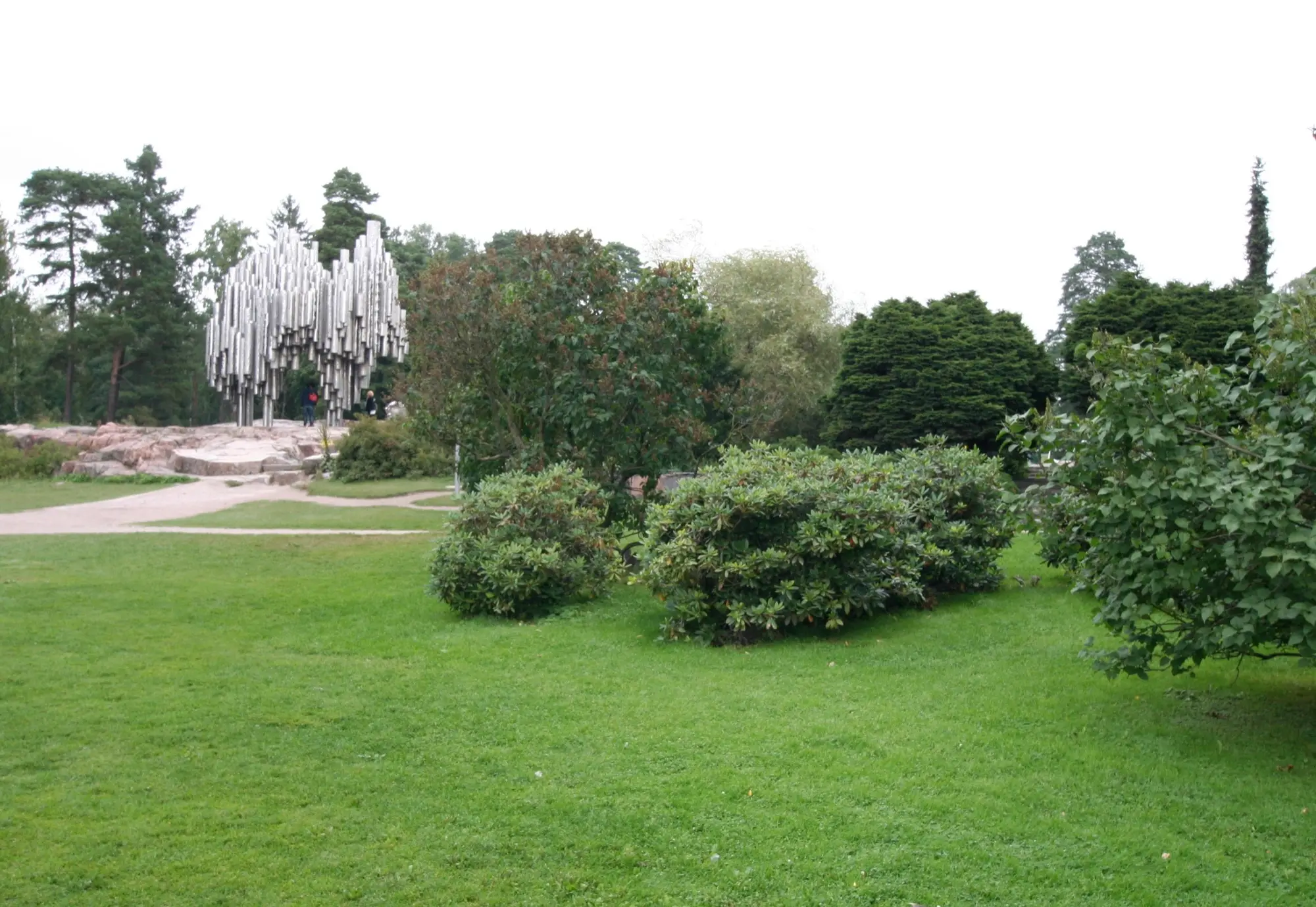

The Sibelius Monument (Sibelius-monumentti) is sculptor Eila Hiltunen's 1967 welded-steel memorial dedicated to composer Jean Sibelius (1865–1957). The work consists of more than 600 hollow pipes accompanied by a separate portrait bust of the composer. It stands in Sibelius Park (Sibeliuksen puisto, postcode 00260 Helsinki) on the Taka-Töölö coast, is free to enter, and remains open at all hours all year.
What to look for at the 600 steel pipes and the Sibelius bust
Unveiled on 7 September 1967, the monument is constructed from welded steel and features over 600 pipes clustered together in an undulating formation, alongside a distinct bust of the composer mounted on a nearby rock. Details recorded by MyHelsinki confirm its permanent location in Sibeliuksen puisto in Helsinki's Taka-Töölö district.
Visitors can walk inside the multi-dimensional sculpture where echoes and sounds form in the hollow pipes. The structure responds directly to natural conditions, capturing wind currents through the open vertical tubes. In addition to the full-size installation in Taka-Töölö, the monument also has a 1964 scale model at UNESCO headquarters in Paris, produced by Hiltunen prior to the completion of the main work in Finland.
Eila Hiltunen and the 1967 debate over abstract art
The creation of the memorial followed an extensive national debate regarding public art styles. After the Sibelius Society, which was founded in 1957, organised a two-stage memorial competition, Eila Hiltunen won the second round with her entry Passio Musicae.
As documented by the HAM Helsinki Art Museum, the public debate between abstract and figurative art was settled by adding a portrait head of Sibelius alongside the pipes. Traditionalists argued that a national memorial to Finland's preeminent composer required a recognisable human likeness, while proponents supported modernism. The inclusion of the separate portrait bust resolved the dispute, allowing the abstract pipe mass to stand as originally conceived.
Visitors can walk inside the multi-dimensional sculpture where echoes and sounds form in the hollow pipes. The completed work was unveiled on 7 September 1967, joining the smaller 1964 scale model at UNESCO headquarters in Paris as an internationally recognised representation of Hiltunen's design.
Sibelius Park and the Taka-Töölö shoreline
Sibelius Park (Sibeliuksenpuisto, nicknamed Sibbari) covers 9.8 hectares in Töölö along Mechelininkatu. According to records maintained by Vihreät sylit, the grounds were named after Jean Sibelius in 1945 in honour of his 80th birthday.
In addition to the steel music memorial, Sibelius Park also contains Aarre Aaltonen's (1889–1980) bronze Kalevala (Finnish national epic) sculpture Ilmatar ja sotka (Ilmatar and the Scaup). This figurative work won an open competition held in 1939 and was unveiled in the park in 1946.
Those walking around the park perimeter can check daylight and sunset hours when planning an afternoon visit along the seaside paths.
How to get there from the centre
The Sibelius Monument is located in Sibelius Park (Sibeliuksen puisto, 00260 Helsinki, Taka-Töölö). The monument to composer Jean Sibelius (1865–1957) by sculptor Eila Hiltunen was unveiled on 7 September 1967 and is made of welded steel with over 600 pipes and a bust of the composer on one side.
Sibelius Park (Sibeliuksenpuisto, nicknamed Sibbari) covers 9.8 hectares in Töölö along Mechelininkatu and was named after Jean Sibelius in 1945 for his 80th birthday. Travellers heading northwest from central Helsinki can combine a visit here with other sights covered in the broader guide to things to do in Helsinki. Walking routes from Mannerheimintie pass Parliament House and the nearby Oodi Central Library, while routes returning toward the centre through Etu-Töölö lead toward Temppeliaukio Church. For all twelve central landmarks in one place, see our full list of things to see in Helsinki.